
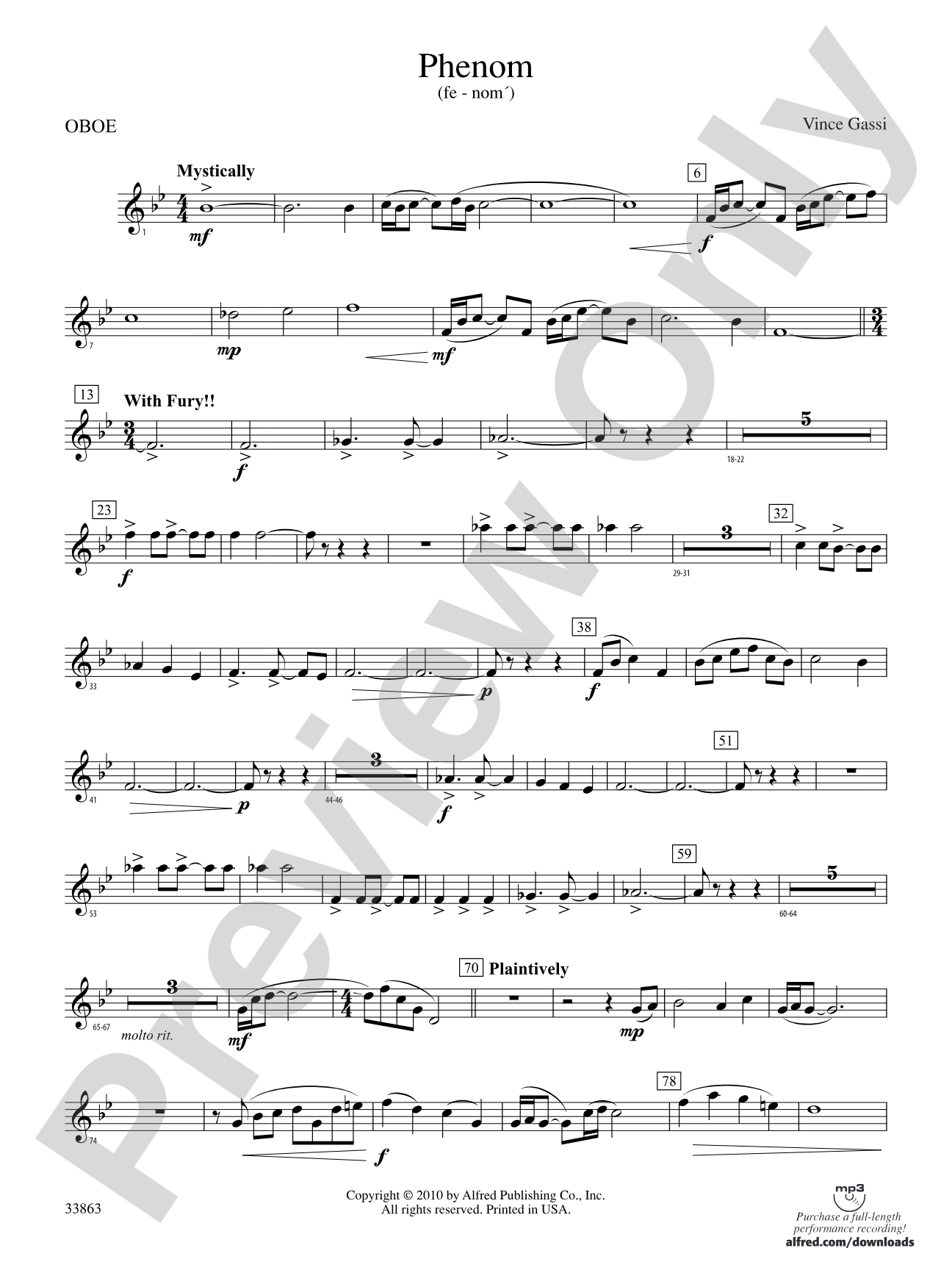

PHENOM/CB: Oboe
By Vince Gassi
Grade: 3 (Medium)
Item: 00-PC-0014594_O1
$5.99
Pickup currently not available
Description
Floating harmonies and angular melodic curves set the stage in the opening measures of this imaginative new work for band. The main theme then bursts in with a powerful call and response statement, developing and transforming and gradually working its way to a lyrical section painted with vibrant textures and colors. The intensity of the main theme cannot be held at bay for long, however, as it rematerializes and transports this work to a dramatic conclusion.


Don't just read it, hear it, play along with it, and watch your students grow with it. In MakeMusic Cloud, PHENOM/CB: Oboe comes alive with professional accompaniment, adjustable tempo, and built-in practice tools that turn solo practice into real progress.
Open in the Player
Jump straight in and assign it today.
Start Your Free Trial
Open this title and explore the full library in minutes.
Sample Audio
1
Audio File
--:--
0:00
0:00
Sample Video
No sample videos found.
Additional Details
Series:
Alfred Concert Band
Publisher:
Alfred Music
Page Count:
274
SKU:
00-PC-0014594_O1
More about this title
About the Composer: Vince Gassi
Vince Gassi has been publishing through Alfred Music since 2006, building a catalog of more than 100 compositions that speak directly to the energy and ambitions of young musicians. His work as a composer, conductor, and clinician draws from two decades of experience teaching instrumental music at elementary and secondary levels, combined with formal training at the University of Western Ontario and advanced study in composition and arranging at the Dick Grove School of Music in Los Angeles. He holds a Ph.D. from York University in Toronto.
Gassi is a frequent presence at major music education venues, serving as guest conductor, adjudicator, and clinician across the United States and Canada. His seminars on creative engagement and digital workflows for music directors have become influential in the field. His compositions appear regularly on contest lists and at venues like the Midwest Clinic in Chicago, and have been performed and recorded internationally across North America, Europe, and Japan.
Why we love this
Gassi structures this piece as a conversation between contrasting musical ideas, giving your band genuine dramatic architecture to build toward. The journey from floating, impressionistic opening through a powerful thematic statement and into lyrical color work creates natural pacing that keeps ensemble energy focused and audiences engaged. At Grade 3, the compositional ambition and emotional arc feel genuinely mature without demanding virtuosity your students don't yet have.
What to expect
Gassi opens with impressionistic soundscapes that feel almost abstract, then suddenly anchors the piece with a bold, declarative theme that propels forward with genuine rhythmic drive. The shift into lyrical territory brings warmth and color, but the main theme's pull is too strong to resist, and the piece builds toward a conclusion that feels both inevitable and earned.
Who it's for
Concert bands at the Grade 3 level seeking a composition that balances musical substance with technical accessibility. This score works for ensembles preparing for contest or festival performance, or for any director wanting to program a contemporary work with clear structural direction and emotional payoff.
How to get the most out of it
- Shape the opening harmonies with careful balancing so floating textures remain transparent; this sets up the impact of the main theme's arrival.
- Treat the main theme's call and response as a conversation between sections, keeping clear character distinction between each phrase rather than pushing for uniform blending.
- Use the lyrical section to explore dynamic subtlety and sustained tone quality; these measures reward the ensemble's refinement more than technical display.
- Prepare the dramatic return of the main theme with controlled buildup; the intensity lands harder when transitions feel inevitable rather than sudden.
How to use it
Program this as the centerpiece of a set that needs contemporary repertoire with substance; its Grade 3 accessibility makes it suitable for mid-season festivals without overshadowing more advanced works on the same concert. The dramatic arc and variety of textures also make it an effective closer for a contest set, leaving audiences with a sense of genuine musical journey.
Skills your students will build
- Balancing multiple harmonic layers and maintaining textural transparency in opening sections
- Executing clear articulation and character definition in call-and-response dialogue
- Sustaining lyrical phrasing and dynamic control in slower, expressive passages
- Building ensemble intensity through gradual layering and dynamic shaping toward climactic moments
- Responding to structural shifts and managing transitions between contrasting musical sections