
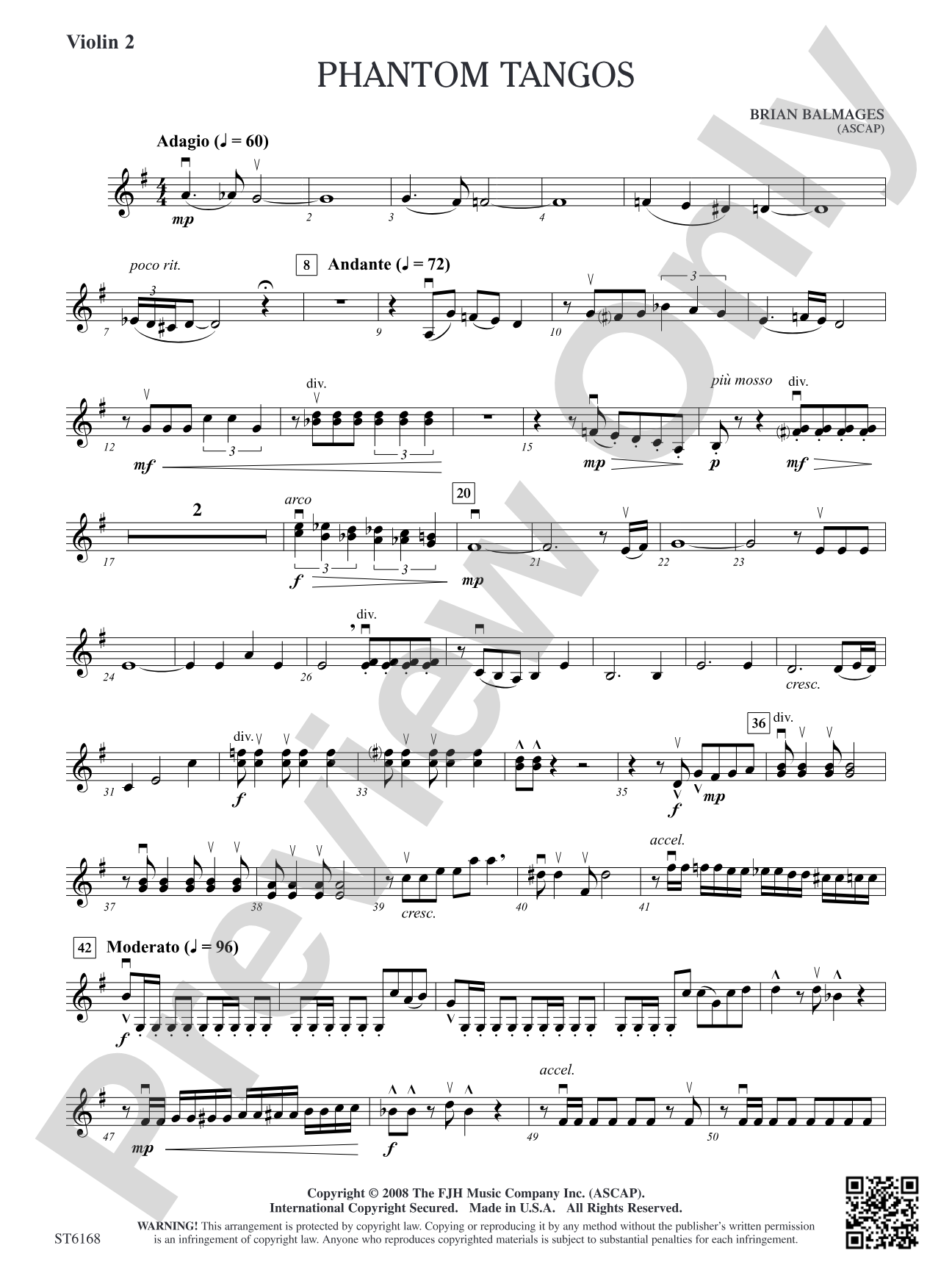

Phantom Tangos: Violin 2
By Brian Balmages
Grade: 4
Item: 98-PC-DST6168_VN2
$7.00
Pickup currently not available
Description
This serious festival work relies heavily on various elements of the tango, set in a more contemporary framework. While the title mainly refers to the way various tangos come and go (through multiple transitional devices), it also references the opening and closing sections, which include a "phantom sound" through the use of mild dissonance and sudden dynamic changes that seemingly appear out of nowhere. Highly creative and unique!


Phantom Tangos: Violin 2 isn't in MakeMusic Cloud just yet...but it could be. Let us know you'd like to see it, and you'll help shape what comes next. In the meantime, start a free trial and dive into thousands of interactive titles your students can play along with today.
Request This Title
Tell us you want it.
Start Your Free Trial
Explore everything that's ready to play right now.
Sample Audio
1
Audio File
--:--
0:00
0:00
Sample Video
No sample videos found.
Additional Details
Series:
FJH String Orchestra
Publisher:
The FJH Music Company, Inc.
SKU:
98-PC-DST6168_VN2
More about this title
About the Composer: Brian Balmages

Brian Balmages has established himself as a composer and conductor working across orchestral, band, and chamber repertoire with equal facility. His works have been performed by ensembles ranging from professional symphony orchestras to school programs in some of the world's most prestigious venues, including Carnegie Hall, the Kennedy Center, and the Sydney Opera House.
Among his many honors, Balmages received the A. Austin Harding Award from the American School Band Directors Association and won the 2020 NBA William D. Revelli Composition Contest. He was appointed to the American Bandmasters Association and received the inaugural James Madison University Distinguished Alumni Award. His music has been programmed at significant national events, including the 2013 Presidential Inaugural Prayer Service. Currently, he serves as Director of MakeMusic Publications and Digital Education for Alfred and MakeMusic.
Why we love this
Balmages captures something genuinely theatrical here. The tango idiom gives the piece immediate character and appeal, while the contemporary dissonance and phantom effects create moments of real mystery that string players find exciting to execute. This is the kind of Grade 4 work that earns festival commendations without feeling like a stepping stone.
What to expect
Balmages conjures the passion and rhythmic drive of tango while layering in contemporary dissonance that keeps the idiom from feeling nostalgic. The phantom effects create an unsettling elegance, as if the tango is being glimpsed through a veil of modern harmony. The piece hovers between familiar and strange, grounded and ethereal.
Who it's for
String orchestras at the festival or concert level who want contemporary music with immediate stylistic appeal. This work suits programs seeking Grade 4 repertoire that challenges students musically without demanding extreme technical virtuosity.
How to get the most out of it
- Shape the dynamic shifts around the phantom sections deliberately. These aren't accidents; they're the compositional architecture. Let your ensemble hear the difference between intentional dissonance and ensemble sloppiness through controlled, aware playing.
- Balance tango rhythm against contemporary textures by rehearsing the Latin inflection separately from the surrounding harmonic language. Your strings need to commit fully to the rhythm without apologizing for the modern sonorities.
- Use the transitions as rehearsal landmarks. Mark where tangos arrive and depart in your score, and treat each entrance as a fresh compositional moment rather than a routine modulation.
- Blend the opening and closing phantom sections by experimenting with bow pressure and vibrato control. The mild dissonance works best when players are unified in their approach to tone color.
How to use it
Program this as a centerpiece for a contemporary music concert or a festival showing. Its tango foundation makes it accessible to audiences while its compositional sophistication signals serious artistry. It pairs well with both classical and modern works on the same concert.
Skills your students will build
- Latin rhythm and tango inflection in string articulation
- Blending dissonant sonorities while maintaining ensemble cohesion
- Responding to sudden dynamic changes with precision
- Navigating multiple tonal centers and transitional devices
- Balancing stylistic idioms within a single contemporary work