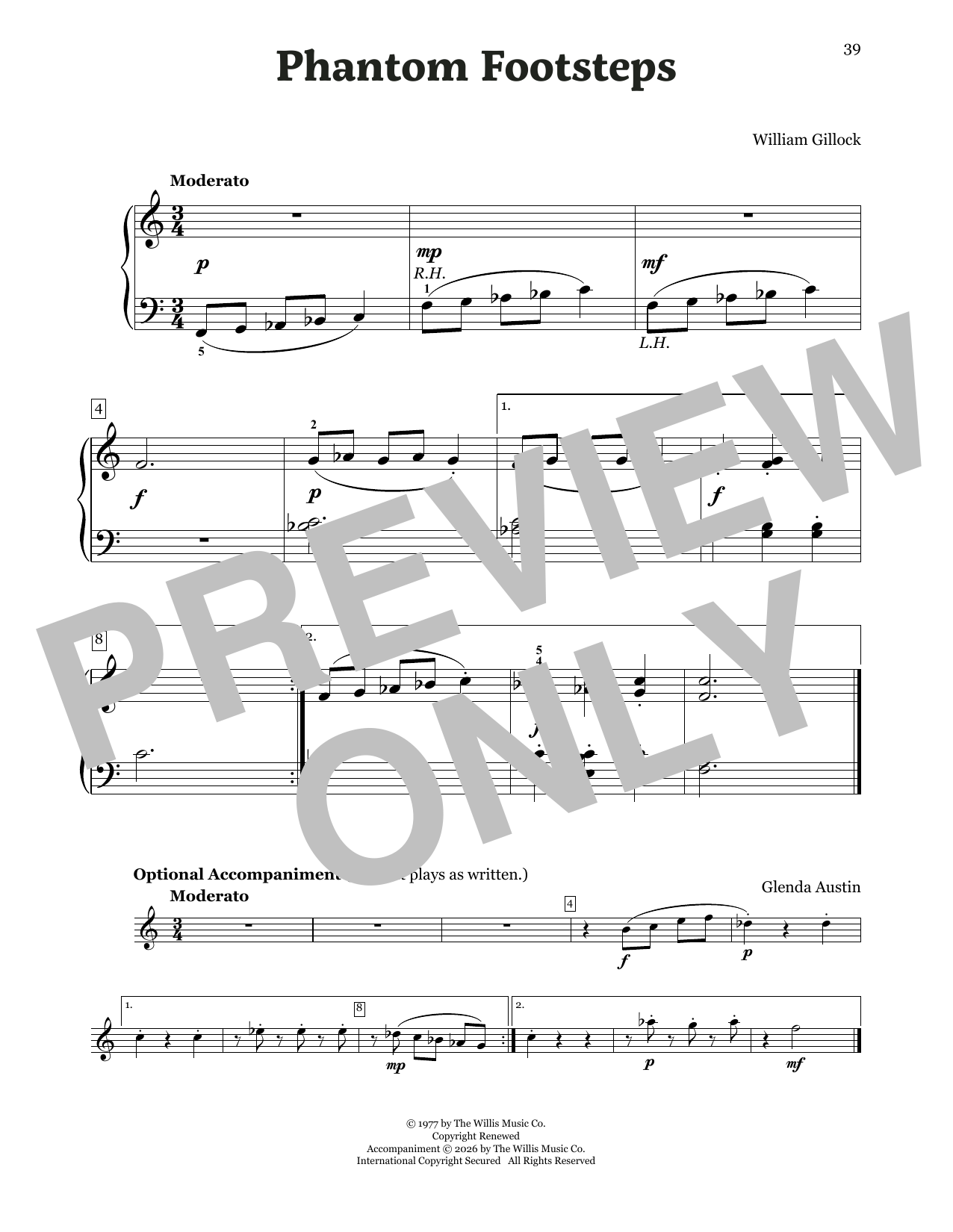
William Gillock (1917-2002) shaped American music education through a catalog of accessible yet musically substantive works for young pianists. His compositions balance technical instruction with genuine artistic intent, making him a staple in progressive piano curricula for decades.
Why we love this
Gillock's educational pieces never talk down to students. Phantom Footsteps delivers the atmospheric intrigue and stylistic sophistication that keeps intermediate students engaged while building real pianistic skills. It's the kind of piece that makes a student feel like a real musician.
What to expect
Mysterious and slightly unsettling, with the kind of delicate spookiness that comes from clever voicing rather than dramatic gesture. There's a sense of movement and gentle intrigue throughout, enhanced by the interplay between the melody and its carefully orchestrated accompaniment.
Who it's for
Intermediate pianists who are ready to explore contemporary classical idioms and character pieces with real musical substance. This works well for students transitioning from early intermediate to intermediate, or as a recital piece for the solid intermediate player.
How to get the most out of it
Shape the opening theme with subtle dynamic shaping rather than treating it as metronomically flat; let the pizzicato figuration support the melody's contours naturally.
Pay attention to the printed pedal markings. Gillock's indications here are not decorative; they create the harmonic color that makes the piece work.
Practice hands separately at performance tempo until the accompaniment pattern becomes absolutely habitual, freeing your attention for melodic phrasing and tone control.
How to use it
Include this on a student recital to add color and variety to a program of classical and contemporary works. It also serves beautifully as a teaching piece for exploring how composers create mood through texture and harmonic placement rather than relying on extreme dynamics.
Skills your students will build
Sustaining melodic legato over rhythmic accompaniment patterns
Understanding harmonic function in contemporary classical idiom
Interpreting and executing printed pedal markings for tonal effect
Developing touch differentiation between melody and accompaniment
Reading and executing contemporary notational conventions
You May Also Like
Scan to Complete Your Purchase
Use your phone's camera to scan the code below
You'll log in on your phone and the order will be added to your account