
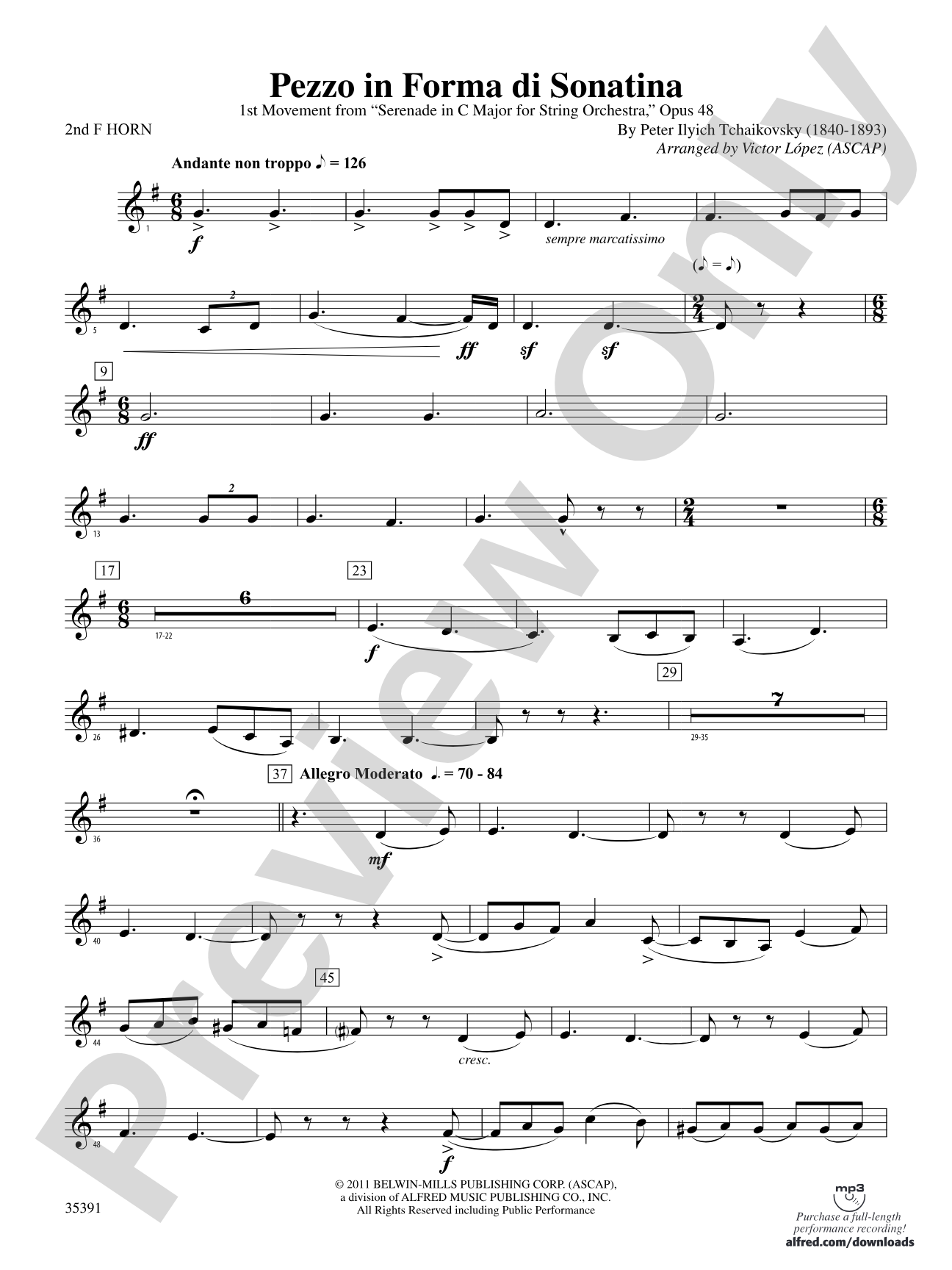

Pezzo in forma di Sonatina: 2nd F Horn
1st Movement from "Serenade in C Major for String Orchestra," Op. 48
By Peter Ilyich Tchaikovsky / arr. Victor López
Grade: 3 (Medium Easy)
Item: 00-PC-0014938_H2
$5.99
Pickup currently not available
Description
Pezzo in forma di Sonatina is the 1st Movement from Serenade in C major for String Orchestra, Opus 48, written by Piotr Ilyich Tchaikovsky. In this adaptation for concert band, Victor López presents us with a colorful evocative portrait through adherence to the Classical attributes of balance, elegance, and grace. "Finale," the fourth and concluding movement, is also available (00-30798). Each movement may be performed individually or in tandem.


Don't just read it, hear it, play along with it, and watch your students grow with it. In MakeMusic Cloud, Pezzo in forma di Sonatina: 2nd F Horn comes alive with professional accompaniment, adjustable tempo, and built-in practice tools that turn solo practice into real progress.
Open in the Player
Jump straight in and assign it today.
Start Your Free Trial
Open this title and explore the full library in minutes.
Sample Audio
1
Audio File
--:--
0:00
0:00
Sample Video
No sample videos found.
Additional Details
Series:
Belwin Concert Band
Publisher:
Alfred Music
Page Count:
260
SKU:
00-PC-0014938_H2
More about this title
About the Composer: Peter Ilyich Tchaikovsky
Piotr Ilyich Tchaikovsky (1840–1893) stands as one of the most performed composers in the orchestral repertoire. His gift for melody and orchestration shaped Romantic music across every genre—from sweeping symphonies and ballets to chamber works and vocal music. Tchaikovsky's command of instrumental color and emotional directness made his music accessible to performers and audiences alike, qualities that explain why his works remain central to music education and concert halls worldwide.
His Serenade in C major, Opus 48, demonstrates the formal clarity and lyrical beauty that define his mature style. Written in 1880, this work balances classical structure with romantic expression, offering string orchestras and, through skilled arrangement, concert bands a gateway to Tchaikovsky's compositional mastery.
Why we love this
Victor López's arrangement preserves the melodic warmth and orchestral sophistication of Tchaikovsky's original while crafting an accessible entry point for Grade 3 concert bands. The sonatina form keeps the musical argument clear and engaging, making this an ideal choice for groups developing facility with Classical structures within a Romantic harmonic language. Programming this movement signals serious musical ambition without overwhelming developing ensembles.
What to expect
A lyrical journey through graceful, elegant phrasing marked by Tchaikovsky's gift for straightforward melodic beauty. The sonatina framework provides architecture without stiffness, allowing warm harmonic colors and balanced orchestration to create an intimate yet refined atmosphere that feels both timeless and generous.
Who it's for
This arrangement serves Grade 3 concert bands ready to explore Classical forms through Romantic sensibility. Directors programming a young ensemble in a formal setting will find this adaptation musically substantial yet achievable, combining technical accessibility with genuine artistic merit.
How to get the most out of it
- Shape the primary melody with consistent phrase length and direction; this movement's elegance depends on legit, singing lines from your first chairs rather than technical display.
- Balance the harmonic and accompaniment voices so the woodwind and brass colors emerge distinctly without overshadowing the melody line.
- Attend to dynamics as structural markers; the gentle swells and recessions guide both performers and listeners through the sonatina architecture.
- Allow the ensemble time to breathe between sections; resist the urge to rush through transitions, which are often where Tchaikovsky plants unexpected harmonic turns.
How to use it
This movement works beautifully as a concert opener, establishing refinement and control before more elaborate works. Alternatively, pair it with the available "Finale" movement (00-30798) to present a complete two-movement suite, or combine it with other Grade 3 Classical-era adaptations to create a thematic concert on form and orchestration.
Skills your students will build
- Sonatina form awareness (exposition, development, recapitulation)
- Lyrical melodic phrasing and line singing in band context
- Harmonic clarity and voice independence in Classical orchestration
- Balance between melody and accompaniment textures
- Stylistic interpretation of Romantic-era expression within Classical structure