
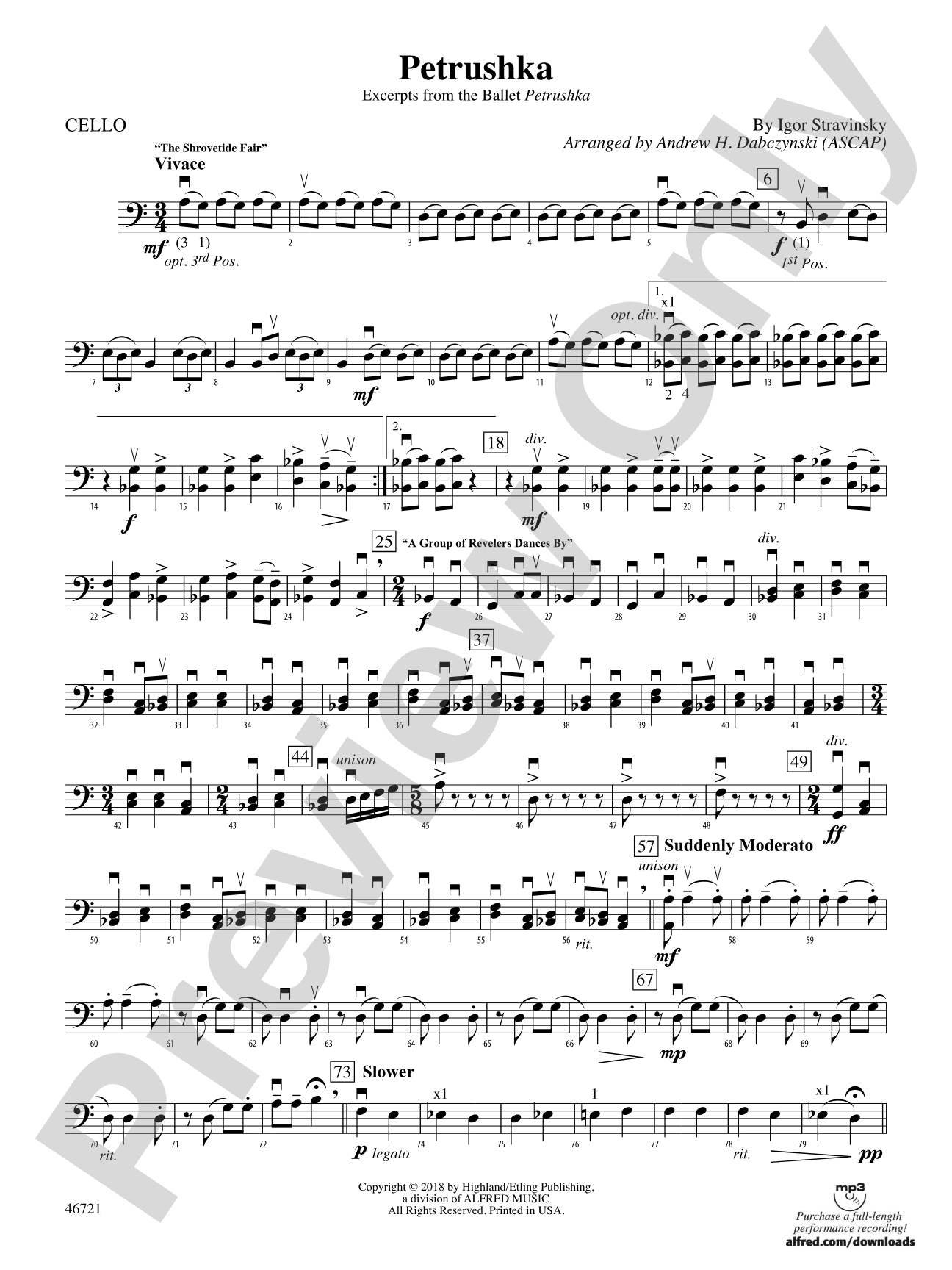

Petrushka: Cello
Excerpts from the Ballet Petrushka
By Igor Stravinsky / arr. Andrew H. Dabczynski
Grade: 3
Item: 00-PC-0017856_VC1
$5.99
Pickup currently not available
Description
The genius of Stravinsky is available to young string players in this arrangement of "Petrushka." Here is an arrangement by Andrew H. Dabczynski of excerpts from the masterpiece ballet that will introduce the orchestra to 20th-century musical composition---with mixed meters and strident harmonies---in a challenging but always playable and logical context. The powerful sound of this Stravinsky classic is guaranteed to engross students and wow listeners in concerts and festivals.


Don't just read it, hear it, play along with it, and watch your students grow with it. In MakeMusic Cloud, Petrushka: Cello comes alive with professional accompaniment, adjustable tempo, and built-in practice tools that turn solo practice into real progress.
Open in the Player
Jump straight in and assign it today.
Start Your Free Trial
Open this title and explore the full library in minutes.
Sample Audio
1
Audio File
--:--
0:00
0:00
Sample Video
Additional Details
Series:
Highland/Etling String Orchestra
Publisher:
Alfred Music
Page Count:
124
SKU:
00-PC-0017856_VC1
More about this title
About the Composer: Igor Stravinsky
Igor Stravinsky (1882-1971) revolutionized 20th-century music through bold harmonic language, rhythmic invention, and orchestral color. His ballet scores, including Petrushka (1911), remain cornerstones of modern classical music and continue to challenge and inspire musicians across all levels. Stravinsky's fearless approach to dissonance, meter, and form made him a central figure in music education, demonstrating that complex musical ideas can engage listeners of any age.
Why we love this
Andrew H. Dabczynski has distilled the raw energy and harmonic sophistication of Petrushka into an arrangement that respects Stravinsky's voice without overwhelming Grade 3 players. The mixed meters and strident harmonies arrive in logical, playable contexts, giving students genuine exposure to 20th-century compositional thinking rather than simplified approximations. Your orchestra will sound and feel like they're playing something substantial.
What to expect
Petrushka pulses with the energy and chaos of a Russian carnival. The arrangement captures Stravinsky's signature clashing harmonies and sudden metric shifts, creating an edgy, unpredictable sound that keeps both players and audiences engaged. This is modern classical music that feels vital and alive, not historical.
Who it's for
String orchestras at the Grade 3 level ready to tackle genuine 20th-century repertoire. Directors seeking concert and festival material that challenges ensemble musicianship without requiring advanced technique. Students who benefit from exposure to dissonant harmony and changing meters in a context that rewards careful listening.
How to get the most out of it
- Establish the irregular meters (shifts between 2/4 and 3/4) early in rehearsal by having the ensemble count aloud; the rhythmic patterns will clarify quickly once players hear the pulse.
- Balance the stark harmonic language by encouraging consistent tone production across parts. Stravinsky's dissonances depend on clarity and blend, not intensity.
- Bring out the character and drama inherent in this Russian carnival music; conductors often undershoot the theatrical quality that makes Petrushka memorable.
- Study the original ballet score or a recording before rehearsals begin so you can communicate the visual and emotional context to your students.
How to use it
Program this as a festival or concert highlight that signals your orchestra's artistic ambition. It pairs well alongside Baroque or Classical standards, offering listeners a vivid contrast in harmonic language and compositional approach. The 20th-century styling also works effectively in thematic concerts exploring musical innovation or Russian cultural traditions.
Skills your students will build
- Reading and performing mixed meters (2/4 and 3/4 transitions)
- Executing atonal and dissonant harmonic language with confidence and accuracy
- Maintaining rhythmic precision in syncopated passages common to 20th-century orchestration
- Balancing complex textures while preserving individual part clarity
- Understanding stylistic conventions of modern ballet music and concert art