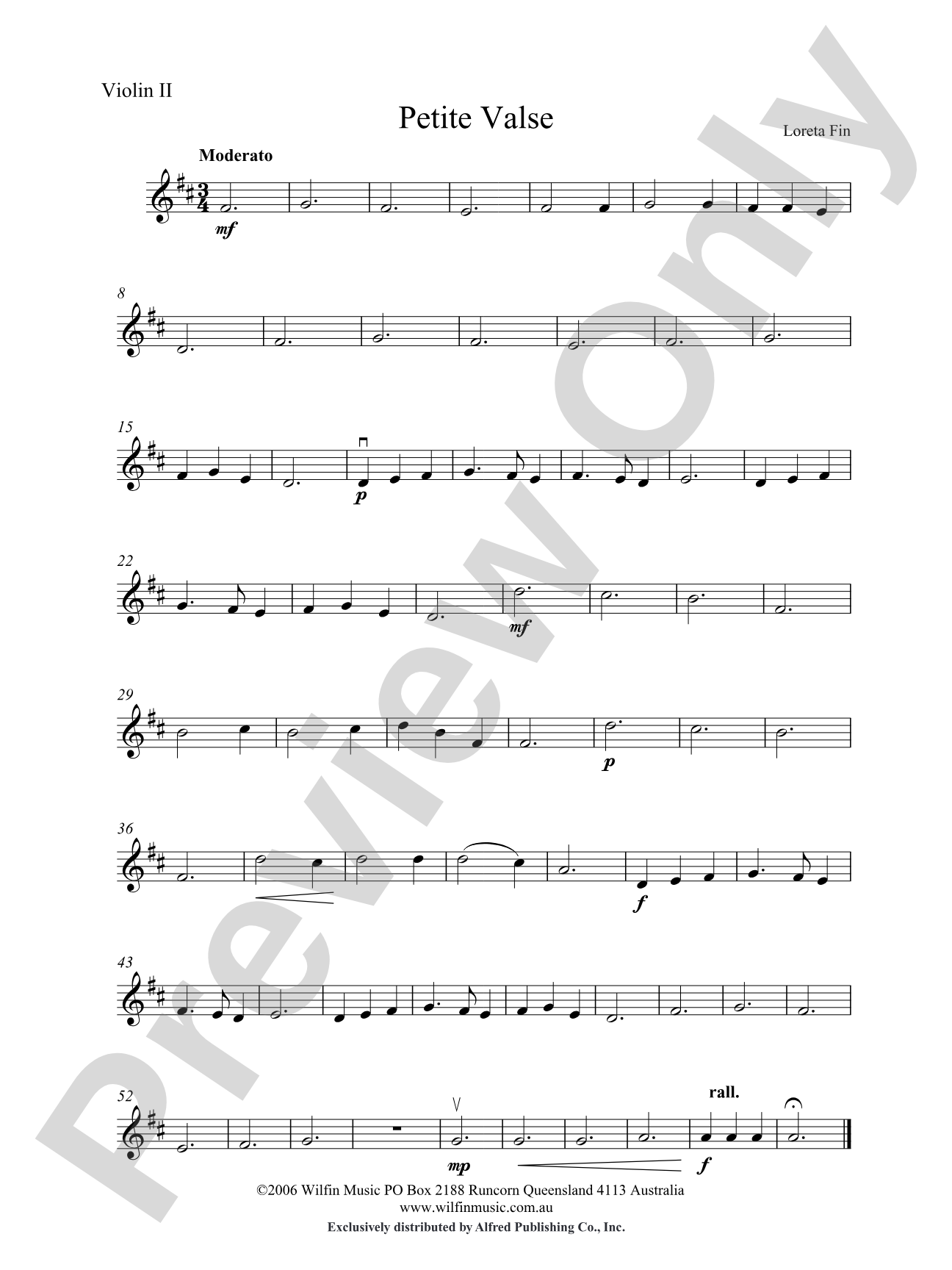
Petite Valse: 2nd Violin Sheet Music Preview

Petite Valse: 2nd Violin

By Loreta Fin

Grade: 1

Item: 76-PC-0000039_VN2

Digital Download
$5.99
Description
A gentle, pretty waltz in D Major which would captivate students and audiences alike. There are interesting melodic parts for all. The piano is needed for the arrangement.

Petite Valse: 2nd Violin isn't in MakeMusic Cloud just yet...but it could be. Let us know you'd like to see it, and you'll help shape what comes next. In the meantime, start a free trial and dive into thousands of interactive titles your students can play along with today.

Sample Audio
No sample audio found.
Sample Video
Additional Details
Series: Wilfin String Orchestra: Young String Ensemble Series
Publisher: Wilfin Music
Page Count: 68
SKU: 76-PC-0000039_VN2

More about this title

About the Composer: Loreta Fin

Loreta Fin

Loreta Fin AM is an Australian violist, string educator, and prolific composer with deep roots in both performance and music education. She studied at the Sydney Conservatorium of Music and served as Principal Viola with the Queensland Pops Orchestra for over 25 years while maintaining an active chamber music career. Since 1993, she has directed strings at Somerville House School in Brisbane, where she shaped generations of young players.

Fin's contributions to music education extend far beyond the classroom. She has presented at multiple Australian National Music Conferences and two American National String Teachers' Conferences, adjudicated at major competitions across Australia, and served as State and National President of the Australian Strings Association. Her work has earned recognition including a Queensland State Award for services to music education, nomination for the ARIA "Best Teacher" award, and the National Award for Services to Music and String Teaching. Since 2015, she has regularly conducted state and national honours ensembles, and her published string works number over 100 titles distributed worldwide.

Why we love this

Fin knows exactly what beginning string orchestras need. Every part has genuine melodic interest, so no section gets relegated to filler accompaniment—this keeps all your players engaged and invested. The waltz form gives you a piece that sounds polished and concert-ready while remaining well within Grade 1 technical demands, making it ideal for building student confidence and audience appeal.

What to expect

Graceful and accessible, with the gentle elegance of a traditional waltz in D Major. The piece unfolds naturally, offering clear phrasing and warm melodic writing that feels inviting rather than challenging; it's the kind of music that makes young players feel like real musicians.

Who it's for

String directors working with beginner to early-intermediate players who want contest and festival-ready repertoire that doesn't sacrifice musicality. This piece rewards orchestras that can balance technical simplicity with thoughtful interpretation, making it perfect for players in their first or second year of group study.

How to get the most out of it

  • Balance the melody between first violins and violas early in rehearsal; Fin's writing gives both voices equal voice, so clarify which carries the line in each section.
  • Work the rhythm of the waltz accompaniment figures with your lower strings and piano as a unit; lock the pulse through that three-beat pattern so the melody can float over a steady foundation.
  • Shape the phrases through the rubato typical of waltz style rather than metronomic evenness; Grade 1 players can handle subtle tempo flexibility when given clear conducting gestures.
  • Coordinate with your pianist well in advance; the piano part is integral to the arrangement and cannot be cut or simplified without altering the piece's harmonic color and character.

How to use it

Program this early in a concert or festival appearance to establish a polished, confident tone for your ensemble. It pairs beautifully with other Grade 1 works in different styles or as a standalone feature that showcases the full string section's maturity without technical or rehearsal burden.

Skills your students will build

  • Playing sustained melodic lines with shape and direction
  • Balancing solo melody against accompaniment figures
  • Feeling and maintaining waltz rhythm and meter
  • Ensemble blend across all four string parts
  • Responding to subtle conducting for tempo and phrasing
  • Coordinating with piano accompaniment

You May Also Like