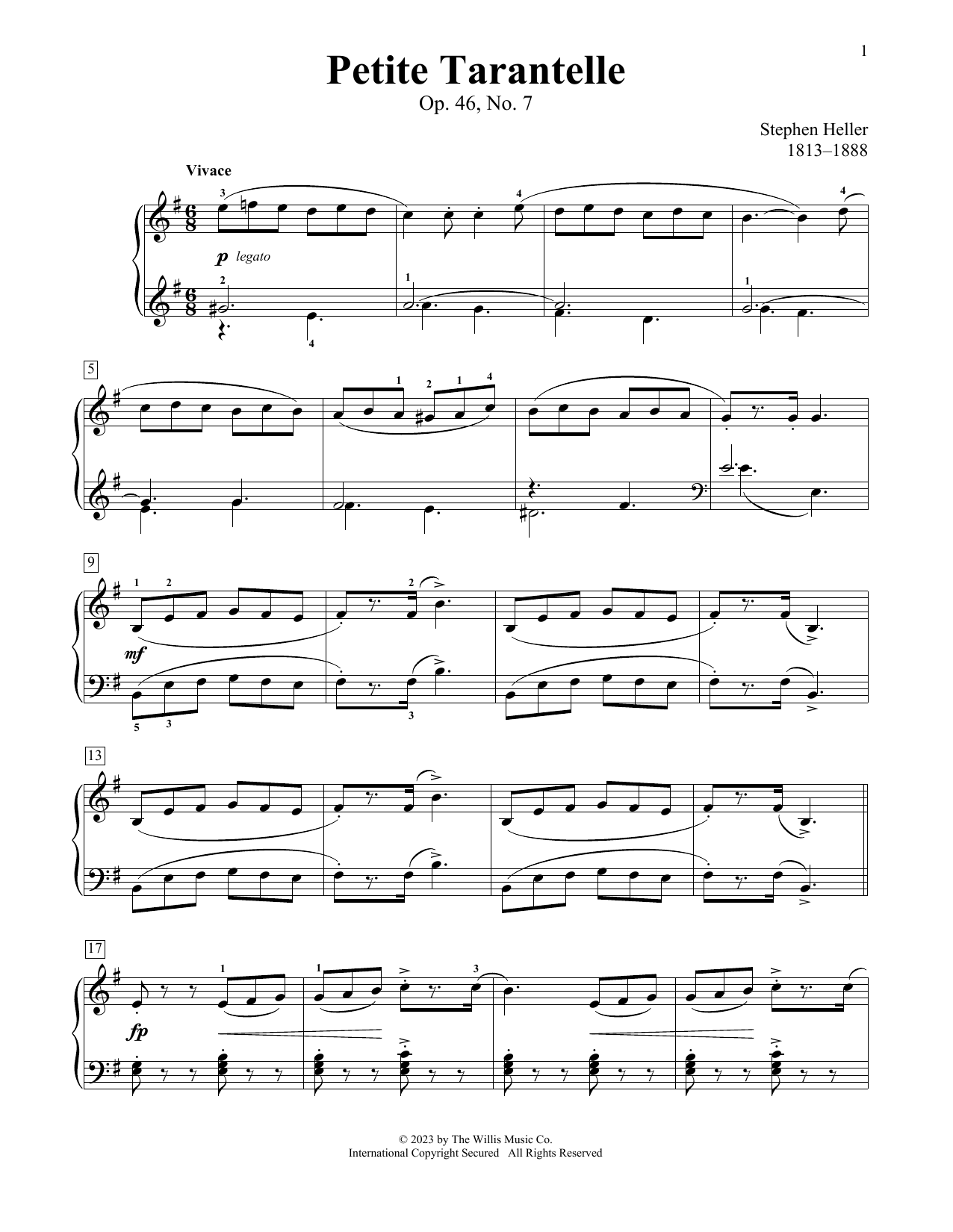
Petite Tarantelle, Op. 46, No. 7 Sheet Music Preview

Petite Tarantelle, Op. 46, No. 7: Educational Piano

Edited by Charmaine Siagian / Edited by Sonya Schumann

Item: 35-DS01339681

Digital Download
$4.99
One moment…
Description

Discover MakeMusic Cloud: thousands of interactive titles your students can play along with today.

Sample Audio
No sample audio found.
Sample Video
Additional Details
Publisher: Hal Leonard
Page Count: 3
SKU: 35-DS01339681

More about this title

About the Creator: Cécile Chaminade

Hyacinthe Éléonore Taupin, known professionally as Cécile Chaminade, was a French composer and pianist whose prolific output spanned over 400 works across multiple genres. Though her symphonic ambitions were constrained by the artistic prejudices of her era, she focused her considerable talents on solo piano works and art songs that showcased both technical brilliance and emotional sophistication.

Chaminade's piano miniatures occupy a distinctive space in the teaching repertoire. Written with the amateur musician in mind, yet demanding genuine musicianship, these pieces helped establish her reputation across Europe and America. Her work remained in active performance throughout the 20th century, and her compositions continue to serve as bridges between the Romantic tradition and the needs of contemporary music students.

Why we love this

This brief tarantella captures the energy and technical sparkle that made Chaminade's miniatures so compelling to pianists of her era. At three pages, it demands genuine rhythmic precision and finger independence without the length that would overwhelm students building their classical repertoire.

What to expect

Effervescent and propulsive, this tarantella sparkles with the brightness of salon tradition. Beneath the surface charm lies a surprisingly clever construction that keeps performers engaged through shifts in harmonic color and rhythmic emphasis, creating genuine musical interest rather than mere technical display.

Who it's for

Intermediate piano students who have developed basic technical facility and are ready for classical miniatures with genuine musical substance. This work suits students preparing recital programs or those seeking pieces that teach elegant phrasing within a manageable scope.

How to get the most out of it

  • Establish a steady pulse for the tarantella rhythm before working through tempos. The characteristic lilting quality depends entirely on rhythmic clarity beneath the surface figuration.
  • Identify which hand carries the primary melody at any given moment and project it while maintaining clean voice separation. Chaminade layers her thematic material strategically rather than spotlighting one voice throughout.
  • Listen for the harmonic changes underlying the repeated figurations. Understanding the underlying progression helps students play with intentionality rather than mechanical repetition.

How to use it

Include this in a spring recital program featuring French piano miniatures, pairing it with other salon works from the same era. Its compact length makes it ideal as a transition piece between larger works or as part of a themed set exploring compositional variety at the intermediate level.

Skills your students will build

  • Rhythmic precision in tarantella style (triple meter with characteristic rhythmic patterns)
  • Voice independence between hands with layered thematic material
  • Harmonic analysis through listening (recognizing progression beneath figurative surface)
  • Phrasing and musical intent within a short classical form
  • Finger independence and hand separation in rapid figuration

You May Also Like