Petite Importune Mouche (arr. Anthony Petti) Sheet Music Preview

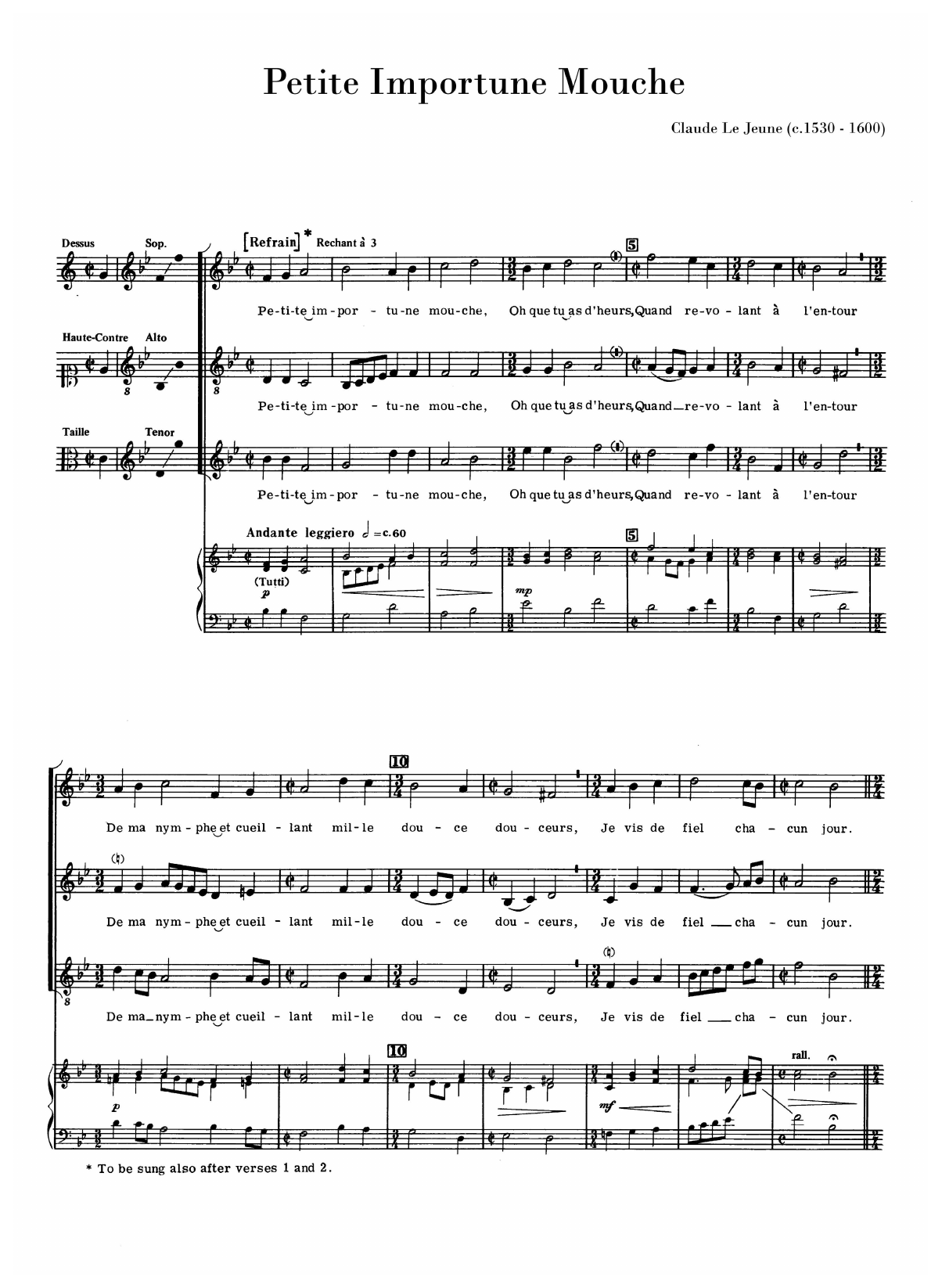
Petite Importune Mouche (arr. Anthony Petti): SAT Choral Octavo

As performed by Claude Le Jeune / Arranged by Anthony Petti

Item: 35-DS00366676

Digital Download
$2.99
Description

Petite Importune Mouche (arr. Anthony Petti): SAT Choral Octavo isn't in MakeMusic Cloud just yet...but it could be. Let us know you'd like to see it, and you'll help shape what comes next. In the meantime, start a free trial and dive into thousands of interactive titles your students can play along with today.

Sample Audio
No sample audio found.
Sample Video
Additional Details
Publisher: Hal Leonard
Page Count: 3
SKU: 35-DS00366676

More about this title

About the Artist: Claude Le Jeune

Claude Le Jeune (c. 1530–1600) stands as one of the Renaissance's most inventive compositional voices, bridging the traditions of Franco-Flemish polyphony with emerging humanist ideals. His sacred and secular works demonstrate sophisticated harmonic thinking and a keen sensitivity to text, qualities that made him a sought-after composer across European courts and a profound influence on his contemporaries.

Why we love this

Petite Importune Mouche captures Renaissance wit in miniature form. Petti's SAT arrangement maintains the piece's playful character while keeping the vocal lines manageable, making it an ideal choice for developing singers who deserve music with genuine personality rather than textbook exercises.

What to expect

A fleeting moment of Renaissance humor, all irritation and swatting. The music buzzes and darts, then resolves into moments of mock exasperation, giving singers the chance to find comedy in carefully composed lines rather than relying on forced interpretation.

Who it's for

SAT choirs at the intermediate level who are ready to explore secular Renaissance repertoire beyond the usual suspects. This works equally well for high school choirs, community ensembles, or collegiate sight-reading groups wanting material with historical substance and immediate appeal.

How to get the most out of it

  • Treat the text painting literally. Each phrase describing the fly's behavior should sound like the action: quick, nagging, then swatted away. The syllabic writing gives you clear opportunities to shape the imagery.
  • Balance the upper voices so the soprano line doesn't overshadow the alto and tenor parts. Renaissance polyphony works best when all three voices share equal presence.
  • Maintain steady pulse without rigidity. The piece works in short phrases, so feel free to breathe generously at cadence points and let each section settle before moving forward.

How to use it

Pair this with other Renaissance secular works for a thematic concert program exploring period humor and courtly entertainment. Its three-page length makes it ideal for filling a program slot between weightier pieces or as a show-closing number that leaves audiences smiling.

Skills your students will build

  • Reading Renaissance notation and harmonic language
  • Text-to-music relationship and expressive phrasing
  • Balancing three independent vocal lines with equal clarity
  • Interpreting printed text and finding musical character within it

You May Also Like