
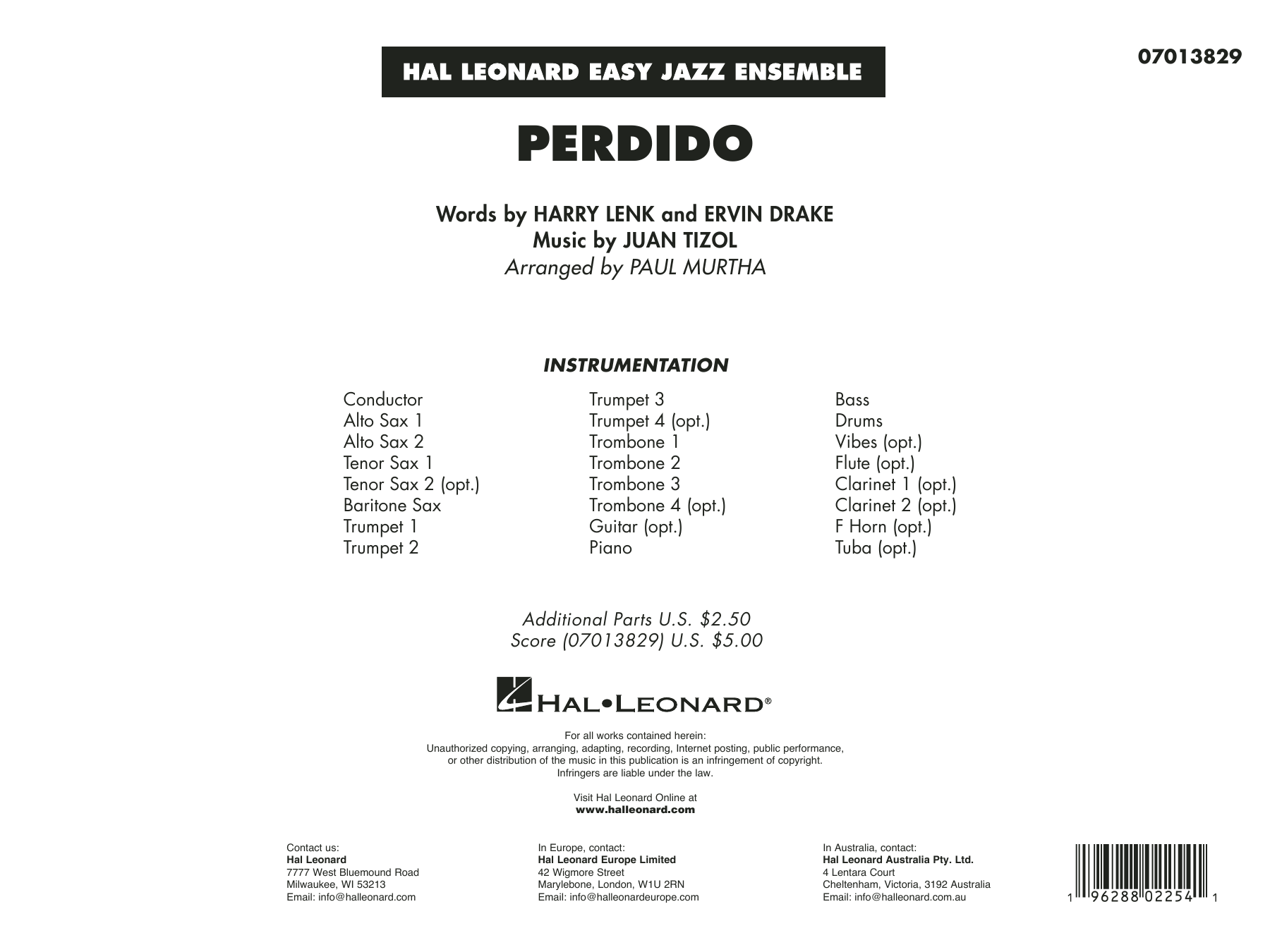

Perdido (arr. Paul Murtha): Jazz Ensemble Conductor Score & Parts
As performed by Duke Ellington / Arranged by Paul Murtha
Grade: 2
Item: 35-PK00555801
$45.00
Pickup currently not available
Buy Extra Parts (Digital PDF Download)
Parts Added to Cart!
Description
This upbeat swing standard remains one of the most popular tunes recorded by the Duke Ellington Orchestra. Here is a carefully arranged chart that sounds sophisticated, yet is easily attainable by young ensembles. Our Easy Jazz Ensemble series is written for full band, playable with four saxes, three trumpets, three trombones, and rhythm section. Each arrangement also includes optional parts for flute, clarinet, F horn, and tuba. Full-length recordings are also available online for each arrangement.


Perdido (arr. Paul Murtha): Jazz Ensemble Conductor Score & Parts isn't in MakeMusic Cloud just yet...but it could be. Let us know you'd like to see it, and you'll help shape what comes next. In the meantime, start a free trial and dive into thousands of interactive titles your students can play along with today.
Request This Title
Tell us you want it.
Start Your Free Trial
Explore everything that's ready to play right now.
Sample Audio
No sample audio found.
Sample Video
No sample videos found.
Additional Details
Publisher:
Hal Leonard
SKU:
35-PK00555801
More about this title
About the Artist: Duke Ellington
Duke Ellington stands as one of the most prolific composers and bandleaders in American music. His output spanned five decades and fundamentally shaped how jazz was written, arranged, and performed; his orchestra became a laboratory for sophisticated harmonies, unconventional voicings, and compositional ambition that extended far beyond dance band conventions. For music educators, Ellington's legacy matters because his charts and compositions offer students a direct line to how jazz arranging actually works: his voice leading is clean, his orchestrations are idiomatic, and his melodies are built to sing through an ensemble.
Why we love this
Perdido has the swagger and energy that makes students excited to rehearse, while Murtha's arrangement strips away nothing essential about the tune's character. The scoring allows younger ensembles to sound confident and polished without requiring years of section refinement, which means your group can focus on phrasing, dynamics, and that essential swing feel rather than technical survival.
What to expect
Perdido swings with the confidence of a seasoned professional ensemble, complete with the kind of melodic hooks that stick in your head for days. There's an easy elegance to the tune; it moves without strain, and the rhythm section gets to feel like the heart of the band rather than just keeping time.
Who it's for
This chart works for jazz ensembles at the middle school level and up, or for high school groups still building their swing vocabulary. It's equally useful for adult community bands wanting a tune that sounds bigger than its technical demands.
How to get the most out of it
- Build the swing eighth-note feel from your rhythm section first. Lock the hi-hat and bass into a relaxed pocket before the horns enter; this foundation makes everything else groove.
- Keep articulation light and punchy in the saxophone section. Murtha's writing moves quickly through the changes, so crisp tonguing on each phrase keeps the melody from blurring into the background.
- Balance your trumpet voices carefully, especially when the melody moves to the second trumpet. The tune's familiar shape means audiences hear it in their bones; slight imbalances in the lead voice stand out immediately.
- Don't rush the tempo. Many young ensembles accelerate 'Perdido' out of sheer adrenaline. A steady, walking tempo lets the harmonic movement shine and gives the arrangement room to breathe.
How to use it
Slot this into a concert of American standards or early jazz classics, where it pairs beautifully with other Ellington compositions or Duke-era repertoire. It also works as a rousing opening number for a pops concert, setting an upbeat tone that immediately wins over audiences unfamiliar with jazz ensemble music.
Skills your students will build
- Reading lead sheets and jazz changes
- Swing eighth-note articulation and feel
- Section balance and blend across trumpet, trombone, and saxophone sections
- Improvisation-ready familiarity with a jazz standard
- Rhythmic precision in ensemble unison passages