
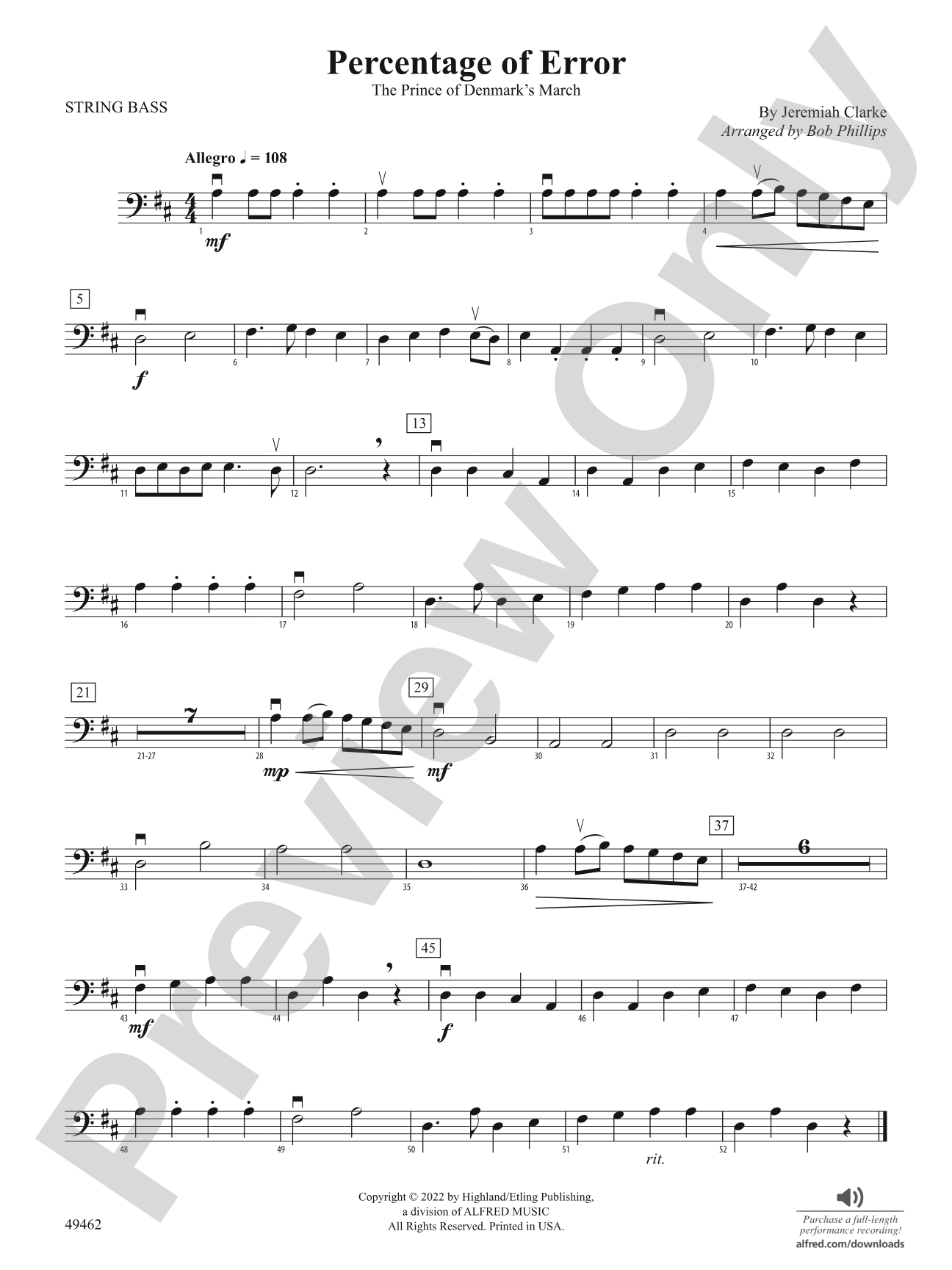

Percentage of Error: String Bass
The Prince of Denmark March
By Jeremiah Clarke / arr. Bob Phillips
Grade: 1.5
Item: 00-PC-0018780_SB
$3.00
Pickup currently not available
Description
This arrangement of "The Prince of Denmark March," or "Trumpet Voluntary," provides the perfect setting for advocacy and striving for excellence since it is so recognizable. Three different versions of the final 8 bars, containing incorrect notes, are included. Each version contains an increasing percentage of correct pitches. Each represents a different letter grade. Play all four versions and then explain to parents and administration that the A+, 100% correct version is what we do every day in orchestra. All sections play the melody in this piece, still providing a solid musical setting in a novelty piece. Audience members are sure to recognize it which makes it perfect for finding "errors." Along with the "real" music for the final 8 bars, three other versions are included. The first version has 80% of the correct notes and 20% incorrect. The next has 90% correct notes and 10% incorrect. The next has 95% correct notes and 5% incorrect. The final, "real" version has 100% correct notes. The 100% version should be played first for the audience explaining this version would get an A+ in an academic setting. Then play the 80% or B- version, then the 90% or A- Version, and then the 95% A version. Then explain to parents and administration that the only version that is acceptable is the 100% version and that is what we do every day in orchestra. This provides a perfect advocacy moment to discuss the benefits of music education with parents and a tangible explanation of striving for excellence to parents and students. Includes an educational packet with each part that features technical exercises, history, theory, composition, and more. Correlated to Sound Innovations, Book 1, Level 5. (2:00)


Don't just read it, hear it, play along with it, and watch your students grow with it. In MakeMusic Cloud, Percentage of Error: String Bass comes alive with professional accompaniment, adjustable tempo, and built-in practice tools that turn solo practice into real progress.
Open in the Player
Jump straight in and assign it today.
Start Your Free Trial
Open this title and explore the full library in minutes.
Sample Audio
1
Audio File
--:--
0:00
0:00
Sample Video
Additional Details
Series:
Sound Innovations for String Orchestra
Publisher:
Alfred Music
SKU:
00-PC-0018780_SB
More about this title
About the Composer: Jeremiah Clarke
Jeremiah Clarke (1674-1707) was an English Baroque composer and organist whose prolific output helped define the sound of late 17th-century English music. Best known for "The Prince of Denmark March," a work so enduring it has been mistakenly attributed to Purcell and marketed under the title "Trumpet Voluntary," Clarke held prestigious positions as organist at Winchester College and St. Paul's Cathedral in London.
Clarke's melodic gift and structural clarity made his works ideal for both sacred and secular contexts. Though his life was brief, his compositions demonstrated a mastery of counterpoint and harmonic language that influenced English Baroque practice. His most famous march remains a staple of concert programming across all levels, testament to its immediate appeal and musical substance.
Why we love this
This arrangement transforms a beloved, universally recognized melody into a powerful teaching tool for demonstrating the difference between excellent musicianship and mere competence. The built-in pedagogical framework (four progressively more accurate versions of the final eight bars) lets your ensemble make the case for music education directly to parents and administrators in a memorable, tangible way. Beyond the advocacy angle, students encounter a grade 1.5 arrangement that keeps all sections engaged with the melody while maintaining musical integrity.
What to expect
Stately and familiar, anchored by one of the most recognizable melodies in Western concert music. The arrangement opens with dignity and polish; as you move through the flawed versions, the same tune becomes increasingly ragged, slightly off-kilter, and uncomfortable to hear. The return to the perfect version lands with satisfying clarity and reinstatement of order.
Who it's for
String orchestra directors seeking a high-impact advocacy tool that works with developing ensembles (grade 1.5 level). This piece speaks directly to parents and school administrators who may not see the immediate value of music programs, offering concrete evidence that precision, attention to detail, and daily striving for excellence define ensemble musicianship.
How to get the most out of it
- Lead with the 100% correct version first. This establishes the standard of excellence before moving through the graded versions, so the audience recognizes what "perfect" sounds like.
- Bring out the shift in intonation and rhythmic precision as you progress from the 80% version through the 95% version. Let the ensemble feel how sloppy or off-center notes pull the overall sound.
- Support the string section's uniform vibrato and tone production across all four versions; consistency in execution makes the pitch and rhythm errors stand out rather than getting buried in uneven playing.
- Use clear conducting to highlight where the errors occur in each graded version, so the audience can pinpoint specific problems alongside your explanation.
How to use it
Schedule this for a concert or assembly where parents and administrators will attend, ideally midway through the program when you have full attention. Pair it with a brief opening statement about what excellence in music education requires, then let the four versions and the audience's audible reaction do the talking. Follow it with a polished, standard concert piece to reinforce that this level of care defines everything your program produces.
Skills your students will build
- Intonation accuracy and ear training through comparison of correct and incorrect versions
- Rhythmic precision and ensemble timing across multiple takes of the same material
- Dynamic control and tone production that remains consistent even when melody changes
- Understanding of how small errors compound at the ensemble level