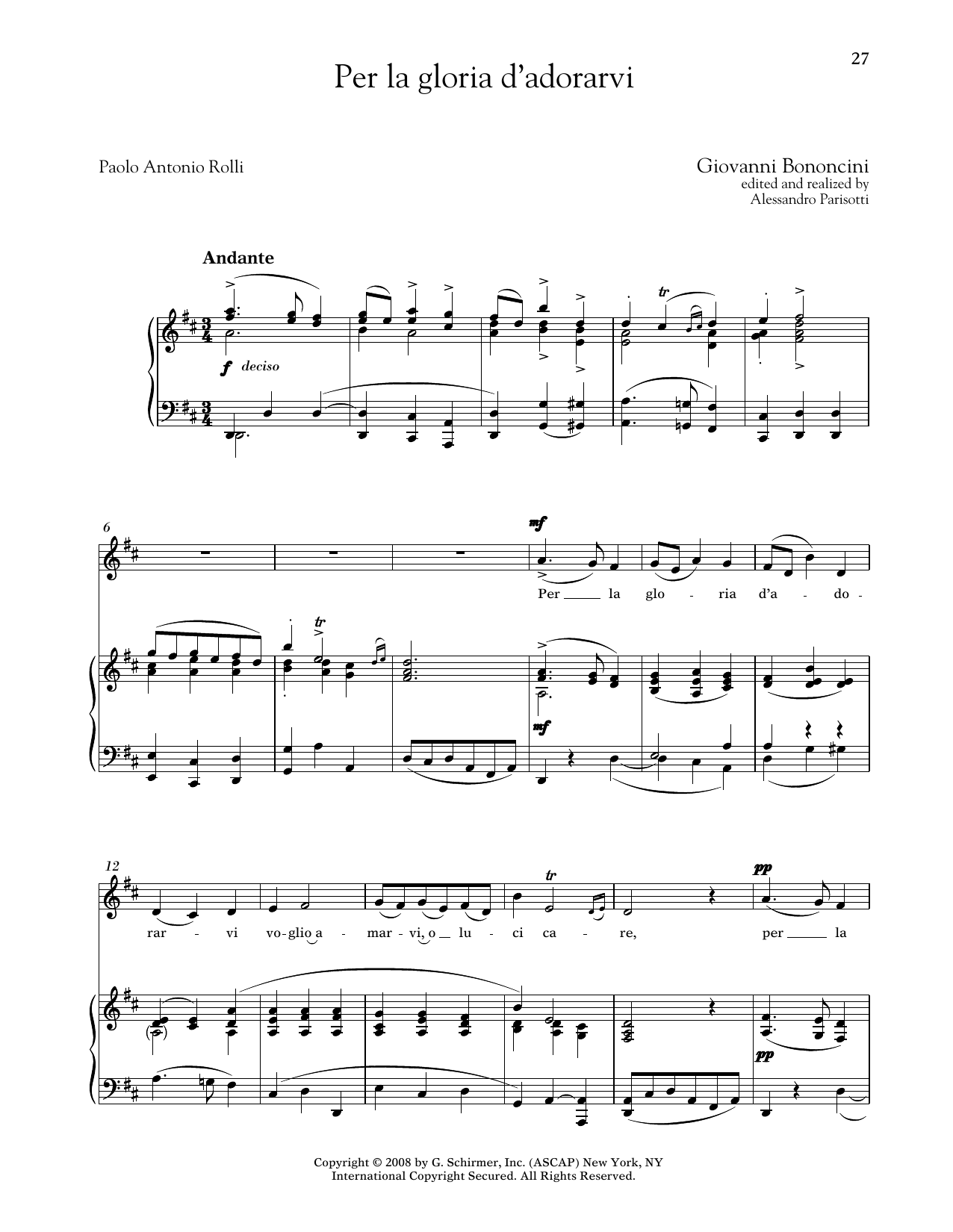
Per La Gloria D'adorarvi (Medium Low Voice) Sheet Music Preview

Per La Gloria D'adorarvi (Medium Low Voice): Piano Vocal

Edited by Alessandro Parisotti (ed.)

Item: 35-DS01578785

Digital Download
$5.99
Description

Per La Gloria D'adorarvi (Medium Low Voice): Piano Vocal isn't in MakeMusic Cloud just yet...but it could be. Let us know you'd like to see it, and you'll help shape what comes next. In the meantime, start a free trial and dive into thousands of interactive titles your students can play along with today.

Sample Audio
No sample audio found.
Sample Video
Additional Details
Publisher: Hal Leonard
Page Count: 5
SKU: 35-DS01578785

More about this title

About the Creator: Giovanni Bononcini

Giovanni Bononcini (1670–1747) was one of the most celebrated opera composers of the late Baroque, rivaling Handel in both popularity and influence across European courts. His gift for lyrical melody and expressive vocal writing made him a sought-after figure in London's Royal Academy of Music, where he contributed prolifically to the operatic repertoire during the 1720s and 1730s.

Bononcini's instrumental works and vocal music reveal a composer deeply attuned to the human voice. His arias balance technical display with emotional directness, a quality that has kept his music relevant for voice students and chamber musicians across centuries. "Per La Gloria D'adorarvi" exemplifies his ability to craft a melody that feels both intimate and architecturally sophisticated.

Why we love this

This aria has the rare quality of sounding effortlessly elegant without demanding showy virtuosity. The writing sits naturally for medium-low voices and gives singers room to explore line and legit connection without wrestling the music into submission. Programming it offers a sophisticated alternative to the usual suspects while remaining completely accessible to students building artistry.

What to expect

Devotional yet assured, the music unfolds with the unhurried grace of someone speaking truth in measured, golden phrases. There's an intimate sincerity here, free from bombast, that invites the listener into a private moment of reflection and adoration.

Who it's for

This works beautifully for intermediate to advanced vocalists (classical singers, art song students, or mature amateur singers) seeking repertoire that demonstrates musicianship rather than gymnastics. It suits voice studios, recital programs, and early music chamber settings where the focus is on line and meaning.

How to get the most out of it

  • Shape the phrases by thinking in long arcs rather than measure-by-measure units; resist the urge to land heavily on cadences, instead letting them breathe and release.
  • Balance the piano part as a true partner rather than accompaniment. The keyboard writing has harmonic color and rhythmic integrity worth hearing clearly.
  • Approach the text with unhurried attention to vowel consistency across the vocal range; the Baroque Italian demands precision without tension.

How to use it

Pair this with other Italian Baroque vocal works to create a coherent song recital program that showcases different dramatic temperaments. It also serves as an excellent test piece for voice students demonstrating progress in phrasing, musicality, and language diction at auditions or jury hearings.

Skills your students will build

  • Sustained legit singing across the range without strain or register breaks
  • Phrasing in longer arcs using textual meaning rather than harmonic landmarks
  • Baroque Italian diction and the vowels that support line continuity
  • Collaborative listening with the pianist to balance melody and harmonic support

You May Also Like