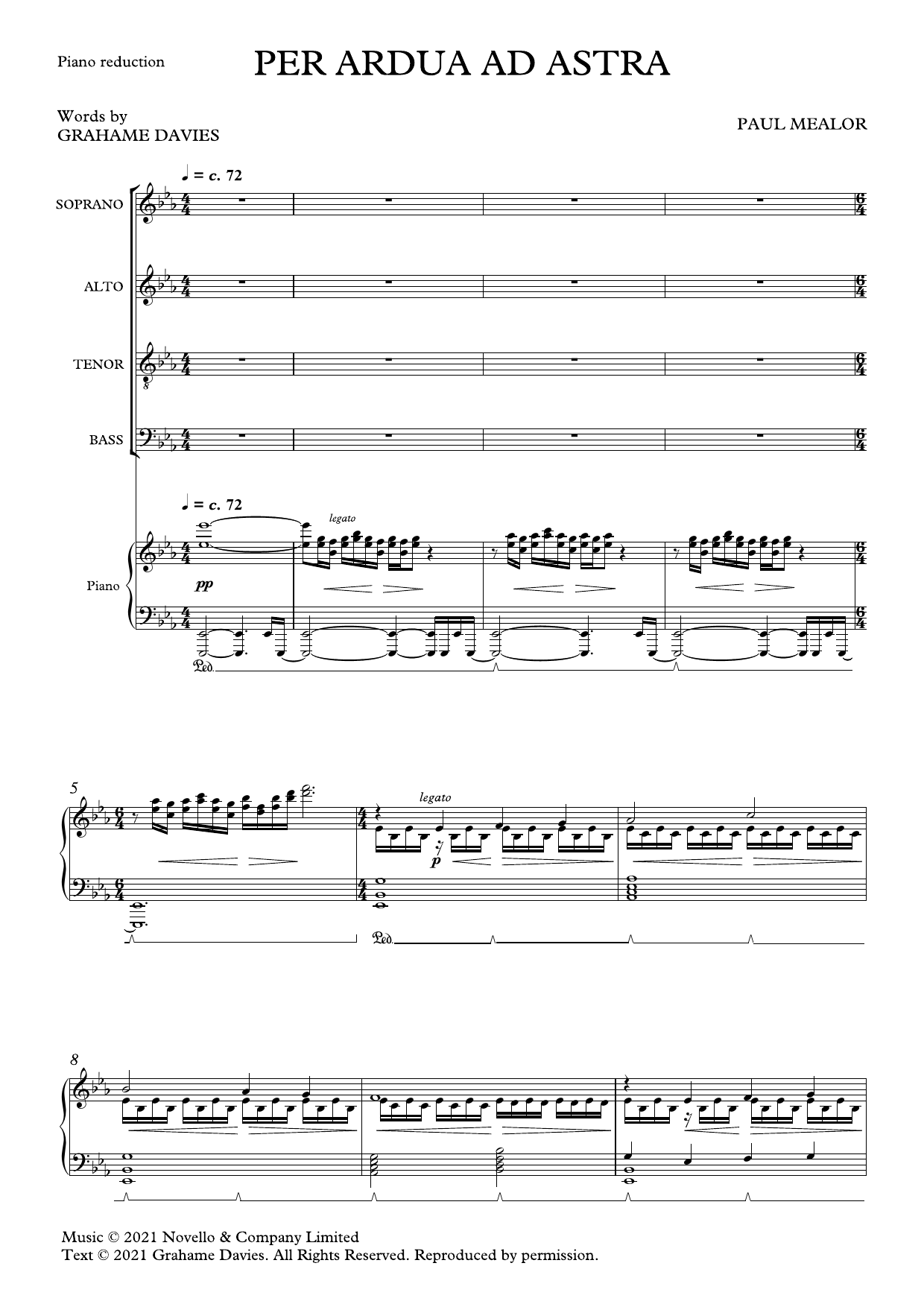
Per Ardua Ad Astra Sheet Music Preview

Per Ardua Ad Astra: SATB Choral Octavo

By Paul Mealor

Item: 35-DS01538578

Digital Download
$5.95
Description

Per Ardua Ad Astra: SATB Choral Octavo isn't in MakeMusic Cloud just yet...but it could be. Let us know you'd like to see it, and you'll help shape what comes next. In the meantime, start a free trial and dive into thousands of interactive titles your students can play along with today.

Sample Audio
No sample audio found.
Sample Video
Additional Details
Publisher: Hal Leonard
Page Count: 15
SKU: 35-DS01538578

More about this title

About the Composer: Paul Mealor

Paul Mealor is a Welsh composer whose choral writing has become central to contemporary sacred and secular repertoire. His works are performed regularly by professional choirs and university ensembles worldwide, and his gift for creating singable, emotionally direct lines has made him a staple of concert programs at all levels.

Why we love this

Mealor constructs this piece with the kind of architectural clarity that lets your singers focus on musicianship rather than wrestling with the score. The text setting feels inevitable, the harmonic language is sophisticated without becoming opaque, and the emotional arc builds naturally from restraint to full expression.

What to expect

The Latin title 'Per Ardua Ad Astra' (through hardship to the stars) signals both aspiration and struggle. The music unfolds with quiet determination, building through cumulative texture and harmonic depth rather than surface drama. There is luminosity here, but it is earned.

Who it's for

This octavo fits advanced high school choirs and college ensembles seeking contemporary classical work with substance and accessibility. Directors programming a concert that bridges liturgical and secular contexts will find this a natural fit.

How to get the most out of it

  • Shape the phrase arcs by thinking in long, connected lines rather than measure-to-measure. Mealor's harmony often sits still, so your singers need a clear sense of where each phrase breathes and lands.
  • Balance the soprano and alto parts carefully in sections where they diverge; these lines often carry thematic material that shouldn't get buried.
  • Allow the lower voices room to anchor the harmonic foundation without pressing; their solidity makes the upper voices sit cleanly.

How to use it

Place this as a centerpiece on a concert exploring contemporary composers who engage seriously with text and form. Its reflective temperament works equally well on a program of sacred works or as the opening gesture for a themed set.

Skills your students will build

  • Phrase shaping across longer harmonic cycles
  • Balancing multiple independent lines within a cohesive texture
  • Accurate intonation in extended harmonic language
  • Text expression without sacrificing harmonic clarity

You May Also Like