
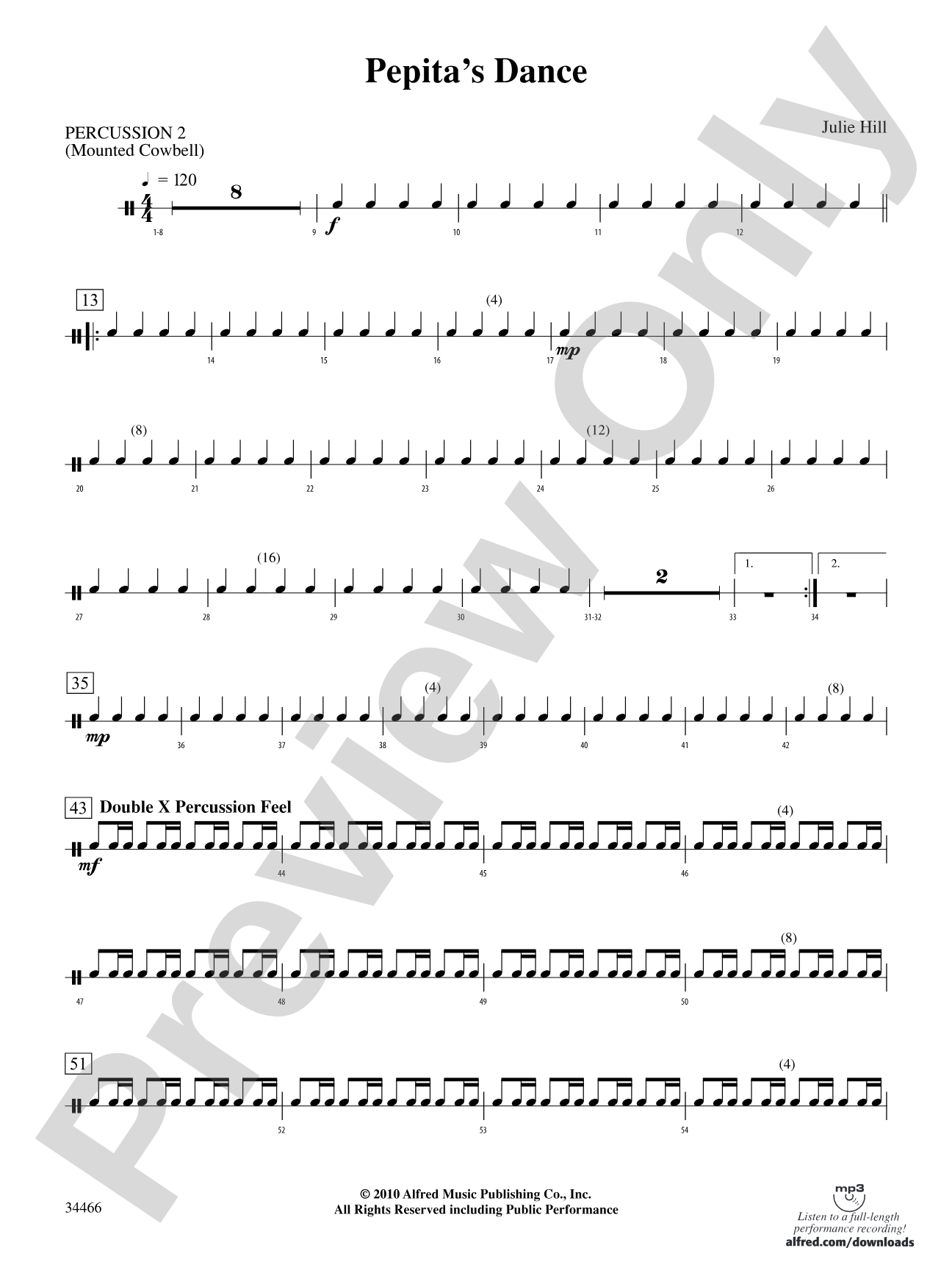

Pepita's Dance: 2nd Percussion
For 7-8 Players
By Julie Hill
Item: 00-PC-0014628_PC2
$3.00
Pickup currently not available
Description
Steel drum bands are becoming increasingly more common in school and community music programs. Students from K--12, to college age and beyond, are experiencing the joy of performing on these Caribbean-created instruments. Compositions and arrangements for the steel drum band have been limited and challenging to obtain . . . until now. Alfred proudly announces Alfred's Steel Drum Ensemble Series, which will address the need for quality steel drum music written for all levels of bands. From elementary/beginning band to high school, college, community, and professional groups, the pieces you are looking for are here, expertly written by educators who have vast experience working with steel drum bands at all levels.
Pepita's Dance is an original work for steel band with extra world music flavor. It acquaints students with world music styles accompanied by groovaliscious rhythms, but moreover, allows for flexibility in ages of the performers. This work is accessible enough for the beginning steel band player, but facilitates open improvisations that accommodate high school and college students as well as professionals.
"This piece is a delightful original composition with a Latin flare."
Jeannine Remy, Percussive Notes


Pepita's Dance is an original work for steel band with extra world music flavor. It acquaints students with world music styles accompanied by groovaliscious rhythms, but moreover, allows for flexibility in ages of the performers. This work is accessible enough for the beginning steel band player, but facilitates open improvisations that accommodate high school and college students as well as professionals.
"This piece is a delightful original composition with a Latin flare."
Jeannine Remy, Percussive Notes
Don't just read it, hear it, play along with it, and watch your students grow with it. In MakeMusic Cloud, Pepita's Dance: 2nd Percussion comes alive with professional accompaniment, adjustable tempo, and built-in practice tools that turn solo practice into real progress.
Open in the Player
Jump straight in and assign it today.
Start Your Free Trial
Open this title and explore the full library in minutes.
Sample Audio
1
Audio File
--:--
0:00
0:00
Sample Video
No sample videos found.
Additional Details
Series:
Alfred's Steel Drum Ensemble Series
Publisher:
Alfred Music
Page Count:
40
SKU:
00-PC-0014628_PC2
Instrumentation:
Steel Drum Ensemble (7–8 Players)
More about this title
About the Composer: Julie Hill
Julie Hill has spent years developing pedagogical percussion works with a particular focus on world percussion and steel drum ensembles. Her compositions for steel bands reflect deep experience teaching across multiple age levels, from elementary students discovering rhythm for the first time to college musicians seeking authentic ensemble challenges.
Why we love this
Julie Hill writes for steel bands with deep understanding of what makes these ensembles work at every level. Pepita's Dance balances immediate accessibility for beginners with genuine musical depth that engages experienced players, which is remarkably rare in steel drum literature. The built-in space for improvisation means you're not locked into one interpretation; your ensemble's personality shapes every performance.
What to expect
Pepita's Dance radiates Caribbean warmth infused with broader world music textures. The grooves are infectious and immediately engaging, yet the arrangement allows moments of reflection that prevent the piece from becoming purely novelty music. Steel drums sing here, not just accent.
Who it's for
Beginning through advanced steel drum ensembles of 7 to 8 players. The piece works equally well in K-12 programs building their percussion offerings and in college or community groups seeking fresh, accessible repertoire. Conductors looking for original steel band music that doesn't compromise on composition quality will find what they need here.
How to get the most out of it
- Establish the groove pocket first. The rhythmic foundation drives this piece, so lock the bass and rhythm parts before layering the melody lines.
- Encourage soloists to inhabit the style rather than play it safe. The improvisation sections are designed to showcase your strongest players, and Hill's arrangement gives them genuine room to breathe.
- Balance the Latin feel with the world music elements. This isn't purely Caribbean; let both influences coexist in the performance rather than emphasizing one over the other.
- Use dynamics to shape the sections. The contrast between grooved passages and melody-driven moments comes alive when you vary volume intentionally.
How to use it
Program this as a centerpiece in a percussion-focused concert or as a standout on a mixed ensemble bill where it signals your program's engagement with world music traditions. It works particularly well mid-set when audiences need an energy lift without losing musical substance. Consider it also as a gateway piece for students new to steel drums; its stylistic clarity and accessible scoring help them understand the instruments' voice.
Skills your students will build
- Reading parts written specifically for steel drum voicing and range
- Performing with secure rhythmic coordination in layered, percussion-driven textures
- Interpreting world music style markers and groove-based arrangements
- Contributing to ensemble improvisation and responding to musical cues from other players
- Balancing melodic and rhythmic roles within the same ensemble