Pentatonic Tune (Encore Plus, Book 2) Sheet Music Preview

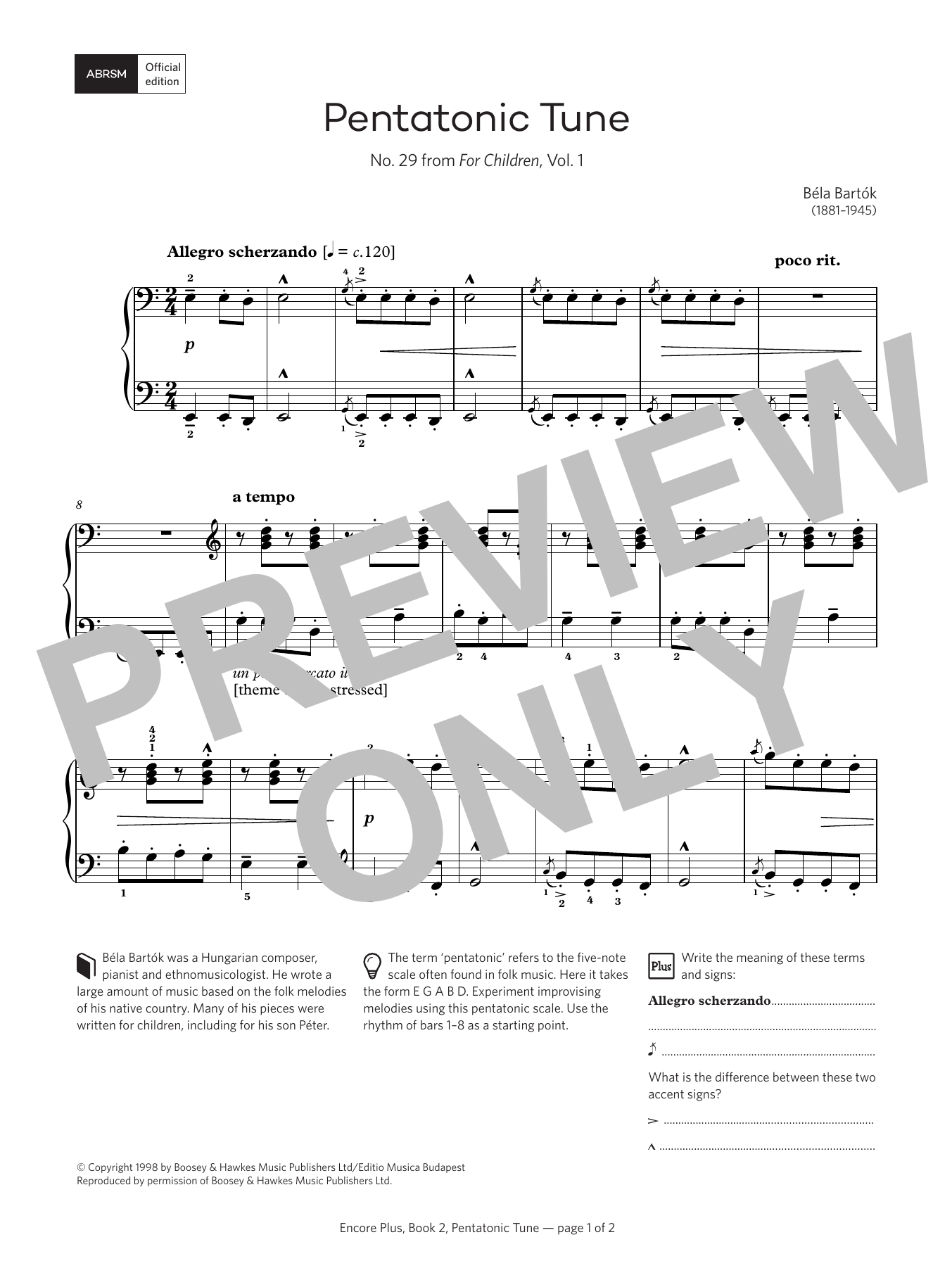
Pentatonic Tune (Encore Plus, Book 2): Piano Solo

By Béla Bartók

Grade: 4

Item: 35-DS01989433

Digital Download
$3.99
Description

Discover MakeMusic Cloud: thousands of interactive titles your students can play along with today.

Sample Audio
No sample audio found.
Sample Video
Additional Details
Publisher: Hal Leonard
Page Count: 2
SKU: 35-DS01989433

More about this title

About the Composer: Béla Bartók

Béla Bartók (1881–1945) was a Hungarian composer and pianist who fundamentally changed how musicians think about folk music and modern harmony. He spent decades collecting and analyzing traditional melodies from Hungary, Romania, and surrounding regions, then synthesized those discoveries into a compositional language that was both deeply rooted in folk tradition and radically contemporary. His pedagogical works, especially the Mikrokosmos series, remain essential teaching tools because they introduce advanced harmonic and rhythmic concepts through music that students actually want to play.

Bartók's approach to music education was direct: compose pieces that develop specific technical and musical skills, but never at the expense of genuine artistic content. He believed young musicians learned best when challenged by real musical ideas, not simplified exercises.

Why we love this

This piece distills Bartók's signature approach into a compact two-page work that feels deceptively simple on first glance. The pentatonic framework gives students immediate access to a folk-like melodic language while the underlying harmony introduces them to Bartók's subtle, non-functional harmonic thinking. It's the kind of piece that sounds fresh every time you return to it, whether you're a student discovering it for the first time or a teacher hearing it performed by yet another group.

What to expect

The piece opens with folk simplicity but reveals a more complex harmonic world underneath. There's an almost hypnotic quality to the pentatonic melody set against accompaniment that shifts tonally and texturally, creating gentle moments of surprise and intrigue.

Who it's for

Grade 4 pianists ready to move beyond diatonic thinking and encounter a composer whose harmonic language rewards careful listening. Students benefit from prior experience with solid technique and music-reading skills, as Bartók assumes you'll engage actively with the score rather than rely on muscle memory.

How to get the most out of it

  • Treat the pentatonic melody as speech, not song. Bartók's folk-inspired lines need rhythmic clarity and tonal directness; avoid over-pedaling, which muddies the line.
  • Listen carefully to how the accompaniment colors change under the melody. These shifts are intentional and should register without becoming heavy-handed.
  • Lock into the rhythmic pulse early, then let the melody breathe within that framework. This piece rewards players who can maintain steady time while still finding flexibility in phrasing.

How to use it

Pair this with other Grade 4 repertoire during a recital or student showcase where you want to highlight how folk-informed classical writing sits between tradition and innovation. It also works as a perfect introduction to Bartók's philosophy if you're teaching students about 20th-century composers who drew from vernacular music sources.

Skills your students will build

  • Pentatonic melody recognition and shaping
  • Reading and responding to non-functional harmony
  • Maintaining rhythmic independence between hands
  • Pedal control in music with chromatic or shifting harmonic content
  • Listening for orchestrational color changes within a piano texture

You May Also Like