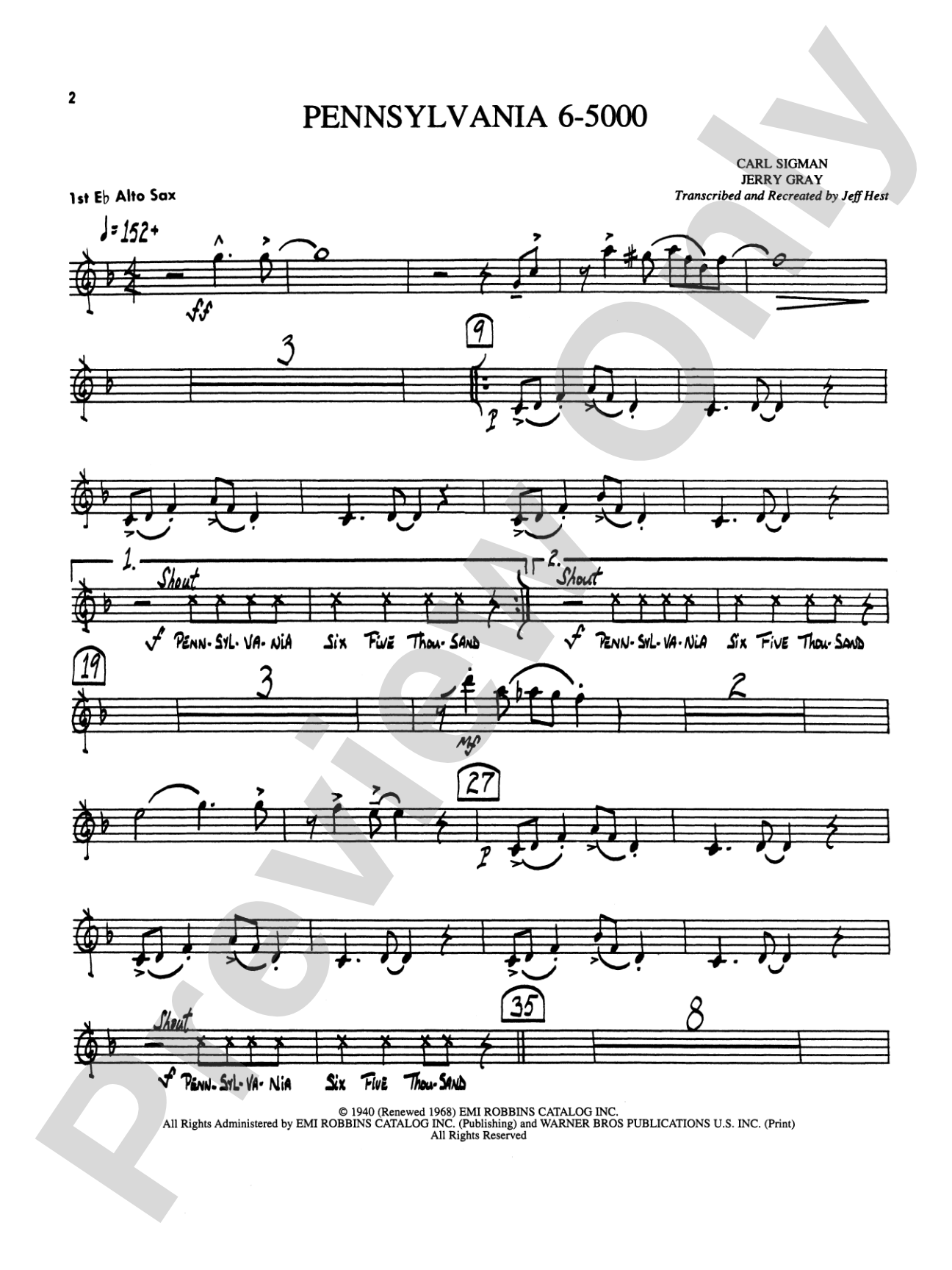
Pennsylvania 6-5000: E-flat Alto Saxophone Sheet Music Preview

Pennsylvania 6-5000: E-flat Alto Saxophone

Vocal Feature

Transcr. Jeff Hest

Grade: 4 (Medium Advanced / Difficult)

Item: 00-PC-0015262_AX1

Digital Download
$3.00
Description
Belwin Jazz Presents Pennsylvania 6-5000, a level 4 jazz vocal series piece designed for high school and advanced junior high school band. Instrumentation includes 5 saxophones, 8 brass, and 4 rhythm parts. Solos are written out with chord changes, the rhythm section parts suggest chord voicings and rhythms and guitar chord frames are provided to help young guitarists.

Don't just read it, hear it, play along with it, and watch your students grow with it. In MakeMusic Cloud, Pennsylvania 6-5000: E-flat Alto Saxophone comes alive with professional accompaniment, adjustable tempo, and built-in practice tools that turn solo practice into real progress.

Sample Audio
No sample audio found.
Sample Video
Additional Details
Series: Jazz Band Series
Publisher: Alfred Music
Page Count: 70
SKU: 00-PC-0015262_AX1

More about this title

About the Arranger: Jeff Hest

Jeff Hest

Jeff Hest has built a diverse career across commercial music, jazz, and theatrical production in New York City. His work spans hundreds of national advertising campaigns, over 40 jazz and pop albums, and musical direction for Broadway and film productions. He has recorded with world-class musicians including Urbie Green, Eddie Daniels, Derek Smith, and Milt Hinton.

Hest serves as an assistant professor of music at the City University of New York, where he teaches courses on music business and technology. His contributions to the music industry earned him a doctoral equivalency from CUNY, recognizing decades of professional achievement as an arranger, composer, and producer.

Why we love this

Hest's arrangement captures the swagger and energy of this classic without oversimplifying the jazz language for younger players. The written-out solos provide scaffolding while the chord changes and voicing suggestions in the rhythm section give students real context for improvisation and comping. This is the kind of professional-quality arranging that makes students feel like they're playing real jazz, not a simplified version of it.

What to expect

Pennsylvania 6-5000 has the polished, upbeat character of 1940s big band music with a modern arranging touch. The piece swings with infectious energy, balancing structured ensemble sections against moments where soloists get room to breathe and connect with the changes.

Who it's for

High school jazz ensembles and advanced junior high school jazz groups ready to tackle authentic big band jazz literature. Ensembles need a competent rhythm section, at least one capable vocalist, and players comfortable reading chord changes and jazz articulation.

How to get the most out of it

  • Lock the rhythm section first. The guitar voicings and suggested rhythms keep the piano, bass, and drums grounded; once those four instruments are tight, the horns sit much more naturally into the groove.
  • Encourage the solo vocalist to sing behind the beat slightly, especially on held notes. This builds the relaxed confidence the tune demands rather than landing too precisely on the bar.
  • Balance the saxophone section carefully during ensemble passages. The five saxes can easily overpower the brass if the lead alto isn't controlling dynamics with the ensemble in mind.
  • Use the chord changes in the solo sections as teaching moments about jazz reharmonization. Show students what's written and why Hest chose those changes for this particular melody.

How to use it

Feature this in a concert celebrating American jazz standards or pair it with other vocal jazz pieces to build a set that showcases your ensemble's range. The 70-page score and parts make it ideal for a full concert program closer or as the centerpiece of a jazz-focused concert in spring.

Skills your students will build

  • Reading jazz chord changes and improvising over changes
  • Jazz articulation and phrasing (especially swing eighths)
  • Ensemble balance in the saxophone and brass sections
  • Rhythm section comping and chord voicing
  • Solo preparation and interpretation with written changes
  • Reading and interpreting guitar chord frames

You May Also Like