
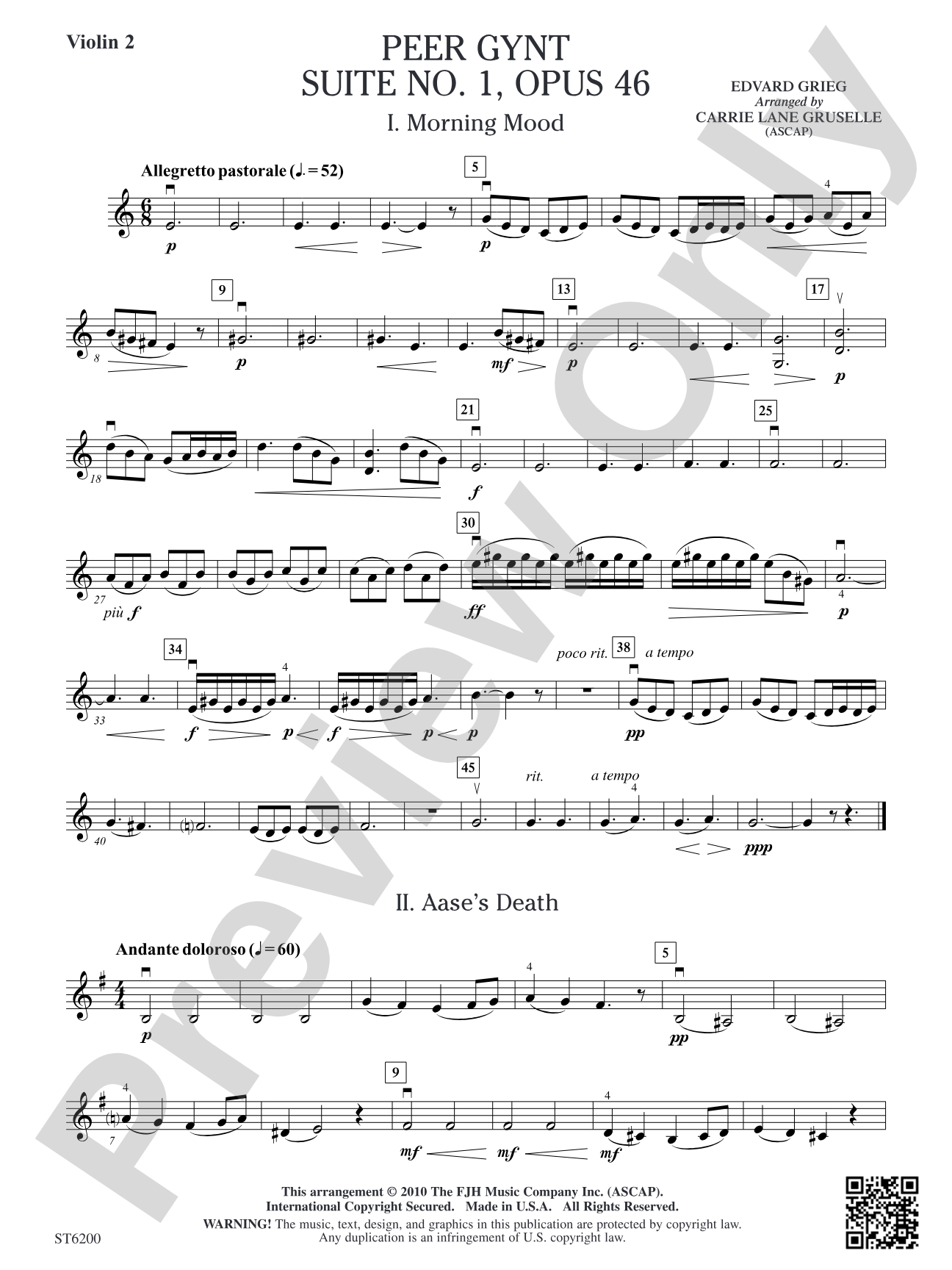

Peer Gynt Suite No. 1, Op. 46: Violin 2
By Edvard Grieg / arr. Carrie Lane Gruselle
Grade: 3.5
Item: 98-PC-DST6200_VN2
$7.00
Pickup currently not available
Description
This exceptional arrangement of Grieg's Peer Gynt Suite No. 1 is a must have for any library. Containing a broad range of Grieg's compositional techniques, the work features lyrical, chromatic, exotic, calming, and stirring music captured in four movements. Movements include Morning Mood, Aase's Death, Anitra's Dance, and In the Hall of the Mountain King. Excellent voicing makes your orchestra sound tremendous regardless of its size. Fabulous!


Don't just read it, hear it, play along with it, and watch your students grow with it. In MakeMusic Cloud, Peer Gynt Suite No. 1, Op. 46: Violin 2 comes alive with professional accompaniment, adjustable tempo, and built-in practice tools that turn solo practice into real progress.
Open in the Player
Jump straight in and assign it today.
Start Your Free Trial
Open this title and explore the full library in minutes.
Sample Audio
1
Audio File
--:--
0:00
0:00
Sample Video
No sample videos found.
Additional Details
Series:
FJH String Orchestra
Publisher:
The FJH Music Company, Inc.
SKU:
98-PC-DST6200_VN2
More about this title
About the Composer: Edvard Grieg
Edvard Grieg (1843-1907) stands as Norway's most celebrated composer, and his music remains foundational to the string orchestra repertoire. His gift for melody and harmonic innovation transformed Scandinavian folk idioms into concert works of international significance, making him essential listening for any developing ensemble.
Greig's dramatic works, particularly his incidental music for Henrik Ibsen's Peer Gynt, showcase his range across intimate character pieces and grand orchestral gestures. His influence on music education is profound: teachers and students engage with his compositional language to develop musicality, understand harmonic color, and experience how folk material can elevate concert music.
Why we love this
Carrie Lane Gruselle's arrangement opens this iconic suite to string orchestras of modest size without sacrificing the brilliant orchestration that makes these movements unforgettable. The four movements provide natural arc and contrast, making this an ideal single work to program when you want immediate audience recognition paired with genuine musical substance.
What to expect
These four movements sweep through a Norwegian landscape: sunlit meadows and morning air, intimate grief, sensual dance, and wild underground revelry. Grieg's melodies sing naturally in every register, and Gruselle's voicing ensures that even smaller string sections capture the harmonic warmth and exotic color that make this suite perennially engaging.
Who it's for
String orchestras at the Grade 3.5 level looking for a complete, recognizable work that demonstrates their ensemble's ability to shape lyrical passages and execute rhythmic clarity. Teachers who want to program Grieg without relying on full symphony orchestra instrumentation will find this arrangement serves intermediate ensembles and developing high school orchestras equally well.
How to get the most out of it
- Shape the opening of Morning Mood with warm, sustained tone in the first violins; this melody defines the entire movement, so establish its gentle phrasing immediately.
- Balance Aase's Death carefully between first and second violins as they trade phrases; clarity matters more than volume here, and letting each line speak prevents the poignant moments from becoming muddy.
- Drive Anitra's Dance with steady, dance-like rhythmic energy; the percussion support in this arrangement allows the strings to sit back slightly and let the movement breathe rather than push.
- In the Hall of the Mountain King builds through orchestration, not tempo; resist the urge to accelerate and instead let the addition of voices and harmonic intensity create mounting excitement.
How to use it
This works beautifully as a standalone feature in a concert celebrating Scandinavian composers, or as a bridge between a classical-era work and contemporary literature within the same program. The four-movement structure provides natural pacing in a concert, and its cultural identity gives context to discussions of nationalism in music.
Skills your students will build
- Shaping lyrical melody across phrase boundaries
- Balancing inner voices during sustained harmonic passages
- Maintaining rhythmic precision in moderately fast dance-like material
- Responding to emotional color shifts within a multi-movement work
- Reading and executing divisi string writing at intermediate complexity