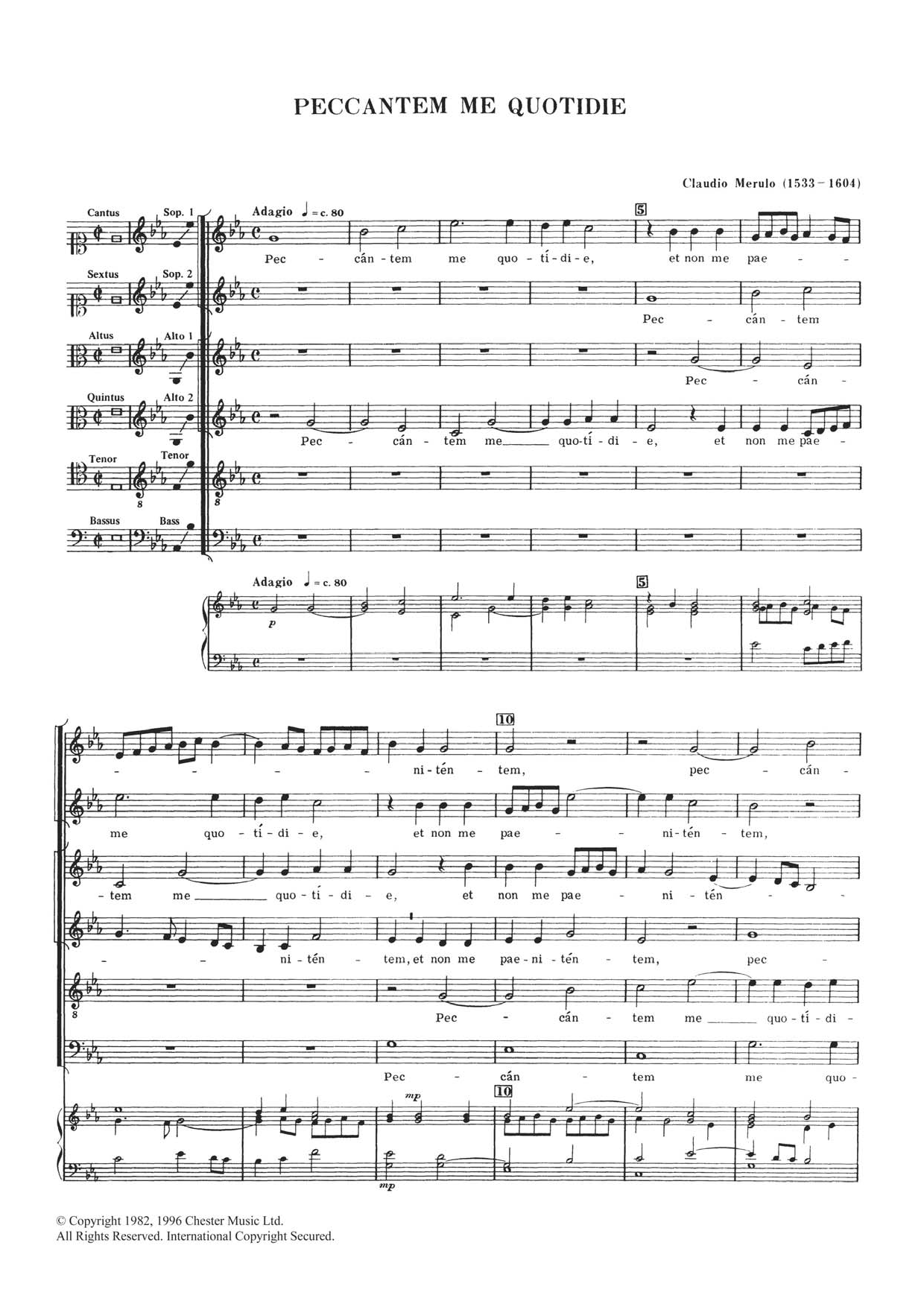
Peccantem Me Quotidie Sheet Music Preview

Peccantem Me Quotidie: SATB Choral Octavo

As performed by Claudio Merulo

Item: 35-DS00366688

Digital Download
$2.99
Description

Peccantem Me Quotidie: SATB Choral Octavo isn't in MakeMusic Cloud just yet...but it could be. Let us know you'd like to see it, and you'll help shape what comes next. In the meantime, start a free trial and dive into thousands of interactive titles your students can play along with today.

Sample Audio
No sample audio found.
Sample Video
Additional Details
Publisher: Hal Leonard
Page Count: 6
SKU: 35-DS00366688

More about this title

About the Artist: Claudio Merulo

Claudio Merulo (1533–1604) was a dominant figure in late Renaissance keyboard music and sacred vocal composition. Active primarily in Venice, he built a reputation as both a virtuoso organist and a prolific composer whose works bridged the transition from strict Renaissance polyphony toward the expressive possibilities of early Baroque writing.

Why we love this

Merulo's sacred motets showcase the spiritual depth and textural clarity that Renaissance choirs crave, without demanding the technical extremes of some of his contemporaries. The piece sits comfortably for intermediate to advanced SATB groups and rewards singers with genuine musical substance rather than filler. Programming it positions your choir in the serious repertoire conversation while remaining accessible for a mixed volunteer ensemble.

What to expect

The text 'Peccantem me quotidie' (I sin daily) opens into a contemplative, introspective soundscape. Merulo's voice leading creates moments of genuine luminosity while maintaining a tone of humble devotion throughout.

Who it's for

This octavo belongs in the library of SATB choirs working at an intermediate level or higher. It also serves well for small chamber choirs or collegiate ensembles seeking Renaissance sacred repertoire beyond the most commonly programmed names.

How to get the most out of it

  • Shape phrases around the Latin text's natural accentuation rather than musical barlines; Merulo's settings follow speech patterns closely, and honoring that makes the piece breathe.
  • Balance the inner voices with care since Merulo frequently carries important material in the alto and tenor lines rather than reserving it for soprano leads.
  • Approach dissonances (especially suspensions) with slight agogic emphasis to clarify voice leading and let singers hear the harmonic logic supporting their part.

How to use it

Include this as part of a Renaissance sacred music concert or a liturgically themed program. It pairs naturally with other 16th-century motets and works particularly well as a reflective moment between more extroverted pieces.

Skills your students will build

  • Reading polyphonic Renaissance voice leading with independent inner voice lines
  • Shaping Latin text underlay and phrasing within a through-composed structure
  • Balancing ensemble voicing when the harmonic weight shifts away from the soprano
  • Performing period appropriate articulation and approach to suspensions

You May Also Like