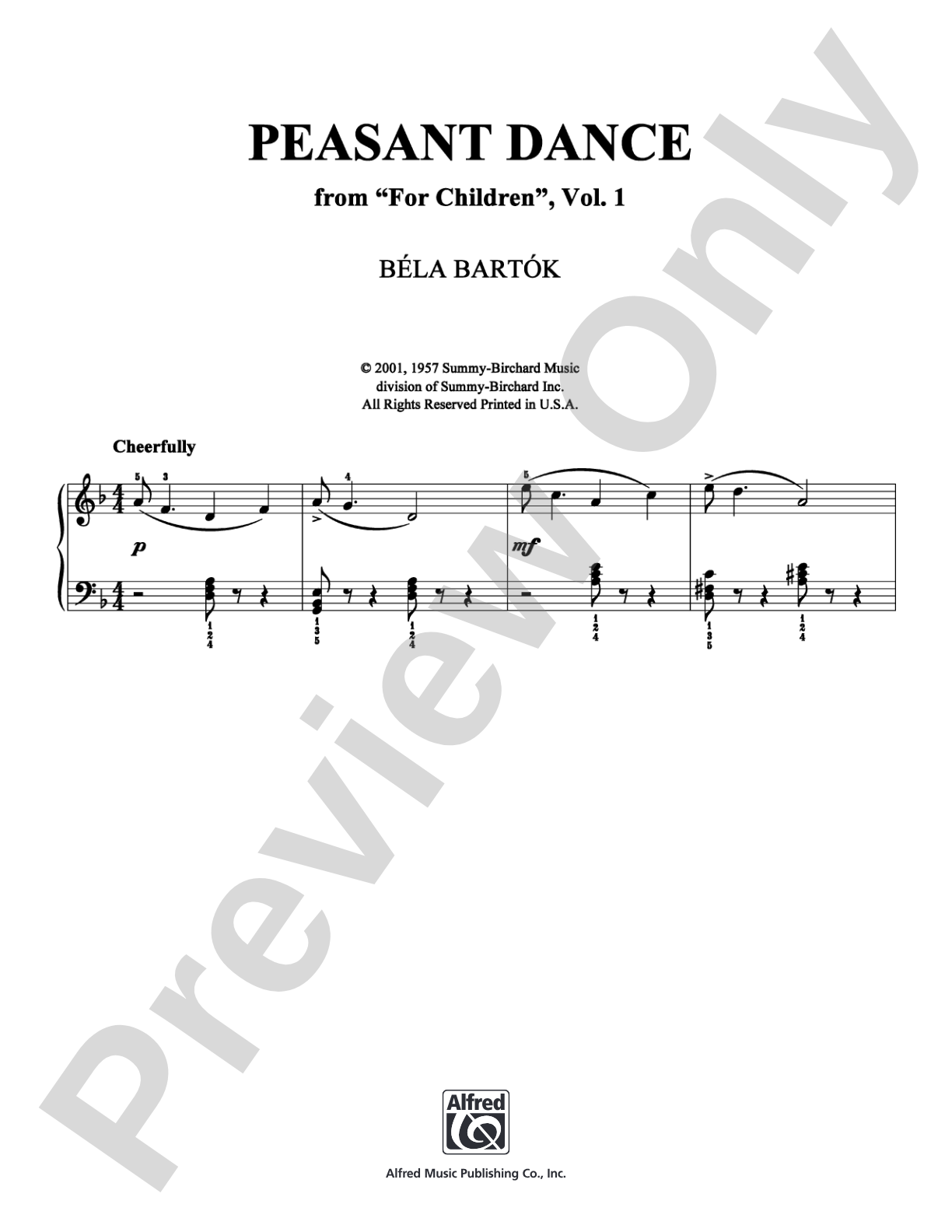
Peasant Dance: Piano Digital Sheet Music

Peasant Dance: Piano Digital Sheet Music

Béla Bartók

Item: 00-PS-0000209

Digital Download
$3.99
Description

Peasant Dance: Piano Digital Sheet Music isn't in MakeMusic Cloud just yet...but it could be. Let us know you'd like to see it, and you'll help shape what comes next. In the meantime, start a free trial and dive into thousands of interactive titles your students can play along with today.

Sample Audio
No sample audio found.
Sample Video
Additional Details
SKU: 00-PS-0000209

More about this title

About the Composer: Béla Bartók

Béla Bartók (1881, 1945) was a Hungarian composer and pianist who revolutionized twentieth-century music by synthesizing folk traditions with modern compositional techniques. He spent decades collecting and analyzing authentic peasant songs from Eastern Europe, and this ethnomusicological work shaped everything he wrote. His piano music ranges from pedagogical pieces designed for young students to complex concert works, all marked by sharp rhythmic vitality, modal harmonies, and the raw energy of the cultures he studied.

For music educators, Bartók's output offers something rare: technically accessible pieces that don't compromise artistic integrity. His writing for piano balances clarity with genuine musical substance, making his works ideal for building both technical facility and interpretive maturity.

Why we love this

Bartók distills genuine folk character into a compact, playable form that never condescends. The piece teaches rhythmic vitality and tonal clarity while remaining accessible to students who are encountering twentieth-century idioms for the first time. Programming this alongside standard repertoire signals to students that contemporary music lives in the same concert space as Bach.

What to expect

Raw vitality channeled through precise gesture. The piece pulses with the energy of a village celebration captured in a studio, with direct rhythmic statements and an unsentimental joy. Bartók strips away romantic flourish and leaves you with pure kinetic music.

Who it's for

Intermediate pianists comfortable with twentieth-century harmonic language and folk-derived rhythmic patterns. This work suits students ready to move beyond traditional tonal harmony while seeking music that connects to real cultural traditions rather than pure abstraction.

How to get the most out of it

  • Anchor the rhythmic drive without rushing; Bartók's folk-derived patterns need a steady pulse and crisp articulation to land their effect.
  • Shape the melodic line with the weight distribution of a folk fiddler rather than a legato romantic pianist; let the character of the material dictate your touch.
  • Listen for the harmonic color beneath the surface. Bartók's dissonance is intentional and musical, not something to smooth over or apologize for.

How to use it

Use this as a gateway to twentieth-century piano literature in a recital; its accessibility makes it an excellent companion to earlier standard works. It also pairs naturally with other Bartók piano pieces or contemporary folk-derived works, signaling a thematic concert arc.

Skills your students will build

  • Reading and executing folk-derived rhythmic figures with precision and drive
  • Understanding modern harmonic language grounded in modal and pentatonic materials
  • Projecting character and style through articulation rather than pedal or romantic phrasing
  • Balancing rhythmic regularity with musical elasticity appropriate to folk material

You May Also Like