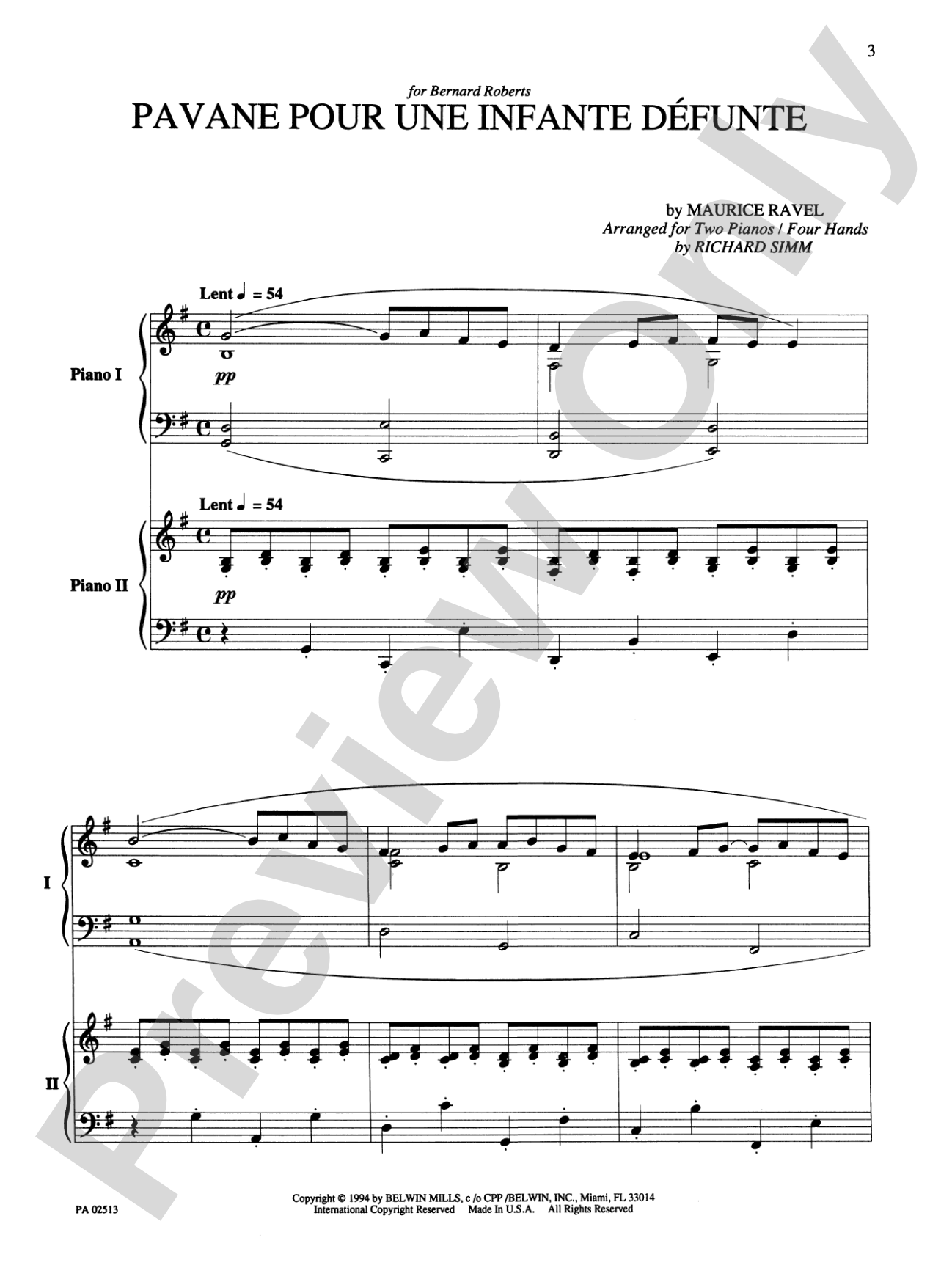
Pavane Pour une Infante Defunte - Piano Duo (2 Pianos, 4 Hands) Sheet Music Preview

Pavane Pour une Infante Defunte - Piano Duo (2 Pianos, 4 Hands): Piano Duets & Four Hands

By Maurice Ravel

Level: Late Intermediate

Item: 00-PB-0000687

Digital Download
$6.99
Description
One of the world's most lovely melodies now available as a piano duo. This lush arrangement was made from the original orchestral score and lays easily under the hands. The flow of the melody from piano to piano is nice. This arrangement is perfect for advancing pianists, and will be a welcome addition to any recital. A Federation Festivals 2024-2028 selection.

Pavane Pour une Infante Defunte - Piano Duo (2 Pianos, 4 Hands): Piano Duets & Four Hands isn't in MakeMusic Cloud just yet...but it could be. Let us know you'd like to see it, and you'll help shape what comes next. In the meantime, start a free trial and dive into thousands of interactive titles your students can play along with today.

Sample Audio
No sample audio found.
Sample Video
Additional Details
Series: Belwin Edition
Publisher: Alfred Music
Page Count: 28
SKU: 00-PB-0000687

More about this title

About the Composer: Maurice Ravel

Maurice Ravel (1875, 1937) was a French composer whose fastidious orchestration and harmonic innovation defined early twentieth-century music. Though often grouped with Impressionists, Ravel was precise and architectural in his approach, crafting textures of remarkable clarity and color. His works remain staples of music education because they reward careful listening and demonstrate how orchestral concepts translate across ensembles and arrangements.

Why we love this

This arrangement respects the original's contemplative pacing while solving a real chamber problem: how to keep the melody singing when you're limited to two instruments. The hand-off between pianos sustains the piece's unhurried nobility, and the writing sits naturally enough that advancing students don't feel trapped by technical awkwardness. It's the kind of selection that feels mature on a program without demanding virtuosity.

What to expect

Stately and tender. The melody glides without urgency, supported by gentle harmonic shifts that color the emotional landscape. There's an elegance here that feels almost ceremonial, yet intimate enough to hold a listener's attention in a small room or large hall.

Who it's for

Advancing pianists working in duet settings, whether as partners of equal ability or in a teaching/student pairing. This works equally well for recitals, chamber concerts, and festival competitions where a touch of Impressionistic sophistication lifts a program.

How to get the most out of it

  • Treat the melody transfer between pianos as a conversation. The pianist carrying the line should shape it with slight rubato; the accompanying pianist provides stability underneath.
  • Balance is not fifty-fifty. The melodic voice needs room to breathe, which means the accompaniment should sit deliberately lower in the mix.
  • Maintain steady eighth-note figures in the accompaniment without rigidity. These pulses anchor the harmony but shouldn't feel metronomic.
  • The piece unfolds over time. Resist the urge to hurry; let silence and space between phrases register with the audience.

How to use it

Pair this with other Impressionistic or early-modern duets for a focused recital theme. It also serves as an excellent selection for festival competitions where the Federation lists guide programming. The piece fills a gap for groups looking for substantial, beautiful repertoire that doesn't demand extreme technical display.

Skills your students will build

  • Melodic phrasing and shaping with awareness of harmonic support
  • Balancing a lead voice against accompaniment texture
  • Pedal coordination across changing harmonic contexts
  • Rhythmic independence while maintaining unified ensemble pulse
  • Reading and interpreting Impressionistic harmony and voice leading

You May Also Like