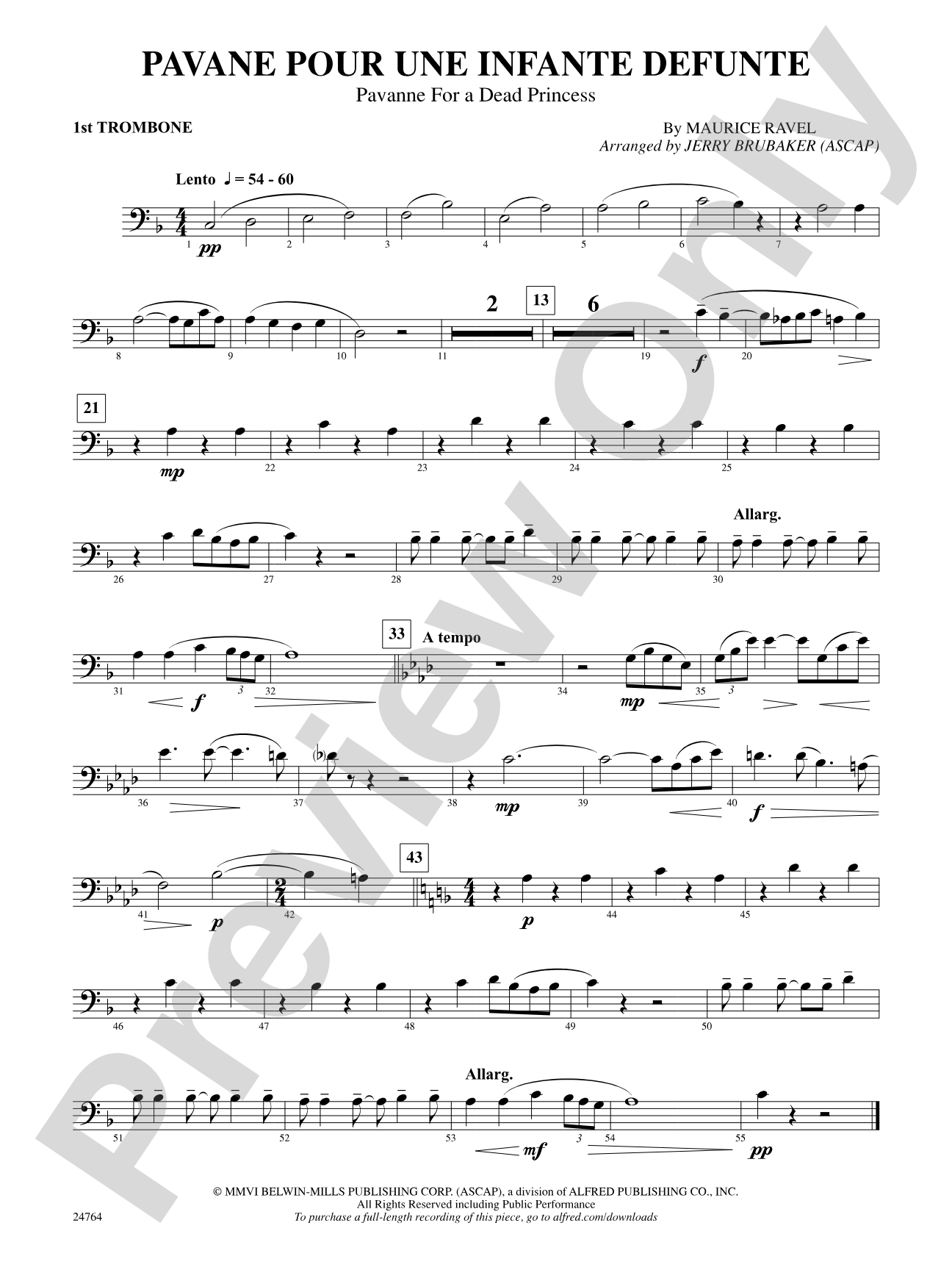
Pavane Pour Une Infante Defunte (Pavanne for a Dead Princess): 1st Trombone Sheet Music Preview

Pavane Pour Une Infante Defunte (Pavanne for a Dead Princess): 1st Trombone

By Maurice Ravel / arr. Jerry Brubaker

Grade: 3 (Medium Easy)

Item: 00-PC-0000907_TN1

Digital Download
$3.00
Description
Maurice Ravel was only 24 when his piano solo "Pavane Pour une Infante Defunte," which translated means Pavane for a dead princess, became the rage of the drawing rooms and salons of Paris in 1899, but the work already held the unmistakable stamp of his style. Ravel orchestrated the work in 1910. Jerry Brubaker presents this lovely work in a Concert band setting with all of the lush melodies and harmonies of the original work but with simplified ranges and a comfortable key. A marvelous choice for a truly beautiful piece of impressionistic literature!

Don't just read it, hear it, play along with it, and watch your students grow with it. In MakeMusic Cloud, Pavane Pour Une Infante Defunte (Pavanne for a Dead Princess): 1st Trombone comes alive with professional accompaniment, adjustable tempo, and built-in practice tools that turn solo practice into real progress.

Sample Audio
0:00
0:00
Sample Video
Additional Details
Series: Belwin Concert Band
Publisher: Alfred Music
Page Count: 120
SKU: 00-PC-0000907_TN1

More about this title

About the Composer: Maurice Ravel

Maurice Ravel (1875-1937) was a French composer whose fastidious approach to orchestration and harmonic color defined early twentieth-century impressionism. His works prize elegance and clarity over romantic excess, and his gift for reimagining instrumental textures across different ensembles made him one of the era's most versatile orchestrators.

Why we love this

Jerry Brubaker's concert band setting captures the essential character of Ravel's original without asking brass players to climb into uncomfortable ranges or reed players to sustain beyond their breath capacity. The arrangement preserves the work's unmistakable impressionistic colors while landing solidly in the Grade 3 range, making it genuinely accessible for high school and select middle school ensembles.

What to expect

The piece unfolds with the unhurried dignity of a formal processional, its gentle woodwind figures supported by warm harmonic foundations in the lower voices. There is a timelessness to it, a sense of quiet reverence that feels neither sad nor celebratory, but rather contemplative and deeply still.

Who it's for

Concert bands at the high school level and accomplished middle school ensembles will find this arrangement both musically rewarding and technically manageable. It serves groups looking to program substantial works of genuine artistic merit without requiring the advanced technical demands of the original orchestral score.

How to get the most out of it

  • Balance the melodic line carefully across instruments; the primary melody passes between woodwinds and brass throughout, and uneven transitions between sections will disrupt the piece's sustained elegance.
  • Maintain an unhurried tempo and resist any tendency to rush through phrases. The music's beauty emerges from sustained lines and rich harmonic resolutions, not from forward momentum.
  • Shape dynamics with restraint. This is impressionistic music, not romantic drama; subtle crescendos and diminuendos serve the piece far better than bold contrasts.
  • Pay special attention to intonation in the slower harmonic passages where multiple chord tones sound together. Tuning issues become immediately apparent in open, lush voicings.

How to use it

Program this as a contrasting centerpiece on a concert featuring more contemporary or energetic works; its impressionistic palette and measured pacing offer both respite and sophistication. It works equally well as a festival or contest selection for groups seeking to demonstrate musicianship and refined ensemble sound rather than technical fireworks.

Skills your students will build

  • Sustaining long melodic lines across phrase boundaries without loss of tone quality
  • Balancing individual instrument color within a blended ensemble texture
  • Responding to subtle dynamic shaping and harmonic movement
  • Ensemble intonation in slow, open harmonic writing
  • Following a conductor's interpretation of rubato and flexible phrasing

You May Also Like