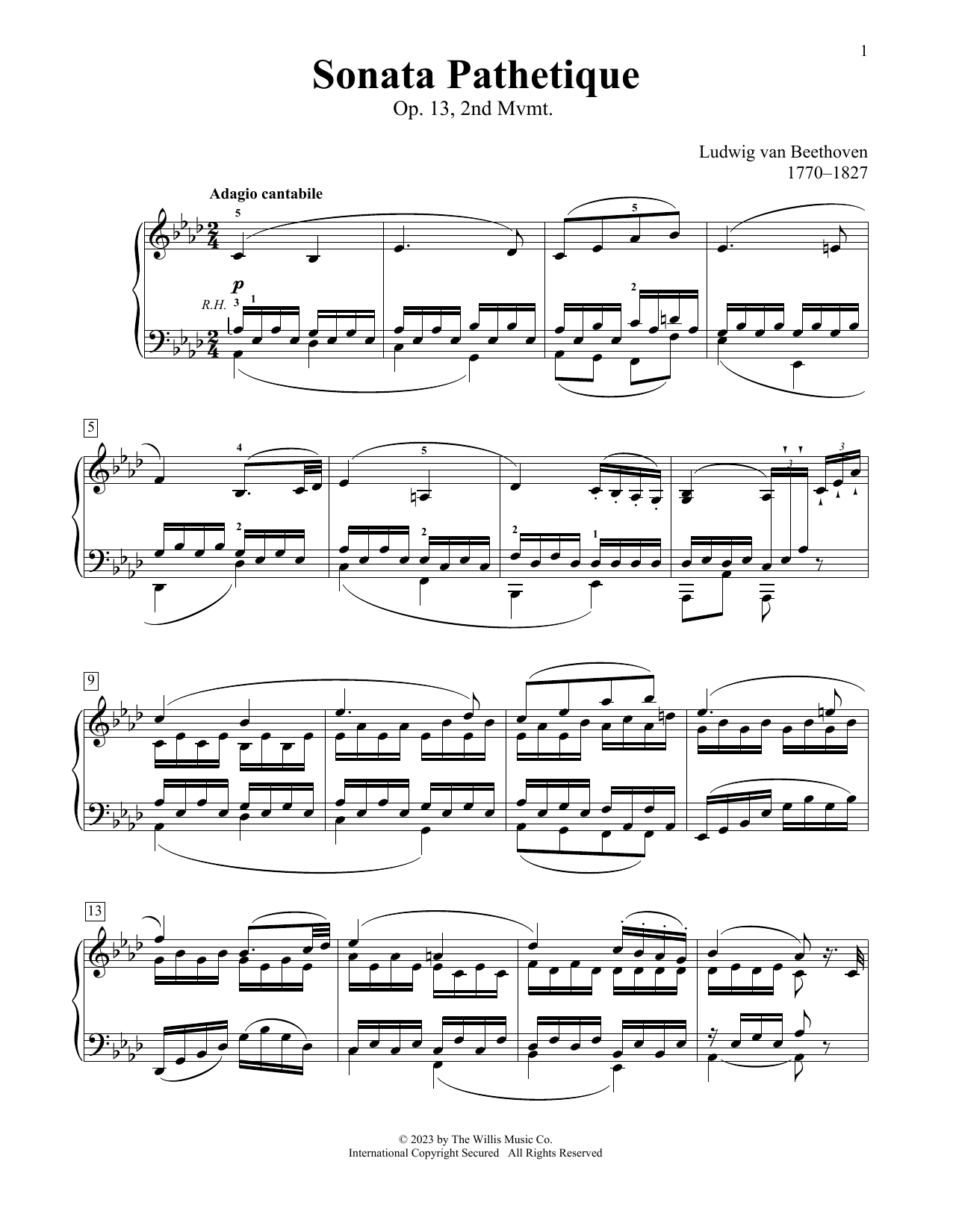
Pathetique Sonata, Op.13, 2nd mvmt Sheet Music Preview

Pathetique Sonata, Op.13, 2nd mvmt: Educational Piano

Edited by Charmaine Siagian / Edited by Sonya Schumann

Item: 35-DS01340321

Digital Download
$4.99
One moment…
Description

Discover MakeMusic Cloud: thousands of interactive titles your students can play along with today.

Sample Audio
No sample audio found.
Sample Video
Additional Details
Publisher: Hal Leonard
Page Count: 5
SKU: 35-DS01340321

More about this title

About the Creator: Ludwig van Beethoven

Ludwig van Beethoven (1770-1827) composed the Pathétique Sonata during a period of personal and artistic transition, creating a work that bridges Classical form with Romantic emotional depth. His genius for writing idiomatic keyboard music is nowhere more evident than in this sonata, where he demands both technical facility and profound interpretive maturity from the performer.

The second movement, marked Adagio cantabile, showcases Beethoven's gift for sustained melodic writing and his sophisticated approach to harmonic color. This movement has become a touchstone for pianists seeking to understand how to shape a long lyrical line with both restraint and emotional resonance.

Why we love this

Students encounter one of music history's most recognizable and genuinely moving themes without the technical gauntlet of the first movement. The accompaniment patterns remain consistent enough to build confidence while the melody demands careful shaping and tonal control, making this a pedagogically honest introduction to Beethoven's late Classical voice.

What to expect

A conversation suspended in time. The melody unfolds with the quality of someone sharing a cherished memory, supported by gentle, almost hypnotic accompaniment that seems to exist in a different emotional space. There's an ache here, but not one that demands action; instead it invites reflection and acceptance.

Who it's for

Intermediate pianists ready for Beethoven's emotional vocabulary but not yet ready for the technical demands of the entire sonata. Students who can sustain a singing tone and understand basic harmonic function will find this movement both musically rewarding and achievable within a year of focused study.

How to get the most out of it

  • Shape the opening theme as if singing it; imagine the phrase breathing at natural punctuation points rather than geometric phrase lengths.
  • Maintain clarity in the left hand accompaniment even at soft dynamics; these repeated figures anchor the harmonic motion and must not blur together.
  • Experiment with subtle tempo flexibility in the return of the main theme to reflect its character as a memory or reflection rather than a literal repeat.
  • Balance the ornamentation (trills, turns) so it decorates rather than obscures the primary melody line.

How to use it

Pair this with earlier Classical sonata movements (Beethoven's easier sonatas or works by Haydn and Mozart) to show stylistic evolution, or feature it as a solo recital piece that demonstrates your student's maturity as a musician. Its five pages make it manageable for a spring recital program without overshadowing more technically demanding works on the same concert.

Skills your students will build

  • Sustaining and shaping long lyrical phrases over 16+ bars
  • Maintaining steady accompaniment patterns while balancing dynamic contrasts with the melody
  • Reading and executing Beethoven-era ornaments (trills, turns) within the context of Romantic expression
  • Understanding harmonic function in the context of emotional content rather than merely structural function
  • Interpreting repeat signs and varied reprises with artistic intent

You May Also Like