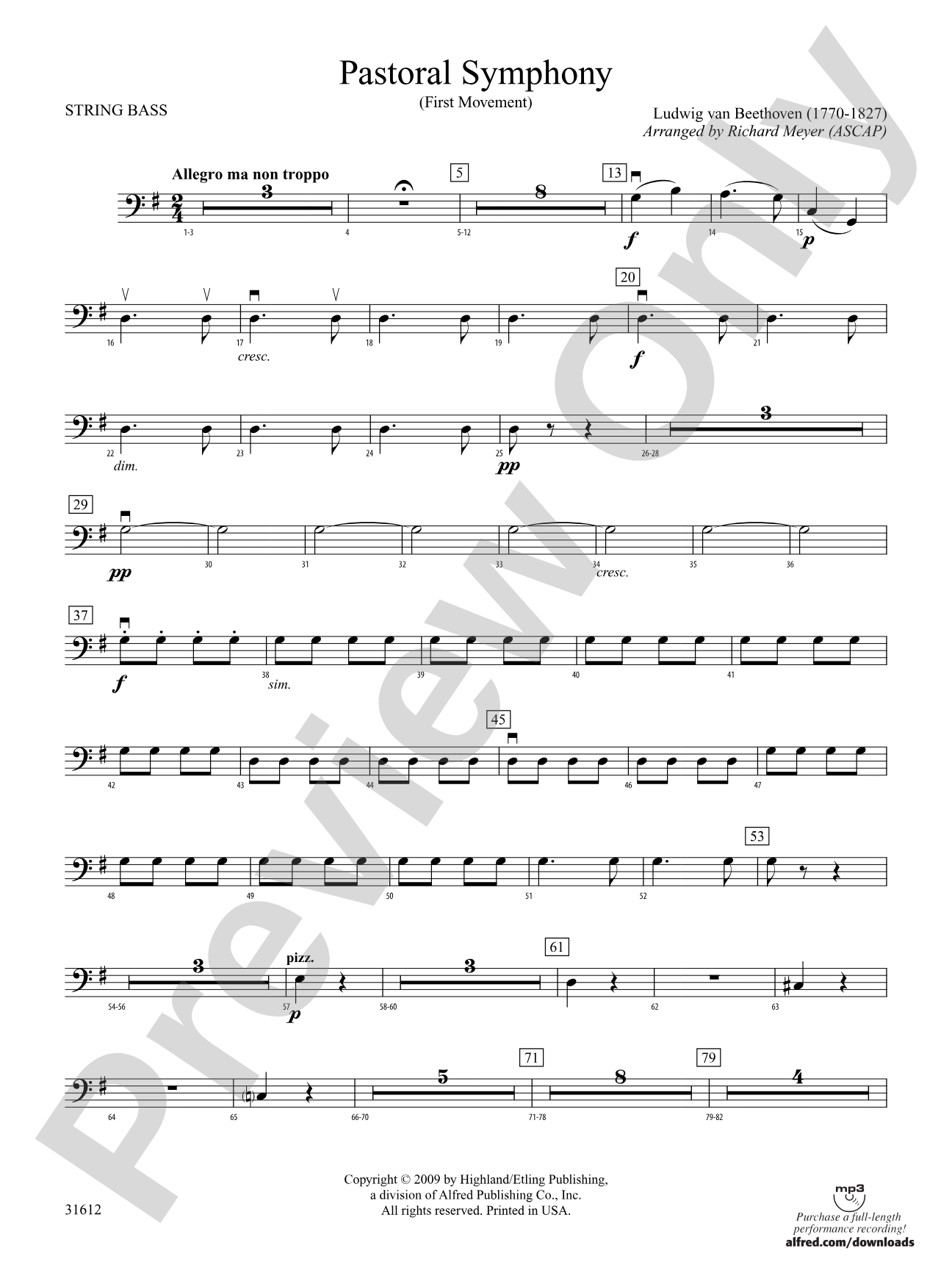
Pastoral Symphony (First Movement): String Bass Sheet Music Preview

Pastoral Symphony (First Movement): String Bass

By Ludwig van Beethoven / arr. Richard Meyer

Grade: 2.5

Item: 00-PC-0001775_SB

Digital Download
$3.00
Description
Carefully arranged with the young orchestra in mind, this version retains all of the charm and color of Beethoven's original. Students will develop their lyrical playing skills while learning to "listen for the tune" as it moves from section to section. A wonderful way to develop proper balance in a symphonic setting, and a great introduction to music that invokes moods and pictures.

Don't just read it, hear it, play along with it, and watch your students grow with it. In MakeMusic Cloud, Pastoral Symphony (First Movement): String Bass comes alive with professional accompaniment, adjustable tempo, and built-in practice tools that turn solo practice into real progress.

Sample Audio
0:00
0:00
Sample Video
Additional Details
Series: Highland/Etling First Philharmonic
Publisher: Alfred Music
Page Count: 196
SKU: 00-PC-0001775_SB

More about this title

About the Composer: Ludwig van Beethoven

Ludwig van Beethoven (1770-1827) stands as one of history's most consequential composers, a bridge between the Classical and Romantic eras. His symphonies redefined what orchestral music could express, moving beyond pure formal elegance to capture emotional depth, struggle, and transcendence. For young musicians, his works offer a masterclass in how melody, harmony, and orchestration work together to create meaning.

Why we love this

Richard Meyer's arrangement strips away nothing essential while making the piece genuinely playable for a young ensemble. The orchestration remains transparent enough that students hear exactly how the melodic line passes between sections, and the harmonic language stays rich without overwhelming developing musicians. Your orchestra will sound sophisticated while building real symphonic maturity.

What to expect

Pastoral means landscape, and you'll hear it: gentle countryside scenes, natural light filtering through movement between instruments. The melodic line wanders from the flutes through the violins, lingering just long enough that players feel part of something larger than their individual parts. There's a quiet contentment here, never loud or forced, always inviting the ear inward.

Who it's for

Young orchestras with solid fundamentals but limited experience playing lyrical music at symphonic scale. This arrangement works for orchestras that have mastered basic ensemble skills and are ready to tackle how a masterwork teaches musical storytelling.

How to get the most out of it

  • Shape the main melody with gentle dynamic swells rather than sudden changes; this pastoral character relies on breath-like phrasing even in a 2.5-level arrangement.
  • Listen for balance between the tune-carrying section and the accompaniment voices. Have non-melody players know which section holds the primary line in each phrase.
  • Let the ensemble settle into a comfortable, walking tempo that allows the character to breathe naturally. Rushing robs the movement of its contemplative quality.
  • Mark entrances clearly in the parts so players can anticipate passing the melody without losing continuity.

How to use it

Program this early in the concert as a bridge piece that shows your orchestra's sensitivity and control. It pairs well after a lighter, shorter opener and before something more dramatic or structurally complex. Spring concerts and festival programs benefit especially from this movement's connection to nature and its appeal to audiences of all ages.

Skills your students will build

  • Sustaining lyrical phrasing across phrase boundaries
  • Tracking and supporting the primary melodic line in an orchestral texture
  • Balance between melody and accompaniment voices
  • Listening for blend and intonation across multiple sections
  • Responding to subtle dynamic shaping in music without dramatic contrasts
  • Understanding how a Classical symphony develops a single idea across the ensemble

You May Also Like