
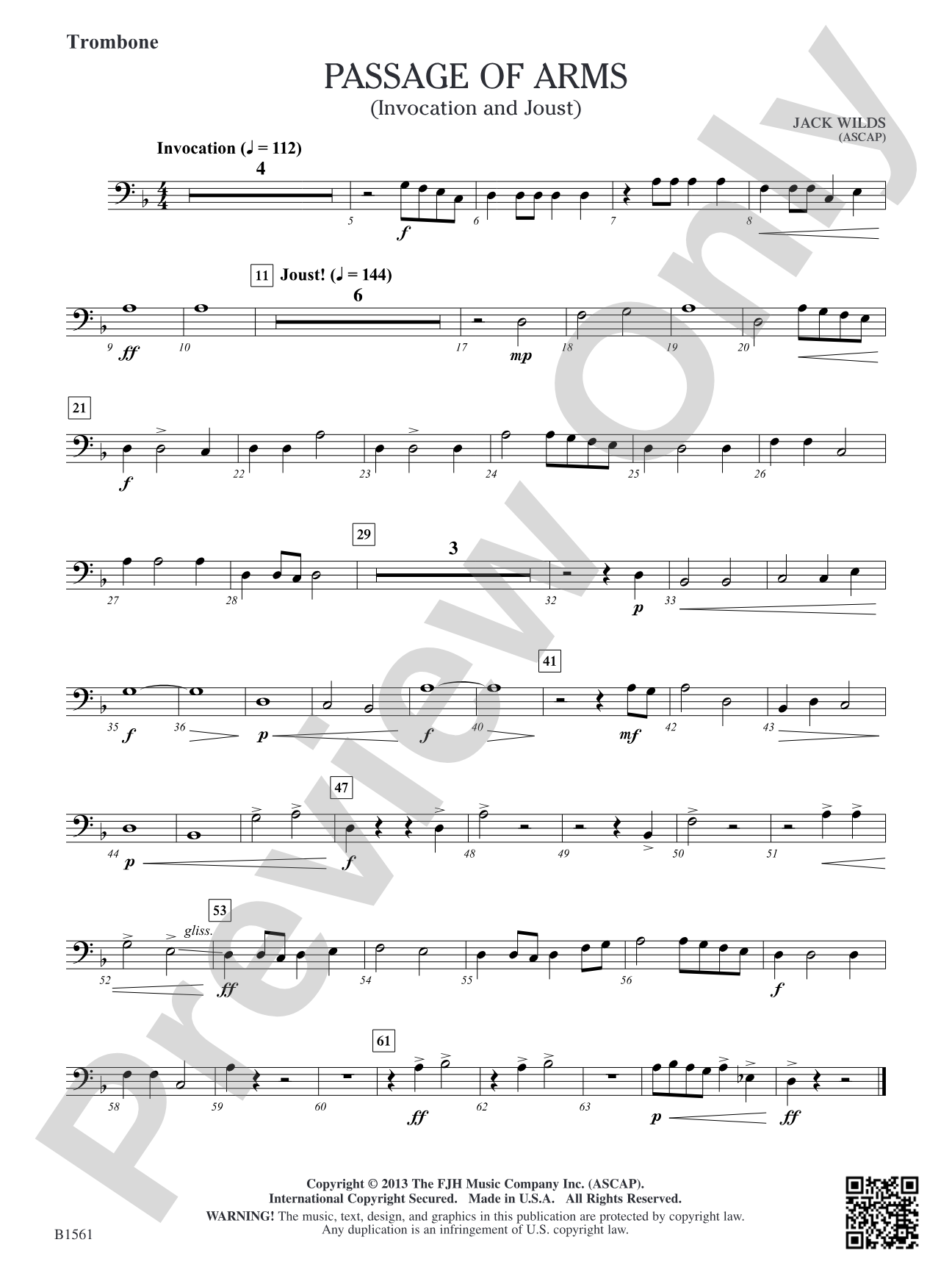

Passage of Arms (Invocation and Joust): Trombone
Invocation and Joust
By Jack Wilds
Grade: 1.5
Item: 98-PC-DB1561_TN1
$7.00
Pickup currently not available
Description
Opening with a sense of solemn reverence and anticipation, this highly energetic work takes place in France during the Middle Ages. As a knight sets up camp in front of a bridge, the battles begin when other knights try to gain passage. Driving rhythms represent the energy of battle while a wide array of percussion mimics the clash of distant swords and battle cries. Eventually, both themes are juxtaposed before a final victorious statement emerges. Intense!


Don't just read it, hear it, play along with it, and watch your students grow with it. In MakeMusic Cloud, Passage of Arms (Invocation and Joust): Trombone comes alive with professional accompaniment, adjustable tempo, and built-in practice tools that turn solo practice into real progress.
Open in the Player
Jump straight in and assign it today.
Start Your Free Trial
Open this title and explore the full library in minutes.
Sample Audio
1
Audio File
--:--
0:00
0:00
Sample Video
No sample videos found.
Additional Details
Series:
FJH Developing Band
Publisher:
The FJH Music Company, Inc.
SKU:
98-PC-DB1561_TN1
More about this title
About the Composer: Jack Wilds

Jack Wilds composes across an expansive range of ensembles and age groups, from children's choirs through professional orchestras. His music draws intentionally from visual art, philosophical and religious texts, and poetry alongside purely musical ideas, resulting in works that challenge performers to engage authentically while meeting them at their current level.
A former public school band director, Wilds has published over 40 works for developing musicians and maintains active roles as a lecturer in composition and theory at Texas State University and as Co-Director of Music at First Presbyterian Church in San Marcos. His wind band compositions appear regularly on festival required repertoire lists across multiple continents and have been heard at the Midwest Clinic and major educator conferences. He has studied composition with Michael Ippolito, Chris Trapani, and Donald Grantham.
Why we love this
Wilds crafts a narrative arc that holds student musicians' attention from the solemn opening through the climactic battle and final victory. The orchestration and rhythmic writing make percussion students feel genuinely part of the action rather than supporting players, and the Grade 1.5 difficulty means even developing bands can execute the dramatic contrasts and driving rhythms without technical overwhelm.
What to expect
The piece unfolds like a medieval tapestry: opening in hushed reverence before the bridge suddenly becomes a battleground, with driving rhythms and clashing percussion igniting an intense conflict. As the two musical ideas collide and resolve, the sense of triumph feels genuinely earned rather than merely loud.
Who it's for
Band directors programming Grade 1.5 works who need a piece with genuine dramatic weight and narrative drive. Percussion sections that have built basic coordination skills will find meaningful parts that showcase their contributions to the ensemble sound. This work fits well in contests and festivals where directors want to program something energetic and musically substantial without requiring advanced technical demands.
How to get the most out of it
- Establish the solemn invocation opening with a deliberate, unhurried tempo; rushing this section undercuts the contrast when the joust begins.
- Assign the percussion parts strategically so that clashing rhythms feel coordinated rather than chaotic; a brief percussion rehearsal separate from full ensemble will pay dividends.
- Build the final juxtaposition of both themes by bringing out the original invocation melody in one section while the battle theme persists underneath, creating textural clarity rather than muddy thickness.
- Shape the closing victorious statement with a clear crescendo arc; resist the urge to hit full volume too early.
How to use it
Program this as a concert opener or early second-half anchor where you want to establish energy and visual drama without starting with ballad repertoire. It pairs effectively alongside contrasting programmatic works and gives students a narrative to latch onto when discussing character and phrasing in rehearsal.
Skills your students will build
- Controlling dynamics in contrasting sections (soft invocation versus driving battle rhythms)
- Coordinating complex percussion lines while maintaining ensemble balance
- Shaping longer musical phrases that sustain tension across multiple measures
- Executing driving, syncopated rhythmic patterns at moderate tempo
- Responding to clear dramatic shifts in a single piece