Passacaglia for Strings: 2nd Violin Sheet Music Preview

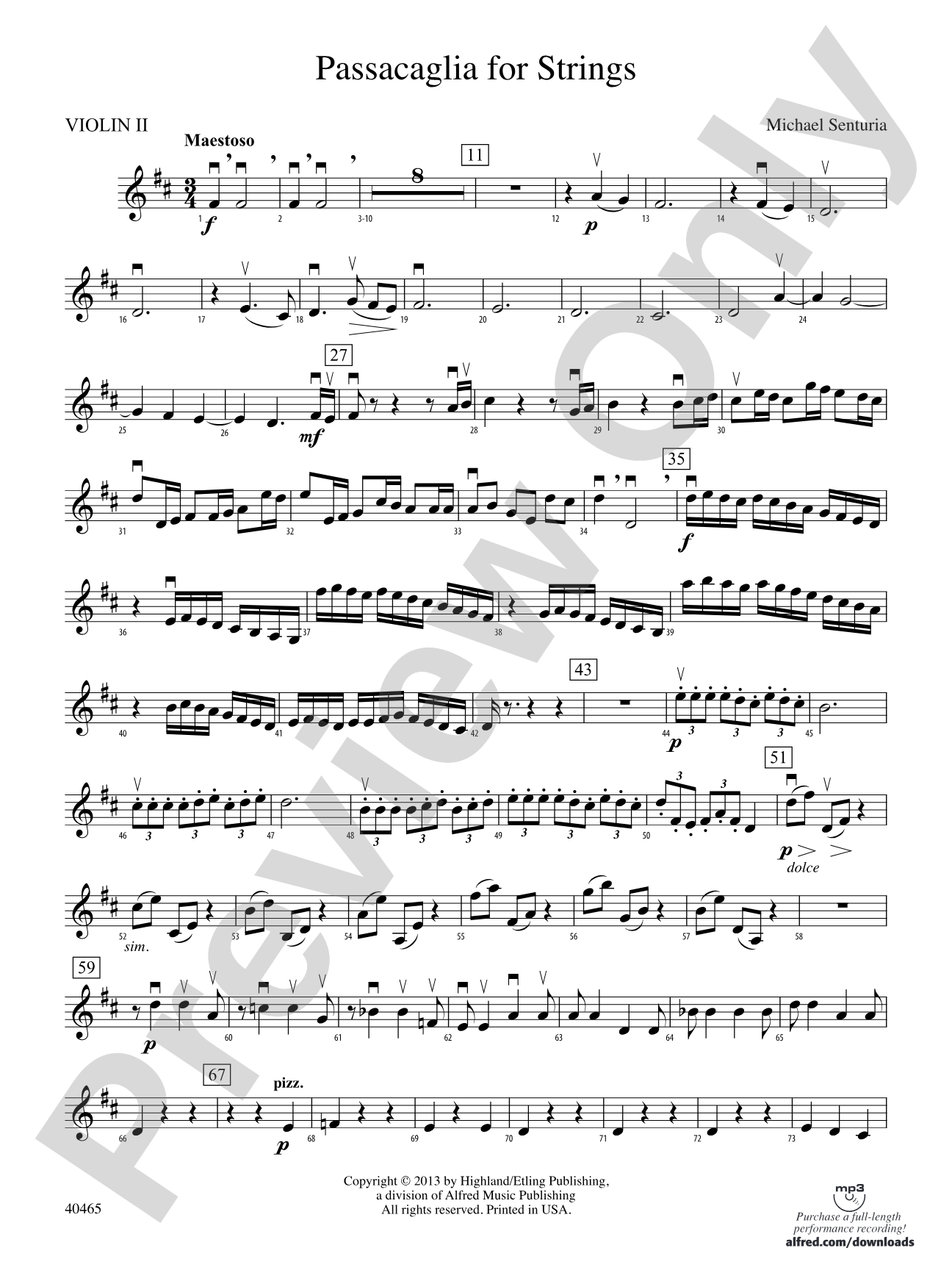
Passacaglia for Strings: 2nd Violin

By Michael Senturia

Grade: 3

Item: 00-PC-0015997_VN2

Digital Download
$5.99
Description
Here is an ideal way to introduce young string players to simple, yet endlessly fascinating Baroque variation technique. Above a stately bass line appears a series of contrasting textures, each requiring a different bowing technique. And at the end, there is a quick romp, itself also a variation!

Don't just read it, hear it, play along with it, and watch your students grow with it. In MakeMusic Cloud, Passacaglia for Strings: 2nd Violin comes alive with professional accompaniment, adjustable tempo, and built-in practice tools that turn solo practice into real progress.

Sample Audio
0:00
0:00
Sample Video
Additional Details
Series: Highland/Etling String Orchestra
Publisher: Alfred Music
Page Count: 124
SKU: 00-PC-0015997_VN2

More about this title

About the Composer: Michael Senturia

Michael Senturia has built a reputation for crafting accessible yet musically substantial works for young ensembles. His compositions respect student musicians as serious musicians while keeping technical demands reasonable, allowing players to focus on musical expression rather than survival.

Why we love this

Senturia has crafted a pedagogically brilliant entry point into Baroque form. Young orchestras get to experience the architecture of variation technique firsthand—each new variation teaches a specific bowing demand without overwhelming the ensemble, and the finale's energetic romp reminds students that Baroque music can genuinely swing.

What to expect

Stately and architectural. The ground bass anchors the listener while successive variations unfold like a series of elegant transformations, each one shifting the texture without abandoning the foundational pulse. The final variation breaks into genuine playfulness, revealing the joy beneath the formal structure.

Who it's for

String orchestras at the Grade 3 level who are ready to move beyond simple note-reading into formal structure and technique variety. This works equally well for conductors introducing variation form or for ensembles preparing concert and festival repertoire that demands precision across multiple bowing styles.

How to get the most out of it

  • Establish the ground bass as the rhythmic foundation in your first rehearsals. Have cellists and basses count through it silently while other sections rest, then layer in upper voices one at a time.
  • Mark the bowing changes clearly in each part. Since contrasting textures define the variations, consistent bow direction across stands ensures the textural shifts land as Senturia intended.
  • Let the quick finale breathe slightly before it begins. A clear breath or eye contact cue will help the ensemble lock onto the faster tempo without rushing.

How to use it

Pair this with other pedagogical Baroque or Baroque-inspired works to build a thematic concert section on form and variation. It also serves as an excellent transition piece in a festival program, offering something substantial enough to showcase growth while remaining approachable for younger ensembles.

Skills your students will build

  • Recognizing and playing variation technique over a fixed ground bass
  • Executing multiple bowing styles within a single piece (required for each textural variation)
  • Maintaining rhythmic precision in a section while listening to the overall harmonic structure
  • Understanding Baroque formal architecture through performance

You May Also Like