Passacaglia Sheet Music Preview

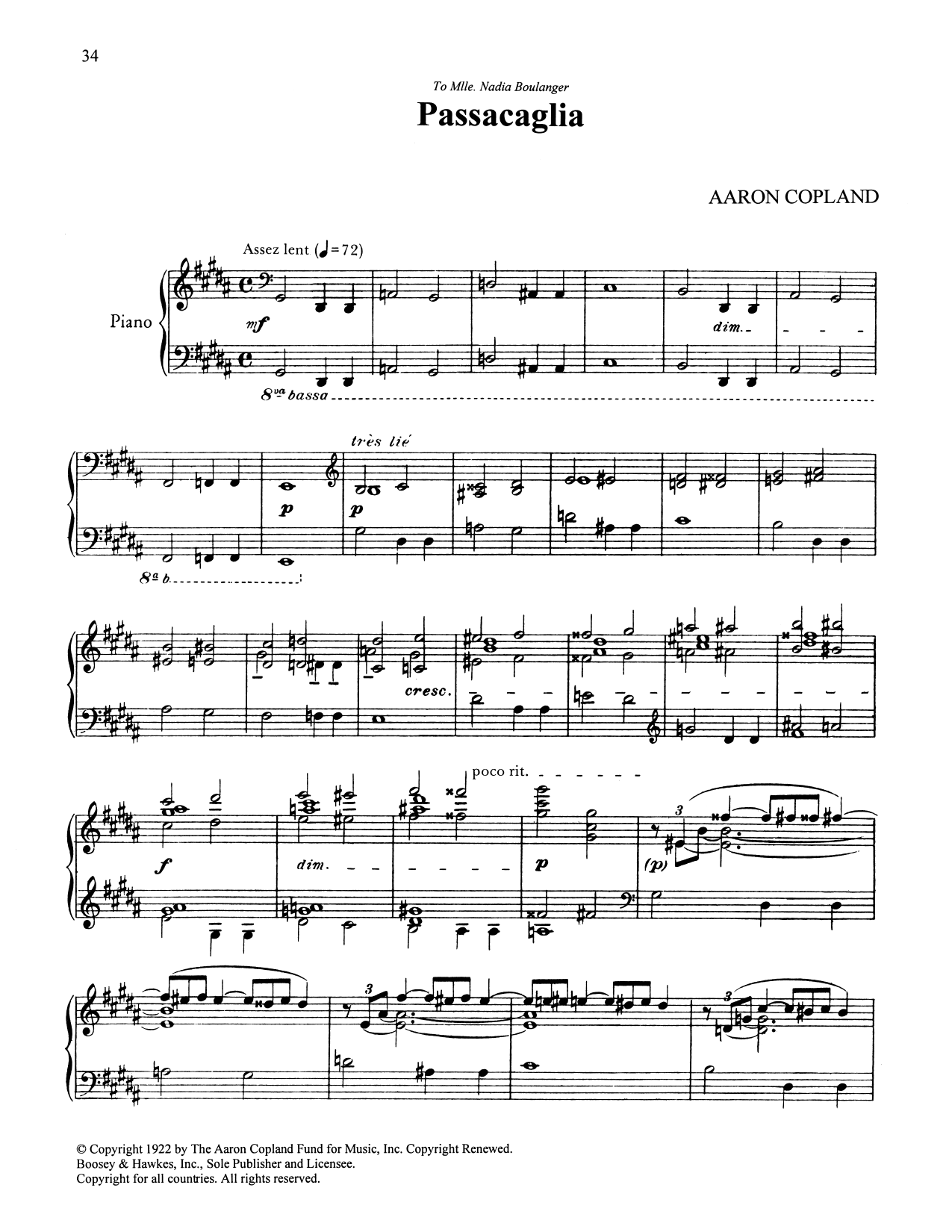
Passacaglia: Piano Solo

By Aaron Copland

Item: 35-DS01979708

Digital Download
$5.99
One moment…
Description

Discover MakeMusic Cloud: thousands of interactive titles your students can play along with today.

Sample Audio
No sample audio found.
Sample Video
Additional Details
Publisher: Hal Leonard
Page Count: 7
SKU: 35-DS01979708

More about this title

About the Composer: Aaron Copland

Aaron Copland (1900-1990) shaped the sound of American concert music by drawing on folk idioms, hymn tunes, and open harmonies that spoke to broad audiences. Beyond his famous ballets and symphonic works, Copland wrote extensively for solo piano, creating pieces that explore both the instrument's percussive and lyrical possibilities while remaining deeply rooted in American musical language.

As a composer and educator, Copland championed new music and mentored generations of young composers. His piano works demand technical facility and interpretive maturity from performers, rewarding careful study with music that feels both intellectually rigorous and emotionally direct.

Why we love this

Copland's command of variation technique shines here; the passacaglia form lets him build momentum through harmonic and textural transformations while maintaining structural clarity. Advanced pianists will find a work that sits perfectly at the intersection of technical challenge and genuine musical substance, with none of the showiness that can plague solo piano writing.

What to expect

The piece unfolds with architectural logic tempered by a distinctly American sensibility. You move through shifting moods and textures while an underlying pulse grounds everything, creating a sense of forward motion that feels purposeful rather than urgent.

Who it's for

Accomplished pianists with solid technique and interpretive experience will find genuine reward in this work. Teachers seeking repertoire that develops both structural understanding and expressive control will appreciate how the passacaglia form offers built-in pedagogical clarity.

How to get the most out of it

  • Map out the bass line before learning the full texture. The ground bass is your structural anchor; knowing exactly where you are in that pattern makes the overlaid variations cohere.
  • Shape each variation as if it were a separate voice entering a conversation. Resist the urge to accelerate or rush; the momentum comes from clarity and character, not tempo.
  • Listen carefully to balance between the hands, particularly in sections where both maintain independent rhythmic material. Neither hand should dominate the acoustic landscape.
  • Practice the full seven pages in sections, then concatenate them only when each segment feels inevitable. Stamina matters here; building endurance without fatigue prevents interpretive collapse at climactic moments.

How to use it

This seven-page solo works as a substantial recital centerpiece for students preparing for competitions or upper-level jury performances. It pairs naturally with other twentieth-century American piano works in a program exploring how composers of that era reinvigorated traditional forms.

Skills your students will build

  • Understanding passacaglia form and the technique of variation over a repeating bass
  • Voice independence when both hands carry significant material simultaneously
  • Long-line phrasing across harmonic cycles rather than measure-by-measure thinking
  • Pedal control for color and resonance without losing clarity
  • Stamina and consistency required for an extended solo work

You May Also Like