
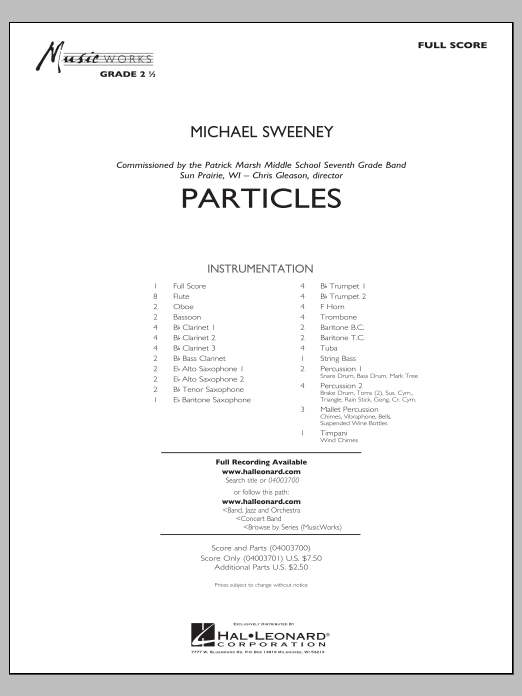

Particles: Concert Band Conductor Score & Parts
By Michael Sweeney
Grade: 2.5
Item: 35-PK00292817
$55.00
Pickup currently not available
Buy Extra Parts (Digital PDF Download)
| Product | Price | Quantity |
|---|---|---|
| Particles - Full Score | $7.50 | |
| Particles - Flute | $6.00 | |
| Particles - Oboe | $6.00 | |
| Particles - Bassoon | $6.00 | |
| Particles - Bb Clarinet 1 | $6.00 | |
| Particles - Bb Clarinet 2 | $6.00 | |
| Particles - Bb Clarinet 3 | $6.00 | |
| Particles - Bb Bass Clarinet | $6.00 | |
| Particles - Eb Alto Saxophone 1 | $6.00 | |
| Particles - Eb Alto Saxophone 2 | $6.00 | |
| Particles - Bb Tenor Saxophone | $6.00 | |
| Particles - Eb Baritone Saxophone | $6.00 | |
| Particles - Bb Trumpet 1 | $6.00 | |
| Particles - Bb Trumpet 2 | $6.00 | |
| Particles - F Horn | $6.00 | |
| Particles - Trombone | $6.00 | |
| Particles - Baritone B.C. | $6.00 | |
| Particles - Baritone T.C. | $6.00 | |
| Particles - Tuba | $6.00 | |
| Particles - String Bass | $6.00 | |
| Particles - Percussion 1 | $6.00 | |
| Particles - Percussion 2 | $6.00 | |
| Particles - Mallet Percussion | $6.00 | |
| Particles - Timpani | $6.00 |
Parts Added to Cart!
Description
This unusual work portrays the transformation of matter from solid to liquid and ultimately to gas. You'll hear a single musical theme transformed throughout, starting with a very rigid and dense opening statement. From there the theme is treated in a lyrical style (liquid), and finally the pace becomes frantic and energetic as the melodic particles transform into gas. Using unique scoring techniques (including a few aleatoric sections and dramatic percussion effects) this descriptive work will stir the imagination of players and audience alike. Dur: 5:30


Particles: Concert Band Conductor Score & Parts isn't in MakeMusic Cloud just yet...but it could be. Let us know you'd like to see it, and you'll help shape what comes next. In the meantime, start a free trial and dive into thousands of interactive titles your students can play along with today.
Request This Title
Tell us you want it.
Start Your Free Trial
Explore everything that's ready to play right now.
Sample Audio
No sample audio found.
Sample Video
No sample videos found.
Additional Details
Publisher:
Hal Leonard
SKU:
35-PK00292817
More about this title
About the Composer: Michael Sweeney
Michael Sweeney has established himself as one of the most prolific and accessible composers for concert band. His works span from educational pieces to sophisticated concert compositions, all characterized by clarity of orchestration and genuine musicality. Sweeney's approach to writing for young ensembles combines technical sophistication with immediate approachability, making his scores both rewarding to teach and engaging for audiences.
Why we love this
Sweeney uses a single musical theme as the anchor for an entire journey, giving players the satisfaction of recognizing and re-encountering familiar material while experiencing it in radically different contexts. The aleatoric sections invite genuine interpretive choices from your ensemble without requiring extended techniques, and the percussion writing delivers theatrical impact without overshadowing the band.
What to expect
The piece unfolds like watching matter shift before your eyes. The heavy, locked opening feels almost claustrophobic in its density, gradually loosening into lyrical passages where the theme floats freely. By the final section, everything accelerates into barely controlled chaos, with individual instrumental lines ricocheting off each other in a kinetic celebration of transformation.
Who it's for
Concert bands at the intermediate level seeking repertoire that demonstrates compositional craft without requiring advanced instrumental technique. This work suits ensembles that have solid fundamentals in place and are ready to tackle expressive interpretation and rhythmic independence.
How to get the most out of it
- Shape the opening rigid theme with deliberate articulation and precise rhythmic spacing; think of each note as a solid block rather than a flowing phrase.
- Allow the liquid section to breathe with natural rubato during rehearsals, then gradually settle into a more consistent pulse as ensemble confidence grows.
- In the aleatoric passages, establish clear visual cues with the ensemble beforehand so players understand when to enter and exit without relying solely on written beats.
- Balance the percussion effects so they punctuate rather than overwhelm; these moments should feel like matter crackling apart, not a rhythm section running away.
How to use it
Pair this with other descriptive or program music to build a concert theme around nature, physics, or transformation. Its five-and-a-half minute length makes it ideal filler between larger works, yet it carries enough substance to stand as a meaningful program element on its own.
Skills your students will build
- Recognizing and interpreting a theme across multiple harmonic and textural contexts
- Balancing articulation and phrasing when the same melodic material shifts stylistically
- Navigating aleatoric notation and managing ensemble independence within structured frameworks
- Responding to complex percussion effects and special techniques without losing overall form
- Maintaining rhythmic precision in contrapuntal writing (gas section)