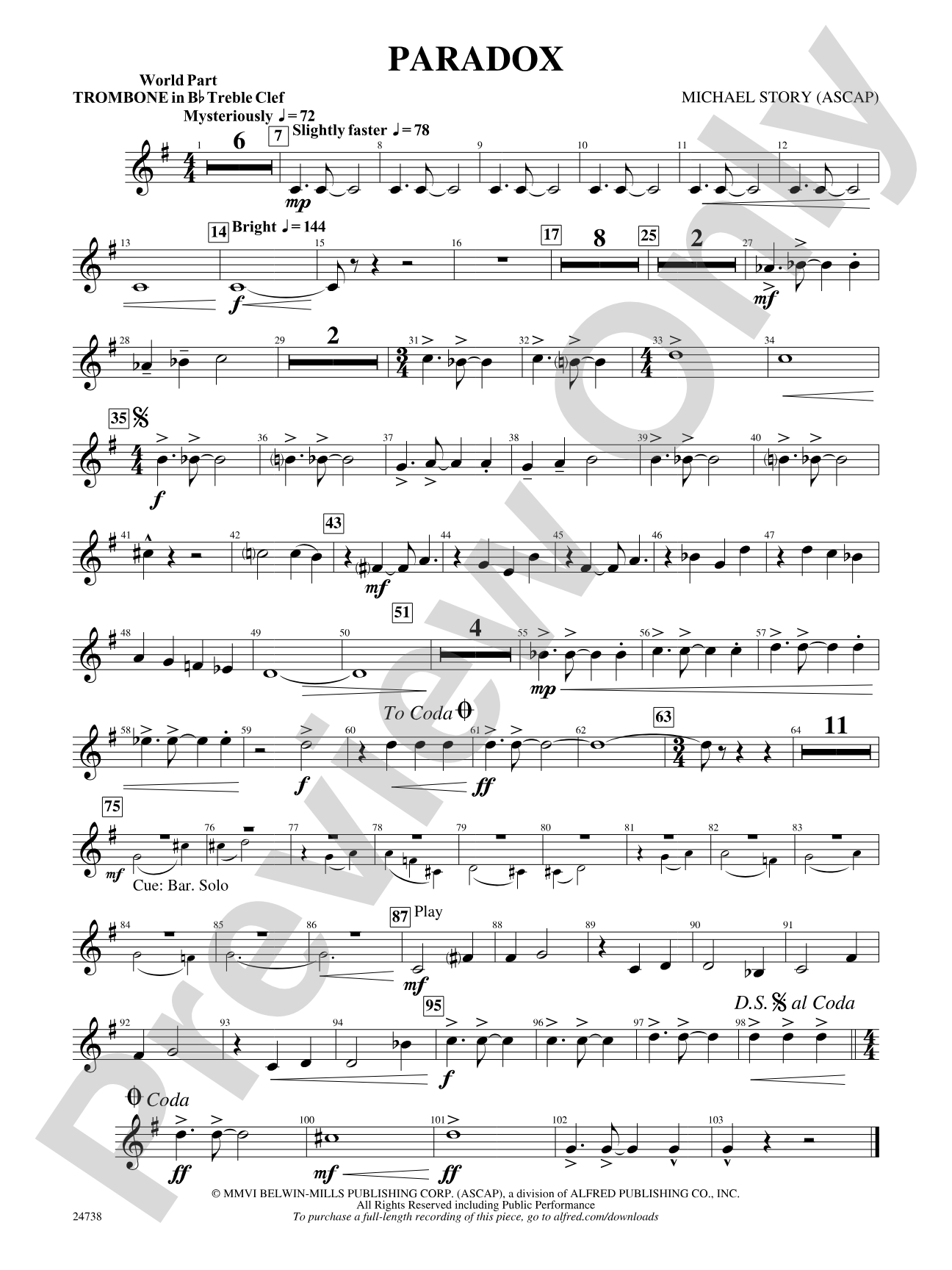
Paradox: (wp) 1st B-flat Trombone T.C. Sheet Music Preview

Paradox: (wp) 1st B-flat Trombone T.C.

By Michael Story

Grade: 2 (Easy)

Item: 00-PC-0000889_wpTN1TC

Digital Download
$3.00
Description
"Paradox" derives its name primarily as a reference to the Tritone Paradox. When pairs of electronically synthesized pitches a half-octave, or tritone apart were played consecutively, some listeners hear an ascending pattern while others hear a descending one. Paradox explores the interval of the tritone, both melodically and harmonically. Created by Michael Story, this contemporary musical puzzle will be well received by performers and audiences alike. This title is available in MakeMusic Cloud.

Don't just read it, hear it, play along with it, and watch your students grow with it. In MakeMusic Cloud, Paradox: (wp) 1st B-flat Trombone T.C. comes alive with professional accompaniment, adjustable tempo, and built-in practice tools that turn solo practice into real progress.

Sample Audio
0:00
0:00
Sample Video
Additional Details
Series: Belwin Young Band
Publisher: Alfred Music
Page Count: 126
SKU: 00-PC-0000889_wpTN1TC

More about this title

About the Composer: Michael Story

Michael Story is a prolific composer and arranger whose work spans educational and professional concert settings. Known for his ability to craft engaging contemporary pieces that challenge young musicians while remaining accessible, Story has become a staple in young band and wind ensemble repertoires.

Why we love this

Story grounds this piece in genuine acoustic science rather than gimmickry, using the Tritone Paradox as a launching point for real compositional exploration. The Grade 2 writing stays transparent enough for developing sections to own their parts while the harmonic language keeps experienced bands engaged.

What to expect

Paradox unfolds like a musical riddle that keeps both performers and listeners slightly off balance in the best way. The tritone's unsettling quality creates an atmosphere of ambiguity and intrigue, with moments of clarity breaking through to keep the listener grounded.

Who it's for

Band directors working with developing ensembles who want to program something contemporary without sacrificing musical substance. Students at Grade 2 level gain exposure to extended harmony and perceptual concepts that deepen their listening skills.

How to get the most out of it

  • Balance the tritone intervals carefully so they register distinctly without overwhelming the ensemble; many students will hear them differently, which is exactly the point.
  • Mark your score liberally with the exact intervals Story uses so your brass and woodwind sections understand the harmonic architecture underneath their individual lines.
  • Bring out melodic statements that move across sections rather than treating them as fill; the piece's logic depends on hearing how the tritone shifts its perceived direction.

How to use it

Program this as a feature piece on a concert that explores contemporary approaches to familiar musical elements, or pair it with a contrasting programmatic work to highlight how different composers tackle storytelling through sound. It works equally well in a contest setting where the harmonic language and Grade 2 accessibility position it for strong results.

Skills your students will build

  • Recognizing and performing tritone intervals in both melodic and harmonic contexts
  • Listening critically to how the same interval can create different perceptual effects
  • Balancing independent ensemble lines to highlight harmonic relationships
  • Interpreting contemporary musical notation and concepts

You May Also Like