
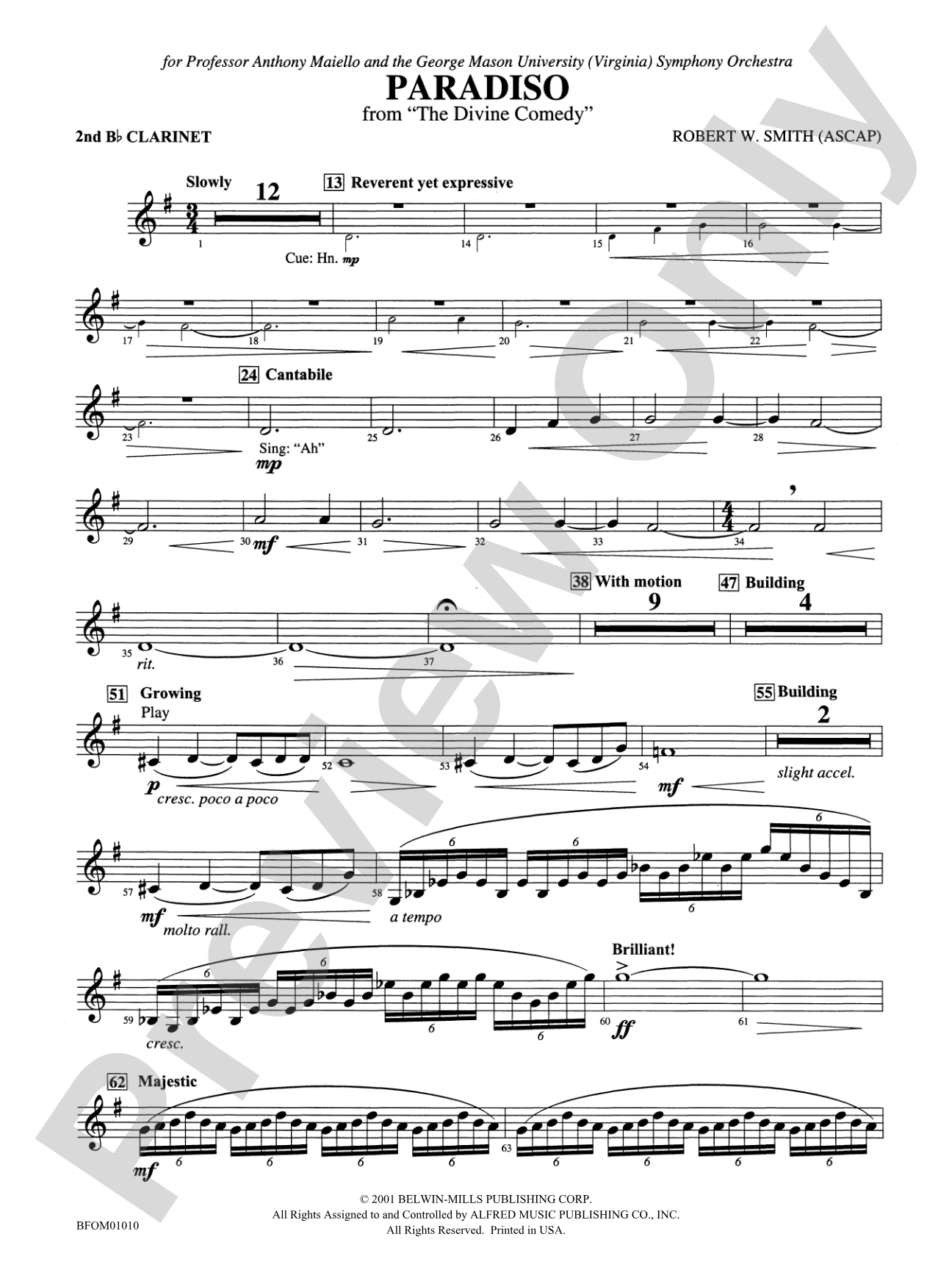

Paradiso (from The Divine Comedy): 2nd B-flat Clarinet
By Robert W. Smith
Grade: 3.5
Item: 00-PC-0014687_C2
$3.00
Pickup currently not available
Description
In each of the past two years, Robert W. Smith has released a movement from his symphony The Divine Comedy. Musicians, conductors, and audiences can now welcome Paradiso, the third movement from the Symphony. Ethereal percussion is the palette with which solo voices paint musical landscapes of what paradise must be. Hints of themes from the other movements emerge to tie together all of the musical elements of this powerful new work. Completely captivating!


Don't just read it, hear it, play along with it, and watch your students grow with it. In MakeMusic Cloud, Paradiso (from The Divine Comedy): 2nd B-flat Clarinet comes alive with professional accompaniment, adjustable tempo, and built-in practice tools that turn solo practice into real progress.
Open in the Player
Jump straight in and assign it today.
Start Your Free Trial
Open this title and explore the full library in minutes.
Sample Audio
1
Audio File
--:--
0:00
0:00
Sample Video
No sample videos found.
Additional Details
Series:
Belwin Concert Full Orchestra
Publisher:
Alfred Music
Page Count:
262
SKU:
00-PC-0014687_C2
More about this title
About the Composer: Robert W. Smith

Robert W. Smith stands among America's most frequently performed composers of orchestral and concert band music, with over 400 published works to his credit. He holds degrees from Troy State University (Alabama) and the University of Miami, and his original compositions have been championed by musicians and audiences across North America, Europe, Australia, and Asia. His symphonies (The Divine Comedy and The Odyssey) have become standard repertoire in professional and educational settings worldwide.
Beyond the concert hall, Smith's music has soundtracked major cultural moments, from presidential ceremonies in Japan to the Olympic Games, the Macy's Thanksgiving Day Parade, and opening day at Dodger Stadium. As a conductor and clinician, he has worked extensively throughout the United States, Canada, and internationally, bringing his compositional vision directly to ensembles and audiences.
Why we love this
This is the payoff moment of Smith's Divine Comedy symphony cycle. Conductors who have programmed the earlier movements now have the complete arc; audiences experience the journey from chaos to enlightenment. The orchestration is immaculate for Grade 3.5 ensembles, with ethereal percussion writing that elevates even developing orchestras and creates an unmistakable sense of arrival and transcendence.
What to expect
Luminous and serene, with an almost visionary quality that unfolds gradually. The ethereal percussion palette creates an otherworldly soundscape while solo voices emerge from the texture like glimpses of something transcendent. There's a contemplative beauty here, reinforced by thematic echoes that remind you of the journey that led to this moment.
Who it's for
Intermediate to advancing full orchestras (Grade 3.5) seeking substantial concert material with genuine artistic depth. This works beautifully for groups with a solid string section and developing woodwind and percussion players who can handle sustained, exposed writing.
How to get the most out of it
- Balance the solo voices against the ethereal percussion foundation. Ensure your principals can sing through their lines without drowning the delicate cymbal and bell textures that create the work's dreamlike quality.
- Study the thematic references to the earlier movements in the score. When you identify these callbacks, mark them clearly in the parts so players understand they're reinforcing the larger symphonic narrative.
- Let the slower passages breathe. Resist the urge to push tempo when the texture thins; the work's power comes from its restraint and spaciousness.
- Shape the dynamic contours with precision. At this grade level, young musicians sometimes lock into one dynamic for an entire phrase. Marking micro-crescendos and diminuendos in the strings will add sophistication to the sound.
How to use it
This is ideal as the centerpiece of a concert exploring Smith's Divine Comedy cycle; pair it with the first and second movements for a complete symphonic experience. Alternatively, use it as an emotional climax to a program that opens with lighter concert fare. Its contest and festival designation makes it compelling for spring competitions, where judges recognize the sophistication of the orchestration and the composer's mastery of form.
Skills your students will build
- Balancing soloistic writing with ensemble texture
- Sustaining long melodic lines with consistent tone quality
- Responding to subtle dynamic and tempo nuance
- Connecting thematic material across large formal structures
- Executing exposed percussion writing with precision and sensitivity