
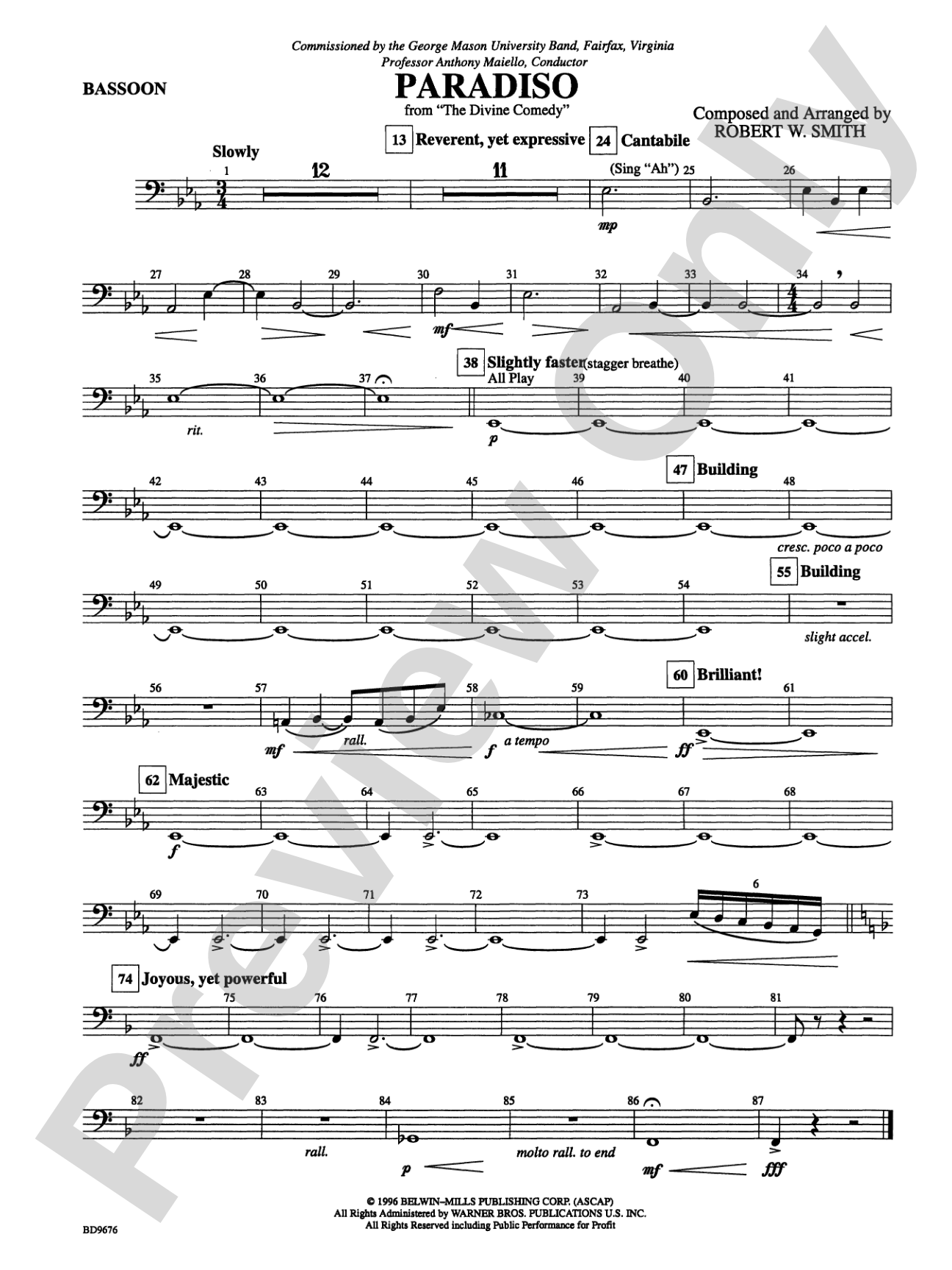

Paradiso: Bassoon
From The Divine Comedy
By Robert W. Smith
Grade: 4 (Medium)
Item: 00-PC-0002041_B1
$5.99
Pickup currently not available
Description
In each of the past two years, Robert W. Smith has released a movement from his symphony The Divine Comedy. Musicians, conductors and audiences can now welcome Paradiso, the fourth and final movement from the symphony. Ethereal percussion is the palate with which solo voices paint musical landscapes of what paradise must be. Hints of themes from the other movements emerge to tie together all of the musical elements of this powerful new work. Completely captivating! (4:45) [The two movements already available are The Inferno (BD9563) and The Ascension (BD01085)].


Discover MakeMusic Cloud: thousands of interactive titles your students can play along with today.
Sample Audio
1
Audio File
--:--
0:00
0:00
Sample Video
Additional Details
Series:
Belwin Classic Band
Publisher:
Alfred Music
Page Count:
214
SKU:
00-PC-0002041_B1
More about this title
About the Composer: Robert W. Smith

Robert W. Smith stands among the most frequently performed composers in the American concert band and orchestral repertoire, with over 400 published works spanning multiple genres and ensemble types. His education at Troy State University (AL) and the University of Miami (FL) established the foundation for a career that has taken him across six continents as both composer and clinician, conducting performances from Japan to the United Kingdom.
Smith's symphonic works, particularly The Divine Comedy and The Odyssey, have secured international recognition and regular performance worldwide. His compositions have appeared on major television broadcasts, from the Macy's Thanksgiving Day Parade to Olympic ceremonies, and his music for developing ensembles (including The Tempest) remains a cornerstone of standard band repertoire.
Why we love this
Paradiso completes a sophisticated four-movement narrative arc that few composers attempt for concert band, and Smith executes it with both musical ambition and practical accessibility at Grade 4. The orchestration strategy here is particularly elegant: rather than relying on dense harmonic textures, he uses ethereal percussion and solo voices to create the piece's emotional landscape, allowing even developing players to participate meaningfully in something genuinely profound.
What to expect
Paradiso inhabits a space of luminous contemplation, where delicate percussion textures float above sustained harmonic foundations like light filtering through stained glass. The movement's reflective character invites listeners into a sonic representation of transcendence, built from restraint and subtlety rather than bombast.
Who it's for
Conductors building toward or completing performance of The Divine Comedy symphony will find this movement essential, while those encountering Smith's work for the first time will appreciate how gracefully it balances technical accessibility with artistic depth. Grade 4 ensembles with strong fundamentals in balance and tonal control will thrive with this material.
How to get the most out of it
- Balance the ethereal percussion writing carefully; these colors define the movement's identity, so they should register clearly without overwhelming the soloists and ensemble voices.
- Approach the thematic references to earlier movements as musical echoes rather than literal quotations. The connections should feel inevitable and understated, not heavy-handed.
- Shape the pacing through dynamics and texture rather than tempo changes. The sustained quality of Paradiso requires careful attention to phrase breathing and line continuity.
How to use it
If you have programmed The Inferno or The Ascension in previous years, Paradiso provides the satisfying culmination that audiences and musicians alike will anticipate. For a single-movement concert performance, this work sits effectively as a closing or near-closing piece, offering both musical weight and a contemplative resolution that allows audiences to leave the hall thoughtfully.
Skills your students will build
- Balancing and blending ethereal percussion textures with sustained ensemble voices
- Executing musically sophisticated phrasing at lyrical, moderate tempos
- Following thematic continuity and development across a large-scale symphonic movement
- Responding to subtle dynamic and textural shifts as primary structural markers
- Coordinating ensemble sound with featured solo voices across the band