
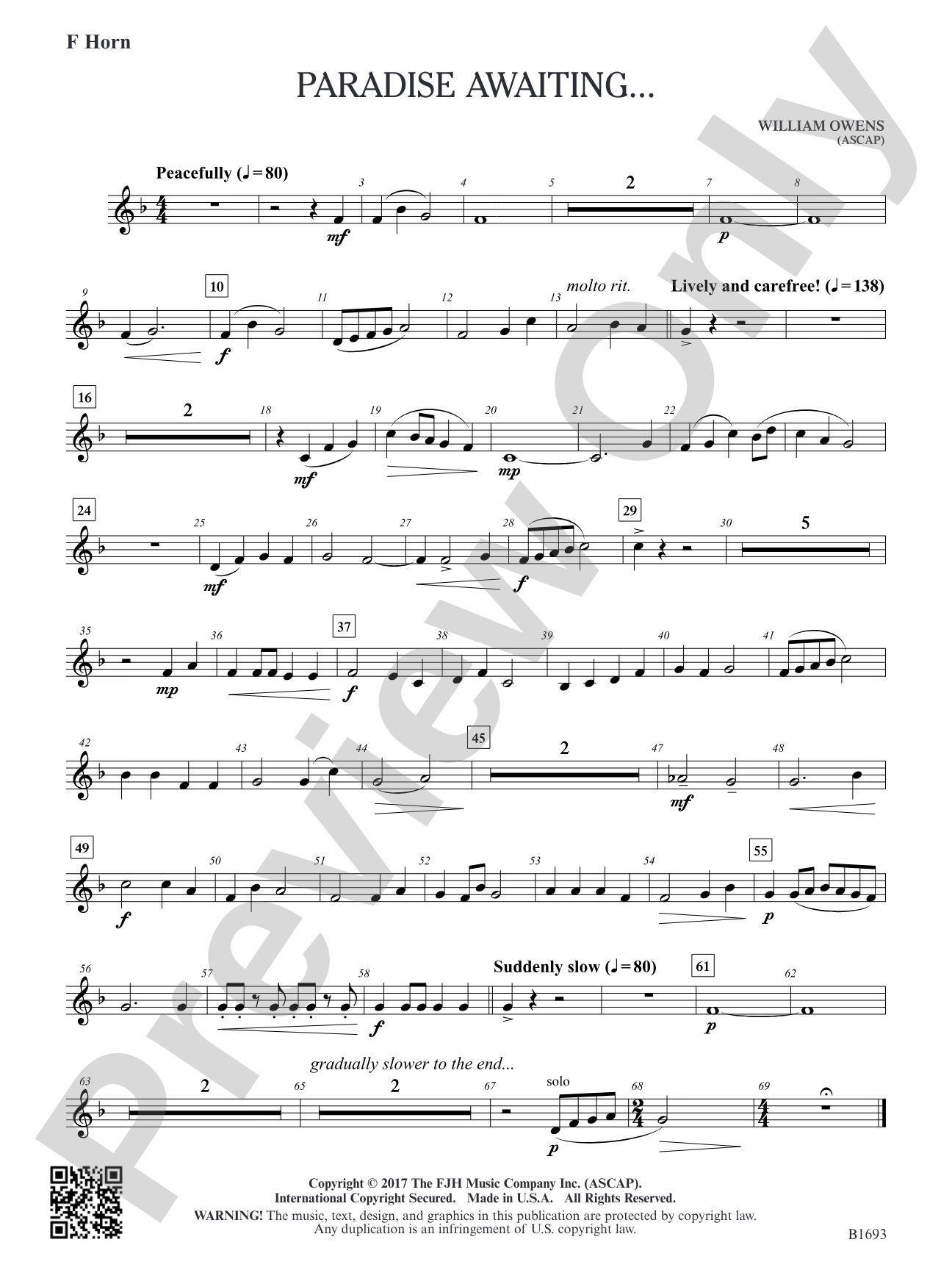

Paradise Awaiting...: F Horn
By William Owens
Grade: 2
Item: 98-PC-DB1693_H1
$7.00
Pickup currently not available
Description
This reflective work about loss also includes great moments of spirit and joy. A gentle opening gives way to the upbeat and energetic melody that playfully passes throughout the ensemble in variations. Eventually the music abruptly settles into a sense of calm as it ends with a single, delicate note that fades to silence.


Paradise Awaiting...: F Horn isn't in MakeMusic Cloud just yet...but it could be. Let us know you'd like to see it, and you'll help shape what comes next. In the meantime, start a free trial and dive into thousands of interactive titles your students can play along with today.
Request This Title
Tell us you want it.
Start Your Free Trial
Explore everything that's ready to play right now.
Sample Audio
1
Audio File
--:--
0:00
0:00
Sample Video
Additional Details
Series:
FJH Young Band
Publisher:
The FJH Music Company, Inc.
SKU:
98-PC-DB1693_H1
More about this title
About the Composer: William Owens

William Owens has shaped the young band repertoire as both educator and composer. A VanderCook College of Music graduate, he spent 30 years directing bands in Texas before turning his full attention to composition. His catalog now exceeds 300 works for concert band, string orchestra, and chamber ensembles, many of which have become standard repertoire across North America.
Owens brings a clinician's ear to his writing: every piece solves a practical problem in the rehearsal room while remaining musically substantive. His work has earned recognition from the American Bandmasters Association, ASCAP, and his alma mater as a Distinguished Alumnus. He resides in Fort Worth with his wife Georgia.
Why we love this
Owens captures the full emotional arc of processing grief and finding renewal within a Grade 2 framework that never feels simplistic. The piece moves with real sophistication through contrasting moods while keeping technical demands accessible, making it equally rewarding for developing ensembles and experienced ones. Directors will appreciate that the thematic variations give every section meaningful material rather than relegating parts to accompaniment.
What to expect
The piece unfolds like a private reflection interrupted by moments of unexpected lightness. Its gentle opening draws listeners inward before the ensemble brightens with passing melodies that feel almost playful; there is tenderness mixed with resilience. The eventual return to calm and that final solitary note create an intimate conclusion that lingers.
Who it's for
Grade 2 concert bands ready to explore emotional depth without sacrificing accessibility. This works equally well for developing ensembles building musicality and for accomplished groups seeking repertoire that demonstrates maturity of expression. Directors seeking contest and festival material that stands apart from standard Grade 2 fare will find a vehicle that can genuinely move an audience.
How to get the most out of it
- Shape the opening dynamically despite its gentleness; let the first statement breathe so the eventual upbeat melody feels like a genuine shift rather than a return to expected territory.
- Track how the playful melody passes through the ensemble and ensure each section claims ownership of its variation. Clarity and secure articulation matter more than loudness.
- Prepare students for the sudden transition to calm by rehearsing the harmonic shift independently; this dramatic moment requires confidence rather than hesitation.
- Guard against rushing the final fading note. The single delicate note demands absolute focus and control from whoever holds it, and silence afterward is part of the piece.
How to use it
Program this alongside music from your ensemble's contest set to show breadth of emotional range in a concert. It pairs naturally with other reflective works or can anchor the second half of a program as a turning point from celebratory opening selections. The Grade 2 level makes it accessible for festival competition while its musical substance earns respect from adjudicators and discerning audiences alike.
Skills your students will build
- Phrasing and dynamic shape in lyrical writing
- Passing thematic material cleanly between sections
- Responding to sudden harmonic and tempo changes
- Sustaining focus and control during soft, sustained passages
- Ensemble balance and blend in varied textures