
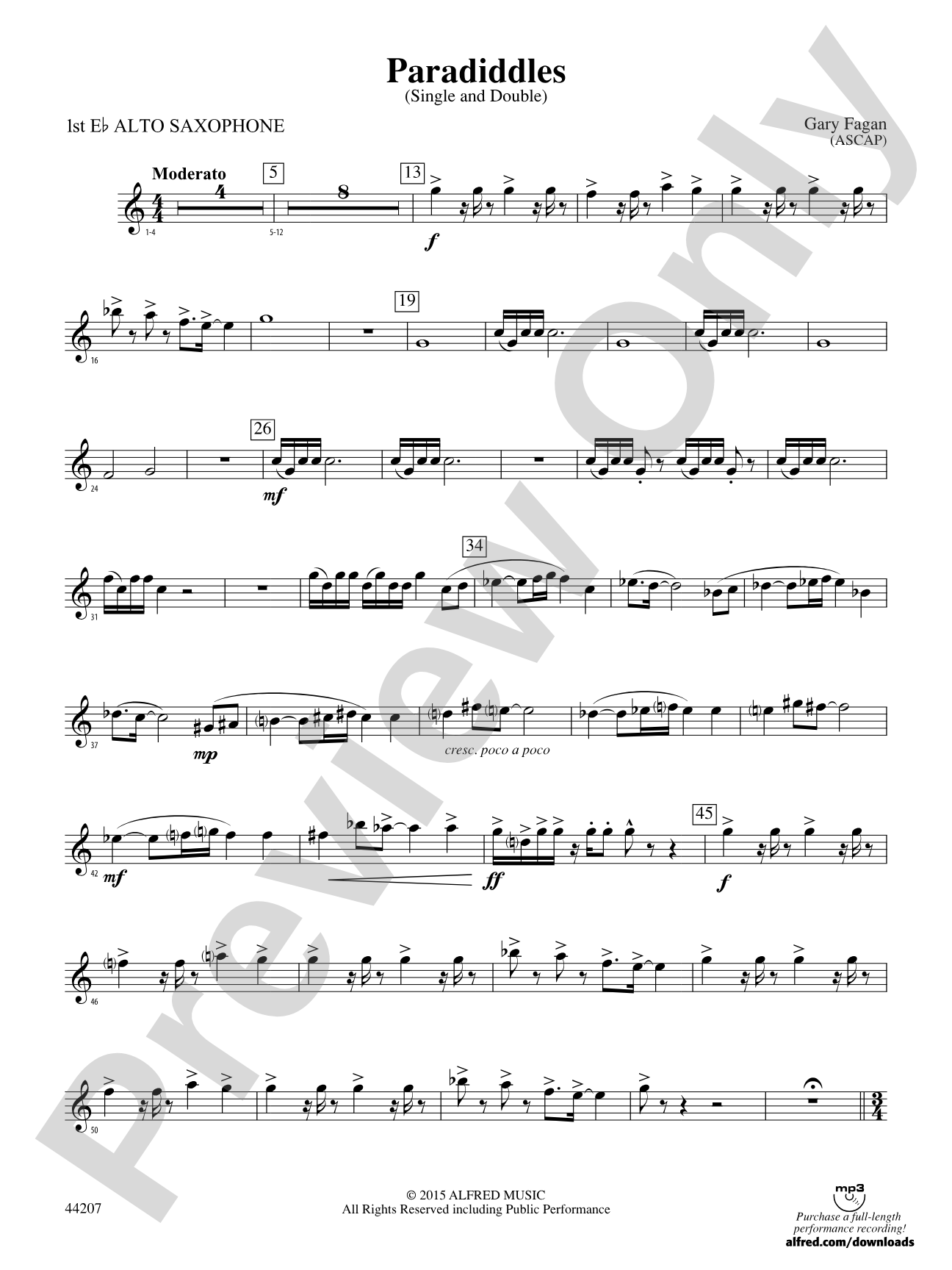

Paradiddles: E-flat Alto Saxophone
By Gary Fagan
Grade: 3.5 (Medium)
Item: 00-PC-0017056_AX1
$5.99
Pickup currently not available
Description
Percussionists must learn both the rudiments and the scales. This piece provides the wind players some exposure to the rudiments. "Paradiddles" creates patterns played by the winds that mimic two types of paradiddles---the single paradiddle and the double paradiddle. This may be the first piece for concert band inspired by, and based on, percussion rudiments. (5:50)


Don't just read it, hear it, play along with it, and watch your students grow with it. In MakeMusic Cloud, Paradiddles: E-flat Alto Saxophone comes alive with professional accompaniment, adjustable tempo, and built-in practice tools that turn solo practice into real progress.
Open in the Player
Jump straight in and assign it today.
Start Your Free Trial
Open this title and explore the full library in minutes.
Sample Audio
1
Audio File
--:--
0:00
0:00
Sample Video
No sample videos found.
Additional Details
Series:
Alfred Concert Band
Publisher:
Alfred Music
Page Count:
256
SKU:
00-PC-0017056_AX1
More about this title
About the Composer: Gary Fagan

Gary Fagan brings decades of practical band directing experience to his compositional work. A Maryland native, he earned his undergraduate degree in Music Education from Bridgewater College and his master's degree from James Madison University. After 36 years leading the band program in Albemarle County, he transitioned to university supervision at JMU while maintaining an active role as an adjunct instructor in arranging.
Fagan's contributions to music education have earned recognition across Virginia, including the Central Virginia Outstanding Middle School Teacher Award from the University of Virginia Chapter of Phi Delta Kappa, Outstanding Educator honors from both the Virginia Governor's School for the Visual and Performing Arts and the Piedmont Council of the Arts, and two listings in "Who's Who Among America's Teachers." His works have reached audiences internationally, performed at venues including the Midwest Band and Orchestra Clinic, the White House, and state inaugurations. He serves as Assistant Director and percussionist with the Charlottesville Band, remains active as a clinician and adjudicator, and holds membership in ASCAP, Phi Beta Mu Bandmasters Fraternity, and the National Band Association.
Why we love this
This piece accomplishes something genuinely original: it brings percussion rudiment concepts directly into the concert band idiom by having the winds play figures that embody single and double paradiddle patterns. Rather than relegating rudiment study to the percussion section alone, Fagan creates a shared musical and technical experience that deepens rhythmic literacy across the ensemble. The result is engaging, musically coherent, and pedagogically valuable without feeling like a lesson.
What to expect
Athletic and inventive, with the energy of a well-executed drill given harmonic substance. The paradiddle patterns create propulsive rhythmic momentum while the concert band scoring ensures the piece feels complete and performance-worthy, not like an extended exercise.
Who it's for
Directors seeking repertoire that builds rhythmic sophistication while introducing ensemble players to percussion concepts in a musical context. This works equally well for bands looking to strengthen their technical foundation or those wanting to bridge the gap between percussion and wind pedagogy.
How to get the most out of it
- Treat the paradiddle patterns as melodic ideas rather than pure technical display. These figures should sing through the band with the same musical intention you'd bring to any lyrical passage.
- Work the winds through the specific sticking patterns separately before combining parts. This reinforces how the paradiddle logic generates the harmonic and melodic content.
- Balance the parts carefully so that the rudiment-inspired figurations remain clear without the band sounding thin or overly mechanical.
How to use it
Slot this into a concert program where you want to showcase rhythmic precision and ensemble maturity without sacrificing musicality. It works particularly well on a program that includes other technically confident pieces, or as a vehicle to celebrate how far a developing ensemble has progressed in sight-reading and rhythmic control.
Skills your students will build
- Single and double paradiddle execution within a harmonic framework
- Recognition of sticking patterns across different instrumental voices
- Tight rhythmic ensemble playing with interlocking figures
- Connecting percussion rudiments to wind literature