
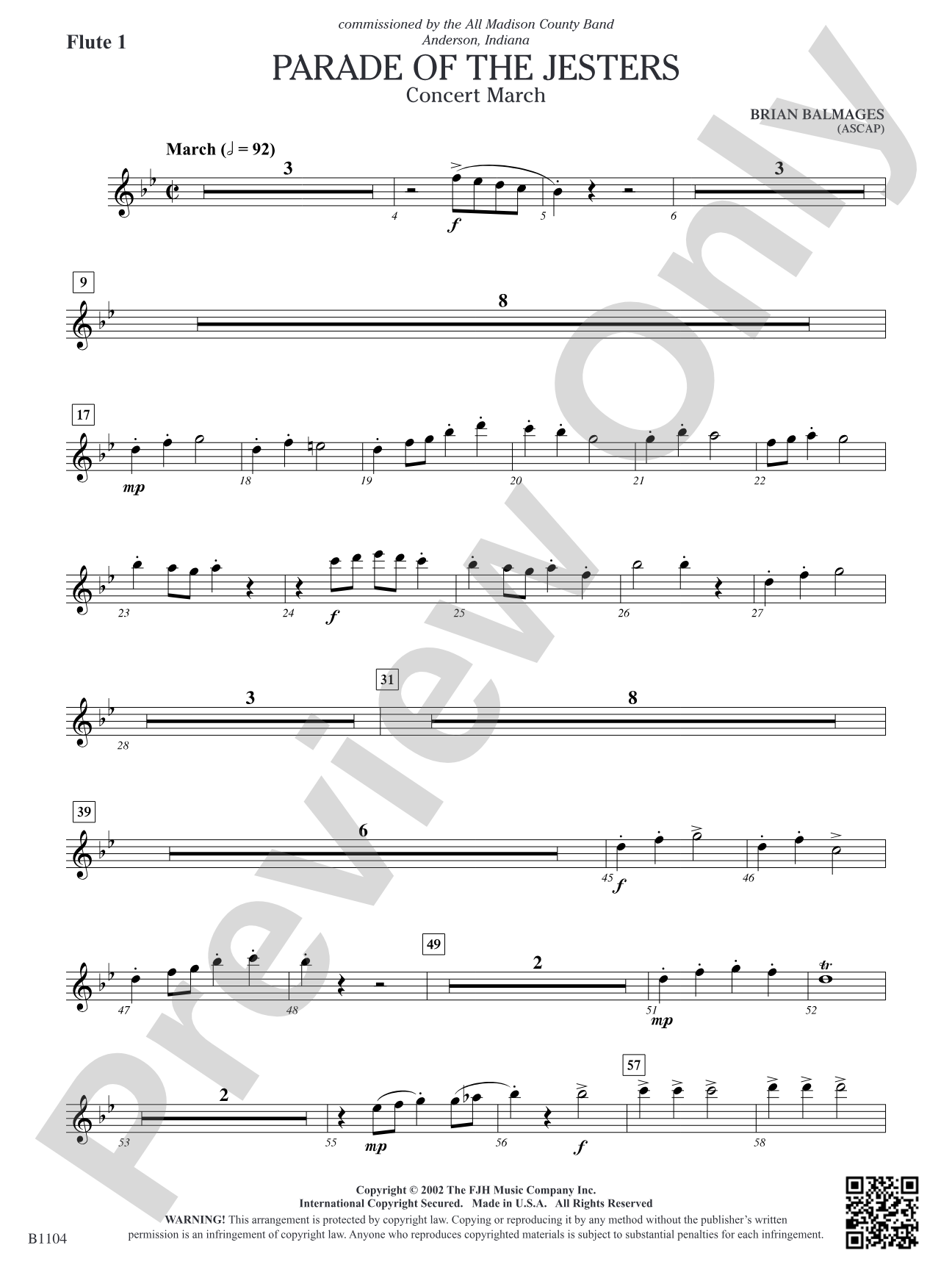

Parade of the Jesters: Flute 1
By Brian Balmages
Grade: 1.5
Item: 98-PC-DB1104_F1
$7.00
Pickup currently not available
Description
Perfect for getting away from the usual march sound without excluding one from your program, this creative work adds several interesting twists to the familiar formula. Written primarily in the lydian mode, the piece opens with a soft and playful dance-like melody. A strong trio and surprise ending compliment this exciting composition. An ideal festival work. (2:20)


Parade of the Jesters: Flute 1 isn't in MakeMusic Cloud just yet...but it could be. Let us know you'd like to see it, and you'll help shape what comes next. In the meantime, start a free trial and dive into thousands of interactive titles your students can play along with today.
Request This Title
Tell us you want it.
Start Your Free Trial
Explore everything that's ready to play right now.
Sample Audio
1
Audio File
--:--
0:00
0:00
Sample Video
No sample videos found.
Additional Details
Series:
FJH Developing Band
Publisher:
The FJH Music Company, Inc.
SKU:
98-PC-DB1104_F1
More about this title
About the Composer: Brian Balmages

Brian Balmages has built a career bridging orchestral, band, and chamber music with equal facility. His works have appeared in prestigious venues including Carnegie Hall, the Kennedy Center, and Sydney Opera House, performed by ensembles ranging from professional orchestras to elementary school groups. He holds membership in the American Bandmasters Association and received the A. Austin Harding Award from the American School Band Directors Association, along with the 2020 NBA William D. Revelli Composition Contest prize for Love and Light.
As a conductor, Balmages maintains active relationships with all-state ensembles, university groups, and professional orchestras worldwide, with guest appearances at major conferences including the Midwest Clinic and College Band Directors Conference. His music was performed during the 2013 Presidential Inaugural Prayer Service, and he has received commissions from institutions including the University of Miami for presidential inaugural festivities. Currently, he serves as Director of MakeMusic Publications and Digital Education for Alfred and MakeMusic.
Why we love this
Balmages strips away the ceremonial weight of the march tradition while keeping its accessibility, replacing the expected diatonic language with lydian color that sounds fresh without demanding advanced reading skills. The contrast between the gentle opening and the energetic trio gives you natural arc and programming flexibility, whether you're building toward a finale or offering a palate cleanser between heavier works.
What to expect
A carnival scene filtered through gentle humor. The lydian mode gives the melody an off-kilter but warmhearted quality, like watching performers in slightly mismatched costumes conducting an intentionally chaotic parade. Energy builds naturally through the trio before the surprise ending catches everyone off guard.
Who it's for
Beginning and early intermediate concert bands seeking a march alternative that doesn't sacrifice momentum or ensemble cohesion. Directors programming festival concerts or end-of-year performances where variety matters more than thematic weight.
How to get the most out of it
- Shape the opening melody as a character introduction, not a functional theme. The playfulness lives in the lightness of articulation and phrasing, not volume.
- Let the rhythm section breathe during the soft opening section rather than locking metronomically. The dance-like quality emerges from rhythmic flexibility.
- Bring the trio forward with confidence. The contrast between sections depends entirely on a marked dynamic shift and cleaner articulation in the faster material.
- Take time with the ending surprise. Your hesitation in rehearsal becomes the audience's delighted realization.
How to use it
Slot this between a lyrical ballad and a substantial finale to reset audience attention without losing momentum. At just over two minutes, it pairs well with a longer work on the same concert or stands alone as a festival selection that demonstrates both technical control and interpretive sensibility.
Skills your students will build
- Understanding and performing in non-traditional modes (lydian tonality)
- Balancing soft, articulate playing with character and intention
- Dynamic contrast and section independence
- Responding to surprises in form and maintaining precision through unexpected endings