
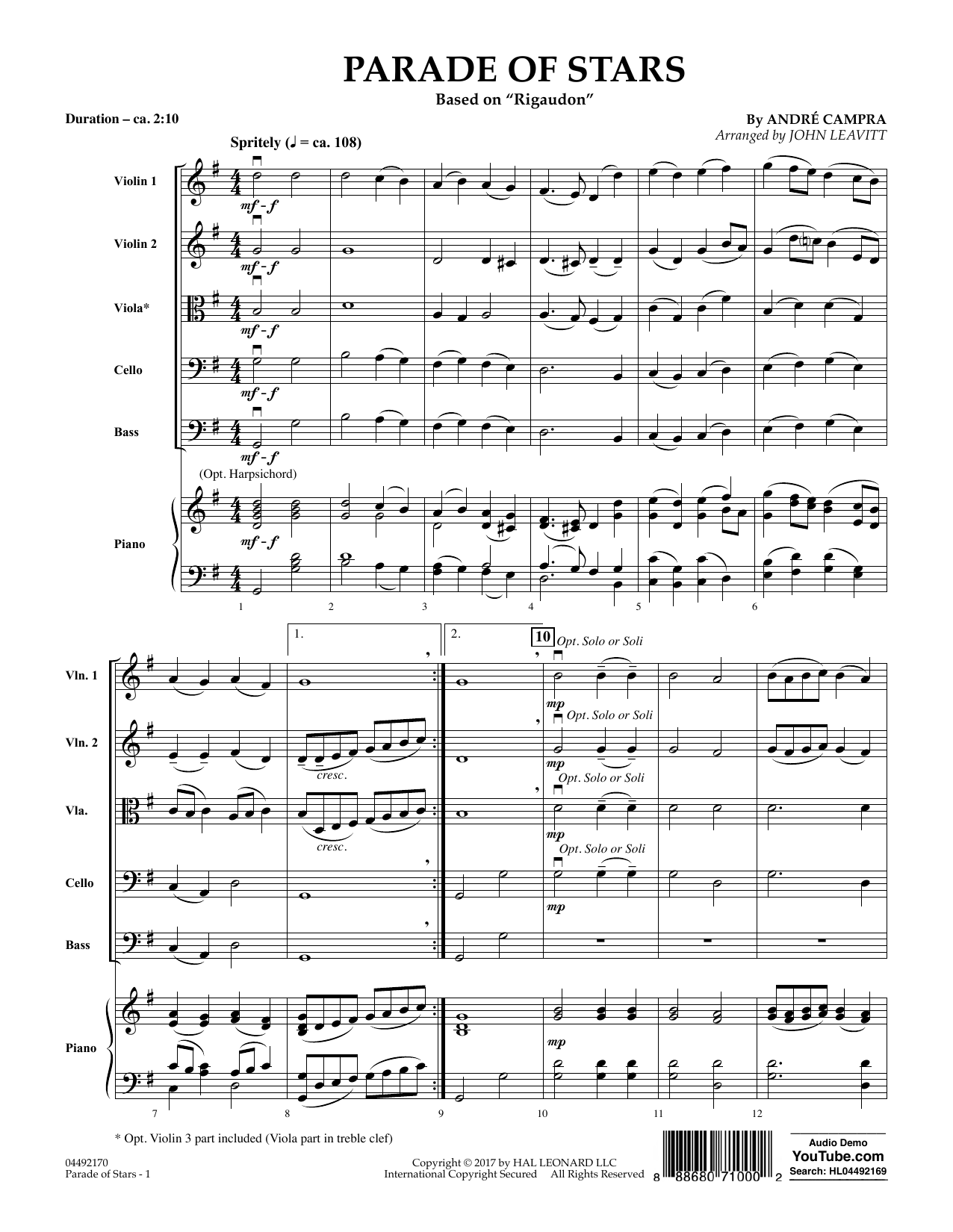

Parade of Stars: String Orchestra Conductor Score & Parts
Arranged by John Leavitt
Grade: 2
Item: 35-PK00412608
$45.00
Pickup currently not available
Buy Extra Parts (Digital PDF Download)
| Product | Price | Quantity |
|---|---|---|
| Parade of Stars - Conductor Score (Full Score) | $7.50 | |
| Parade of Stars - Violin 1 | $7.00 | |
| Parade of Stars - Violin 2 | $7.00 | |
| Parade of Stars - Violin 3 (Viola Treble Clef) | $7.00 | |
| Parade of Stars - Viola | $7.00 | |
| Parade of Stars - Cello | $7.00 | |
| Parade of Stars - Bass | $7.00 | |
| Parade of Stars - Piano | $7.00 |
Parts Added to Cart!
Description
From the Renaissance, John Leavitt brings this terrific ensemble work that is filled with teaching opportunities and performance options. In G major, it features a bit of chromaticism, just right for young learners. Dur: 2:10


Parade of Stars: String Orchestra Conductor Score & Parts isn't in MakeMusic Cloud just yet...but it could be. Let us know you'd like to see it, and you'll help shape what comes next. In the meantime, start a free trial and dive into thousands of interactive titles your students can play along with today.
Request This Title
Tell us you want it.
Start Your Free Trial
Explore everything that's ready to play right now.
Sample Audio
No sample audio found.
Sample Video
No sample videos found.
Additional Details
Publisher:
Hal Leonard
SKU:
35-PK00412608
More about this title
About the Arranger: John Leavitt
John Leavitt has built a distinguished career as a composer and arranger with a keen understanding of what student musicians need to grow. His arrangements balance accessibility with musical substance, giving young players pieces that feel genuinely rewarding to perform while building their technical skills.
Why we love this
Leavitt's approach here gives you a piece that works as both a teaching tool and a genuine concert opener. The strategic use of chromaticism within a straightforward G major setting creates real learning moments without overwhelming inexperienced players, and the multiple performance options mean you can shape this to match your ensemble's strengths on any given day.
What to expect
Bright and celebratory, with a Renaissance flavor that feels both historical and fresh. The piece has a processional quality that keeps energy forward without demanding aggressive tempo or virtuosity.
Who it's for
Grade 2 string orchestras ready for pieces that offer more musical sophistication than their technical demands might suggest. This works beautifully for ensembles with a year or two of training who need accessible material with real substance.
How to get the most out of it
- Balance the melodic line across your first and second violins so the tune stays clear even when inner voices add harmonic color
- Experiment with your chosen performance options during sectionals first; let players hear how different voicings change the overall texture before running the full ensemble
- Anchor the rhythm section (violas and cellos) with a steady pulse; young orchestras often rush moments of rhythmic simplicity, so emphasize their foundational role
How to use it
Open a concert with this to set a joyful tone and showcase your ensemble's growing command of style and articulation. It also pairs naturally with other grade 2 pops or light classical fare when you're building a program that emphasizes musicality over difficulty.
Skills your students will build
- Balancing melodic line against harmonic accompaniment
- Playing with stylistic awareness (Renaissance idioms)
- Managing chromatic passages in an accessible context
- Coordination across multiple performance options and voicings
- Maintaining steady rhythm during structurally simple sections