
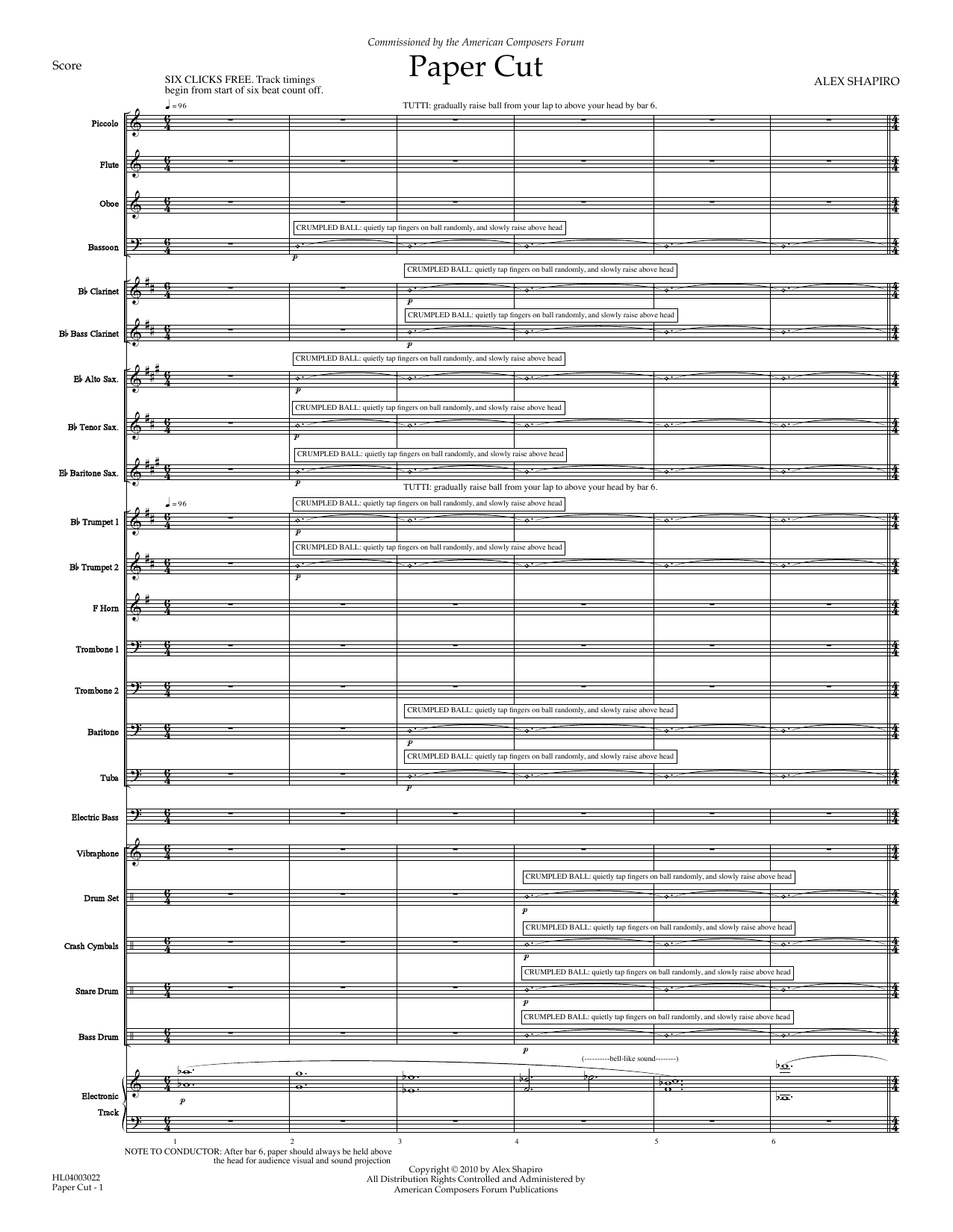

Paper Cut: Concert Band Conductor Score & Parts
By Alex Shapiro
Grade: 3
Item: 35-PK00444410
$10.00
Pickup currently not available
Parts Added to Cart!
Description
Composer Alex Shapiro's piece "Paper Cut" is reminiscent of a movie soundtrack to which the musicians can imagine their own dramatic scene. Paper Cut is written to make the players themselves part of the action with choreographed maneuvers that look as compelling as they sound. In fact, the band members don't even play their instruments until halfway into the piece - instead they "play" paper along with a prerecorded track! The unusual element of paper and the myriad sounds that can emerge from something so simple offers a fresh view of what music-making can be and opens everyone's ears to the sonic possibilities found among everyday objects. Although Paper Cut was composed with middle schoolers in mind, it's also suited to more advanced musicians, since the paper techniques and the skill of playing against a prerecorded track are interesting for all ages. To perform the piece, you'll need an audio system capable of playing the prerecorded audio tracks from a laptop computer via a small digital audio interface connected to an audio mixer. Download information is provided in the printed piece. A free downloadable interdisciplinary curriculum for teaching Paper Cut is also available for download at www.BandQuest.org: https://composersforum.org/bq-compositions/paper-cut/
Learn more on Youtube: https://www.youtube.com/user/ComposersForum/search?query=alex+shapiro+
Bandquest, an exciting series of new music and accompanying curricula for band, is a program published by the American Composers Forum. The series was started as a response to feedback from music educators that there is a pressing need for new, fresh band music. The heart of this program is new works written by a diverse group of leading American composers who have created challenging pieces that are a true departure from standard middle school repertoire. Every BandQuest project includes a residency component in which the composer works collaboratively with a middle school as they create their new piece. Many BandQuest pieces are accompanied by an interdisciplinary curriculum designed to assist students as they learn the music and to integrate each piece with non-music studies. Visit www.bandquest.org to learn more about this innovative series, and email bandquest@composersforum.org to request a free downloadable audio catalog.


Discover MakeMusic Cloud: thousands of interactive titles your students can play along with today.
Sample Audio
No sample audio found.
Sample Video
No sample videos found.
Additional Details
Publisher:
Hal Leonard
SKU:
35-PK00444410
More about this title
About the Composer: Alex Shapiro
Alex Shapiro is a composer who writes across genres and mediums, from concert music to film and television scores. Her work frequently explores unconventional approaches to sound and instrumentation, asking performers and audiences to reconsider what instruments can do and how ensembles can move in space.
Shapiro has earned recognition for her accessible yet inventive compositions that engage young musicians without sacrificing artistic depth. Her pieces often invite performers to become active participants in the theatrical and sonic landscape of the work, rather than simply executing notes on a page.
Why we love this
Paper Cut breaks the fourth wall of traditional concert band performance in a way that genuinely excites student musicians. The choreographed paper techniques and the split between acoustic and prerecorded sound create a piece that reads as contemporary and cinematic while remaining pedagogically sound for middle school ensembles. It's the kind of work that makes band class feel like something students actually want to be part of.
What to expect
Paper Cut unfolds like a film score searching for its narrative. The soundscape is cinematic and atmospheric, with the paper textures creating an intimate, tactile quality that contrasts beautifully against the lush prerecorded accompaniment. There's a playfulness to the work that coexists with real compositional sophistication, making the experience feel both fun and genuinely musical.
Who it's for
This work speaks to middle school bands ready for something beyond standard repertoire, as well as advanced high school or community ensembles seeking fresh material. Directors looking to engage students in experimental sound and choreographed performance will find Paper Cut opens doors to conversations about music beyond traditional instrumental technique.
How to get the most out of it
- Rehearse the paper techniques separately from the prerecorded track at first. Have students practice the sounds and motions they'll execute (crumpling, tearing, rattling) with intentionality so that these textures emerge clearly when layered with the audio.
- Test your audio setup well in advance of performance. Confirm that your digital interface and mixer can handle the prerecorded tracks at consistent levels and that all sections can hear the accompaniment during performance.
- Treat the transition from paper work to instrumental playing as a dramatic moment. Coach students on how they'll move their instruments into position and how that moment of shift contributes to the piece's narrative arc.
- Record a rehearsal performance and listen back as an ensemble. Hearing how the paper textures actually land in the room (not just in their hands) gives students ownership over the sonic choices they're making.
How to use it
Program Paper Cut as a centerpiece on a concert that celebrates new music and experimental approaches to ensemble playing. It pairs well alongside more traditional selections as a contrasting statement piece, or it can anchor a thematic program exploring sound design and unconventional instruments. The built-in interdisciplinary curriculum makes it equally suitable for a collaborative performance that bridges music and visual arts classes.
Skills your students will build
- Producing varied timbres and dynamics from a single object (paper)
- Performing rhythmically against a prerecorded accompaniment
- Coordinating choreographed movement with ensemble sound
- Listening critically to texture and layering in contemporary composition
- Understanding music's relationship to theater and visual performance