
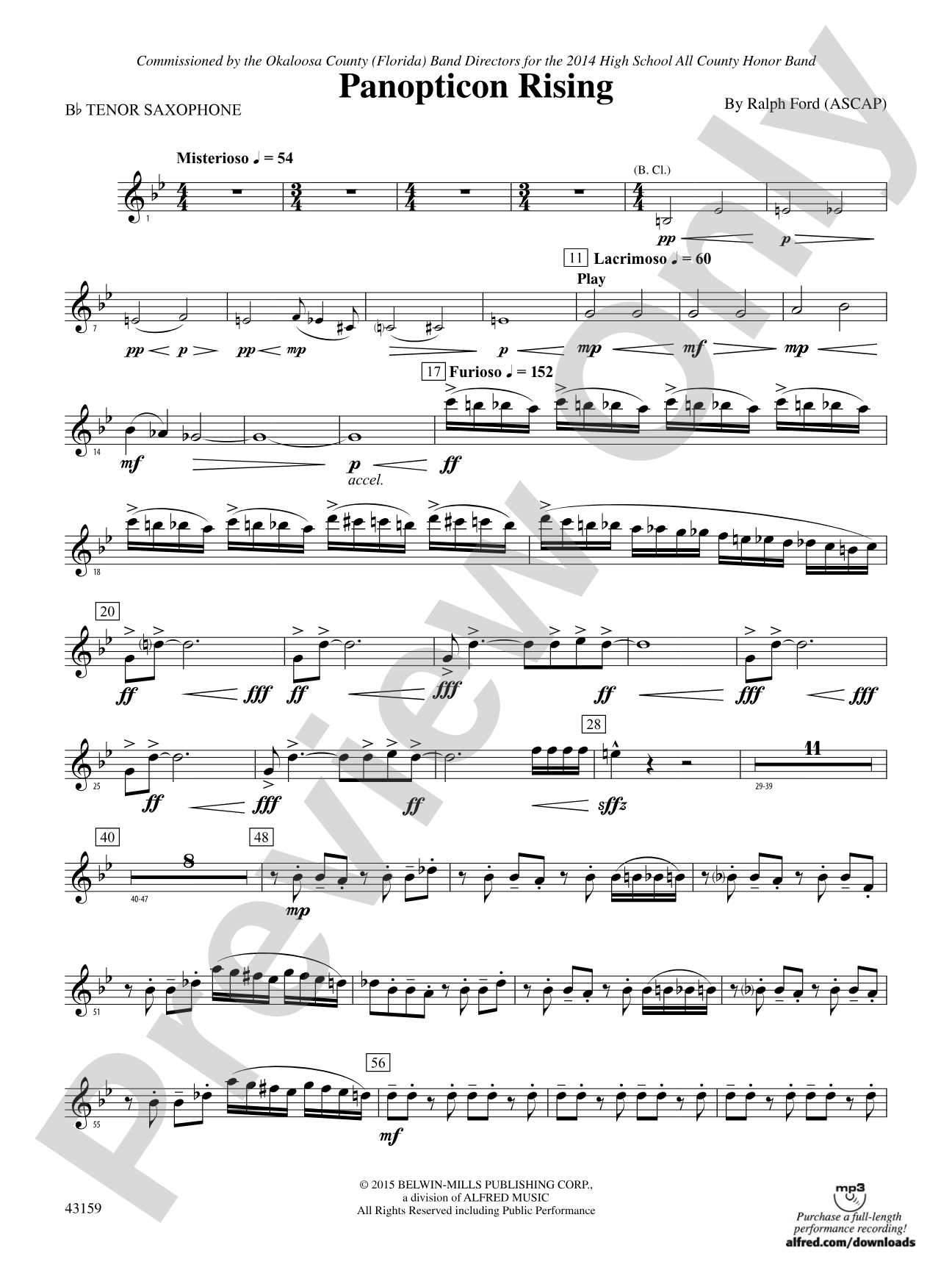

Panopticon Rising: B-flat Tenor Saxophone
By Ralph Ford
Grade: 5 (Difficult)
Item: 00-PC-0016802_TX1
$3.00
Pickup currently not available
Description
The title implies "all watching," hinting to the mythological Greek Watchman Panoptes and "opticon" for watching. This original contemporary composition opens with an unassuming docile theme. The transparency is rapidly replaced with driving tutti components that furiously depict a vividly punctuated theme. Reminiscent passive melodies interrupt occasionally, building to an uncompromising conclusion. With a vivid percussion contribution, this energy-packed composition is unparalleled. Bravo! (5:30)


Don't just read it, hear it, play along with it, and watch your students grow with it. In MakeMusic Cloud, Panopticon Rising: B-flat Tenor Saxophone comes alive with professional accompaniment, adjustable tempo, and built-in practice tools that turn solo practice into real progress.
Open in the Player
Jump straight in and assign it today.
Start Your Free Trial
Open this title and explore the full library in minutes.
Sample Audio
1
Audio File
--:--
0:00
0:00
Sample Video
No sample videos found.
Additional Details
Series:
Belwin Symphonic Band
Publisher:
Alfred Music
Page Count:
280
SKU:
00-PC-0016802_TX1
More about this title
About the Composer: Ralph Ford

Ralph Ford has composed and arranged over 250 works for orchestras, concert bands, jazz ensembles, and marching groups, establishing himself as one of the most prolific voices in contemporary band music. Beyond his output as an exclusive composer and arranger for Alfred Music's Belwin division, Ford has spent nearly three decades on university music faculties, teaching orchestration, arranging, theory, and jazz studies while simultaneously maintaining active careers in media production, broadcasting, and commercial composition. His work spans live radio, television scoring, advertising, and video production, giving his concert music a sophisticated ear for sonority and dramatic pacing.
Why we love this
Panopticon Rising delivers the visceral impact audiences crave at festival and concert settings without sacrificing compositional substance. Ford's structural command is on full display here: the deliberate contrast between the gentle opening and the relentless tutti sections creates genuine dramatic weight, while the transparent orchestration ensures every section stays engaged throughout the five-and-a-half-minute arc. The prominent percussion writing gives your rhythm section players moments they'll remember.
What to expect
The piece unfolds like a psychological threshold: you begin in calm transparency, then cross into relentless forward momentum punctuated by vivid orchestral color. Those moments of passive melody feel almost like remembering something quiet before being swept back into the intensity. The final uncompromising conclusion leaves no ambiguity about where Ford has taken you.
Who it's for
Advanced high school and college concert bands ready for Grade 5 difficulty with the maturity to handle contemporary idiom and dramatic contrast. Directors looking for a contemporary piece that performs well at festivals and concert programs will find Panopticon Rising responsive to rehearsal time invested at this level.
How to get the most out of it
- Shape the opening docile theme with utmost restraint; let the contrast with the driving sections amplify the impact when they arrive.
- Balance the tutti passages so that the punctuated theme cuts through without drowning out the harmonic underpinnings in the lower voices.
- Bring out the occasional passive melody interruptions as genuine moments of breath; they're not breaks in energy but strategic harmonic shifts.
- Coordinate closely with percussion on the vivid contributions; their precision determines whether those sections drive or overwhelm.
How to use it
Program this as a centerpiece contemporary work on a concert or festival set where you want to showcase your band's dynamic range and technical facility. Its five-and-a-half-minute duration fits comfortably alongside shorter pieces or standard repertoire, and the dramatic arc gives audiences a clear sense of arrival and conclusion.
Skills your students will build
- Reading contemporary harmonic language and extended orchestration techniques
- Executing rapid dynamic shifts and articulation changes within driving tutti passages
- Balancing transparent vs. tutti textures to maintain musical shape
- Precision in coordinated rhythmic figures across multiple sections