

Panis Angelicus: Choral Instrumental Pak
By Cesar Franck / Arranged by John Leavitt
Item: 35-PK00247831
$60.00
Pickup currently not available
Buy Extra Parts (Digital PDF Download)
Parts Added to Cart!
Description
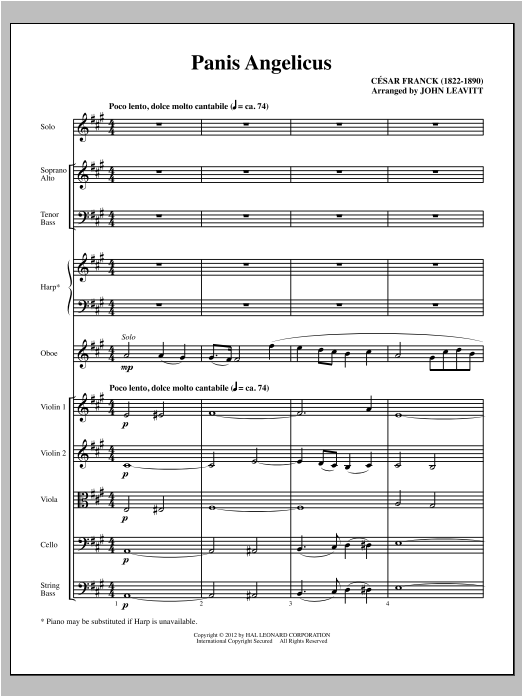
This setting of Cesar Franck's exquisite Latin hymn will enhance many concerts with a high, floating solo supported by rich choral harmony accompanied by keyboard or the optional oboe, harp, and strings.
Duration: ca. 3:15.


Panis Angelicus: Choral Instrumental Pak isn't in MakeMusic Cloud just yet...but it could be. Let us know you'd like to see it, and you'll help shape what comes next. In the meantime, start a free trial and dive into thousands of interactive titles your students can play along with today.
Request This Title
Tell us you want it.
Start Your Free Trial
Explore everything that's ready to play right now.
Sample Audio
No sample audio found.
Sample Video
No sample videos found.
Additional Details
Publisher:
Hal Leonard
SKU:
35-PK00247831
More about this title
About the Composer: Cesar Franck
Cesar Franck (1822-1890) was a Belgian-French organist and composer whose harmonic language shaped choral music for generations. His facility at the organ and deep liturgical knowledge enabled him to write sacred works of exceptional spiritual depth, often featuring the kind of lush, chromatic harmony that influenced countless students at the Paris Conservatoire where he taught.
Why we love this
John Leavitt's arrangement captures the luminous quality of Franck's original while tailoring it perfectly for chamber choirs. The optional instrumental parts (oboe, harp, strings) offer flexibility without compromising the piece's intimate character, and the soaring solo line gives you a natural showcase moment within a program.
What to expect
The piece unfolds with the quiet confidence of a hymn you have known forever. A single voice rises above warm harmonic support, creating a moment of genuine stillness that feels both timeless and intimately present.
Who it's for
This works beautifully for chamber or concert choirs of intermediate to advanced skill who want a sacred piece with real elegance and brevity. It suits ensembles comfortable with Latin text and either keyboard players or access to modest instrumental forces.
How to get the most out of it
- Balance the high solo voice carefully against the keyboard foundation; this piece rewards clarity of texture over volume.
- If using the optional oboe, harp, and strings, rehearse them separately from the choir first to establish clean intonation before blending the forces together.
- Shape the melody with gentle dynamic contours rather than pushing it outward; the floating quality depends on restraint and breath awareness from your soloist.
- Pay attention to vowel consistency in the Latin text, especially on sustained notes where diphthongs can drift out of focus.
How to use it
Slot this near the end of a concert to create a reflective closing, or use it to anchor a sacred music set where its conciseness and refinement provide contrast to longer or more elaborate works. The three-plus minute runtime makes it ideal filler that feels substantial rather than slight.
Skills your students will build
- Sustaining control in high tessituras
- Latin text pronunciation and vowel placement
- Balancing solo line against harmonic accompaniment
- Listening for and responding to optional instrumental colors
- Breath management in a floating, lyrical context