Pagodas Sheet Music Preview

Pagodas: Piano

By Timothy Brown

Item: 98-DW9160

Digital Download
$2.50
Description
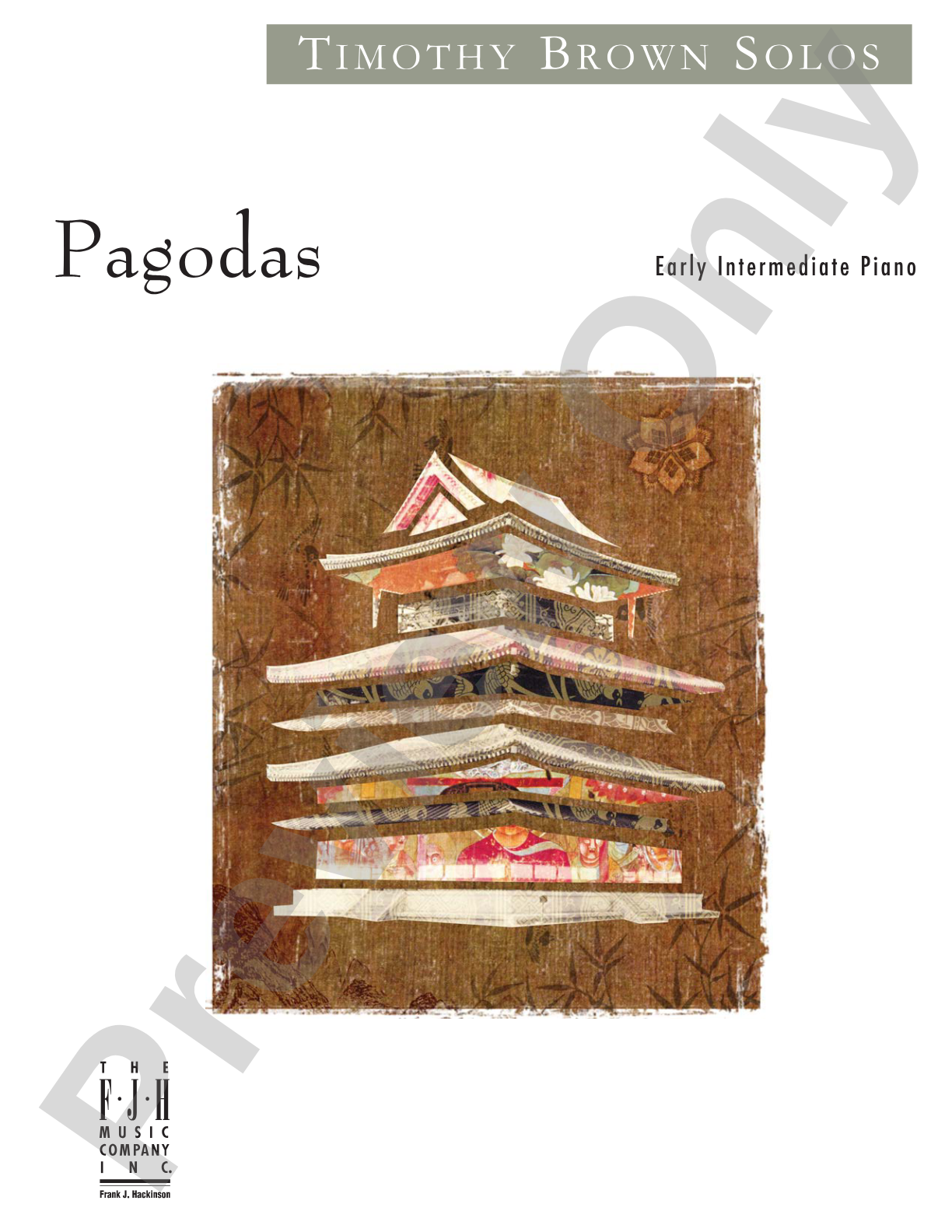
This delightfully impressionistic piece has a westernized sound that retains a hint of the East. Its flowing passages are quick to learn and easily accessible. Pairs of eighths alternate between the hands in arpeggiated runs. Sustained whole notes guide the occasional harmonic movement. Enchanting!

Pagodas: Piano isn't in MakeMusic Cloud just yet...but it could be. Let us know you'd like to see it, and you'll help shape what comes next. In the meantime, start a free trial and dive into thousands of interactive titles your students can play along with today.

Sample Audio
No sample audio found.
Sample Video
Additional Details
Series: Written For You
Publisher: The FJH Music Company, Inc.
SKU: 98-DW9160

More about this title

Why we love this

Brown captures impressionist color and texture without requiring technical virtuosity, making it an ideal bridge piece for pianists ready to move beyond purely classical forms. The East-meets-West harmonic palette gives students a genuinely different sound world to inhabit, and the arpeggiated hand-switching creates an engaging textural puzzle that rewards clean, thoughtful practice.

What to expect

Light and shimmering, with the sense of Eastern imagery filtered through a Western harmonic lens. The rapid hand exchanges create a floating, almost breezy quality, while the sustained notes ground the piece in a dreamy, contemplative space.

Who it's for

Early intermediate pianists who have solid hand independence and can navigate alternating sixteenth-note figures without tension. This piece works equally well for students seeking recital material and for teachers who want to introduce impressionist textures and non-traditional harmonic thinking.

How to get the most out of it

  • Shape the arpeggiated runs as continuous lines rather than broken chords; the eighths should flow between hands without interruption or accent on the hand shift.
  • Use the whole notes as harmonic anchors that need time to breathe; resist the urge to rush through moments when the texture thins.
  • Explore subtle dynamic shaping within the flowing passages to suggest the impressionistic atmosphere without heavy pedaling that muddies the hand independence.
  • Practice the hand crossings slowly enough to feel the weight transfer clearly, then gradually increase tempo once the gesture becomes comfortable.

How to use it

Include this in a recital that pairs classical and contemporary work, or use it as a solo palette cleanser between heavier Romantic or modern pieces. It also works as an engaging early-year assignment for intermediate students navigating hand coordination and textural contrast.

Skills your students will build

  • Hand independence and hand-crossing coordination in running sixteenth-note figures
  • Reading and executing impressionistic harmonic language with whole-note voice leading
  • Balancing melodic flow against rapid accompaniment patterns
  • Sustaining musical line through texture changes and hand-switching patterns

You May Also Like