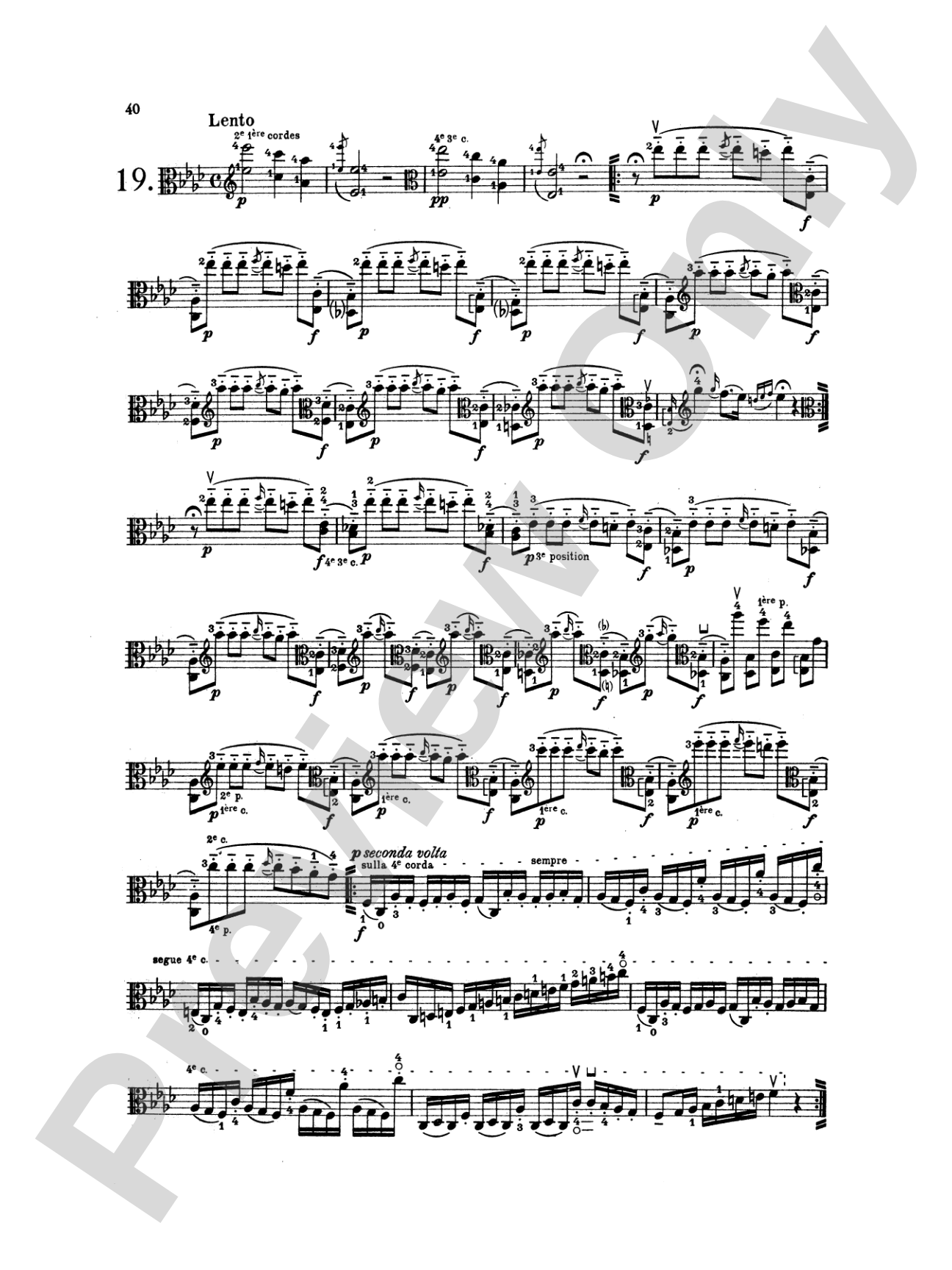
Paganini: Twenty-four Caprices, Op. 1 (Transcribed for Viola Solo) Sheet Music Preview

Paganini: Twenty-four Caprices, Op. 1 (Transcribed for Viola Solo)

By Niccolò Paganini; Transcribed by L. Raby

Item: 00-PC-0010177

Digital Download
$0.99
Description
(Transcribed for Viola Solo)

Don't just read it, hear it, play along with it, and watch your students grow with it. In MakeMusic Cloud, Paganini: Twenty-four Caprices, Op. 1 (Transcribed for Viola Solo) comes alive with professional accompaniment, adjustable tempo, and built-in practice tools that turn solo practice into real progress.

Sample Audio
No sample audio found.
Sample Video
Additional Details
Series: Kalmus Edition
Publisher: Alfred Music
Page Count: 52
SKU: 00-PC-0010177
Instrumentation: Viola Solo

More about this title

About the Composer: Niccolò Paganini

Niccolò Paganini (1782-1840) was an Italian violinist and composer who fundamentally transformed what was possible on the violin. His technical innovations—harmonics, rapid string crossings, left-hand pizzicato, and extreme ranges—were so advanced that audiences of his era suspected supernatural intervention. Beyond virtuosity, Paganini was a serious musician whose compositions demand both technical mastery and musical intelligence.

The Twenty-four Caprices stand as the capstone of violin technique pedagogy and performance. Written without accompaniment, each caprice isolates and develops a distinct technical challenge while maintaining musical substance. Their influence extends far beyond violin: composers from Liszt to Rachmaninoff created variations on these works, and their transcription for other string instruments has become essential repertoire for advancing violists and cellists seeking to expand their technical vocabulary.

Why we love this

These transcriptions unlock material that violists rarely encounter at the advanced undergraduate and professional levels. Paganini's caprices demand the kind of disciplined, focused practice that transforms a competent player into a refined one. The unaccompanied format keeps the focus entirely on viola tone, intonation, and interpretive choices, making these invaluable for serious students preparing for auditions or recitals.

What to expect

Each caprice feels like a conversation between composer and player, stripped of all ornamentation and accompaniment. The music ranges from angular, almost austere technical challenges to passages of surprising lyricism and introspection. There is no hiding behind ensemble texture or accompaniment; every note reflects the soloist's commitment and craftsmanship.

Who it's for

Advanced violists preparing for college auditions, graduate-level study, or professional performance will find these caprices essential. Teachers seeking challenging, substantial repertoire for serious students who have moved beyond standard viola method materials will value their pedagogical clarity and musical depth.

How to get the most out of it

  • Approach each caprice as a complete study in a single technical area rather than a display piece. The musical coherence depends on clarity and purposeful practice at a controlled tempo before reaching performance speed.
  • Pay close attention to the alto clef notation. While violists read alto clef daily, Paganini's wide intervallic leaps and rapid passagework require careful management of position shifts and string crossings specific to viola range and acoustics.
  • Use the written articulations and bowing carefully. These are not violin bowings imported wholesale; they reflect what works distinctly on viola. Respect the composer's indications as solutions to idiomatic viola technique.
  • Record yourself frequently during practice. Paganini's unaccompanied writing exposes every intonation wavering and rhythmic uncertainty. Self-listening is the only reliable feedback available.

How to use it

These work exceptionally well as solo recital repertoire, either presented as complete evenings or strategically programmed alongside works from other eras. A single caprice or pairing of contrasting caprices can anchor a chamber concert or provide an effective opening or closing statement.

Skills your students will build

  • Rapid string crossing and bow control in fast passagework
  • Left-hand facility across wide intervallic leaps and position shifts
  • Intonation refinement in unaccompanied playing without harmonic reference
  • Double stops and multiple-stop techniques
  • Rhythmic precision and articulation clarity
  • Sustained tone quality and vibrato control in exposed lyrical passages
  • Interpretation and musical decision-making without textural support

You May Also Like