
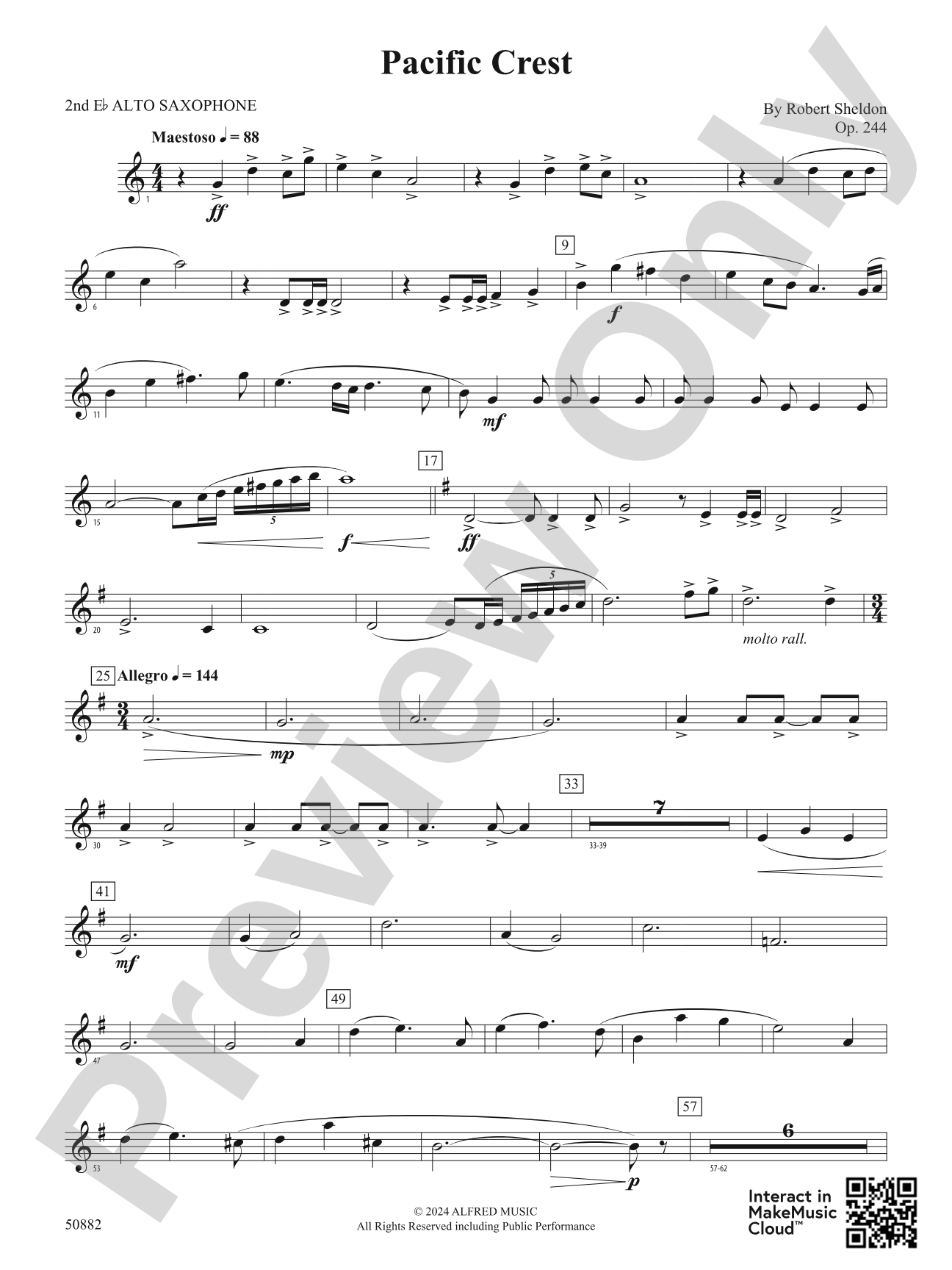

Pacific Crest: 2nd E-flat Alto Saxophone
By Robert Sheldon
Grade: 4
Item: 00-PC-0019303_AX2
$3.00
Pickup currently not available
Description
Pacific Crest, by Robert Sheldon, is an awe-inspiring work named for the ridge of mountains spanning the entire range from Canada to the Mexican border, with music depicting the peaks, panoramic views, and the joy of hiking this incredible trail. (5:05)


Don't just read it, hear it, play along with it, and watch your students grow with it. In MakeMusic Cloud, Pacific Crest: 2nd E-flat Alto Saxophone comes alive with professional accompaniment, adjustable tempo, and built-in practice tools that turn solo practice into real progress.
Open in the Player
Jump straight in and assign it today.
Start Your Free Trial
Open this title and explore the full library in minutes.
Sample Audio
1
Audio File
--:--
0:00
0:00
Sample Video
Additional Details
Series:
Alfred Concert Band
Publisher:
Alfred Music
SKU:
00-PC-0019303_AX2
More about this title
About the Composer: Robert Sheldon

Robert Sheldon stands among today's most frequently performed composers of wind band music, with works that appear consistently on contest lists and concert programs across the globe. His honors include recognition from the American School Band Director's Association, Phi Beta Mu, and the American Society of Composers, Authors and Publishers. Beyond composing, Sheldon co-authored Sound Innovations for Concert Band and maintains an active schedule as a guest conductor for All-State and Regional Honor Bands, clinician at universities and state music education conferences, and conductor in venues ranging from Carnegie Hall to the Sydney Opera House.
Sheldon's prolific output reflects his commitment to wind band literature. He regularly accepts commissions for new works and produces multiple publications annually. His conducting and educational work has taken him throughout the United States and internationally to Japan, Canada, Italy, Germany, Australia, and China. VanderCook College of Music awarded him an honorary doctorate in 2020.
Why we love this
Pacific Crest succeeds because Sheldon's programmatic writing never sacrifices musical substance for scenic storytelling. The piece balances accessible Grade 4 writing with genuine harmonic interest and orchestration that keeps all sections engaged, making it equally rewarding for players and audiences. Its contest-festival credentials combined with concert viability make it a smart choice for ensembles looking beyond traditional march-and-chorale programming.
What to expect
Pacific Crest unfolds like a hike itself: moments of steady, contemplative beauty interrupted by passages of exuberance and wonder as vistas open up. The music captures both the physical experience of climbing and the emotional reward of reaching high ground, with orchestral colors that shift between intimate and expansive.
Who it's for
Concert bands at the Grade 4 level seeking programmatic repertoire that challenges musicianship without overwhelming players technically. Directors preparing for festival or contest competition will appreciate music that combines accessibility with the sophistication judges recognize and audiences enjoy.
How to get the most out of it
- Balance the melodic line across sections as the theme passes between woodwinds and brass; ensure inner voices support without overwhelming the primary voice
- Treat tempo as flexible within Sheldon's intent; slight rubato during the panoramic passages can enhance the landscape imagery without losing structural coherence
- Shape phrases by thinking beyond measure lines, especially in lyrical sections where breathing space and cadential weight define the hiking journey narrative
- Layer dynamics carefully in tuttis; Grade 4 ensembles often add too much volume when everyone plays together, which muddies the orchestration
How to use it
Program Pacific Crest as the centerpiece of a concert exploring American landscapes or as a bridge between traditional and contemporary wind band literature. Its five-minute duration and programmatic appeal make it ideal for family concerts, pops programs, or festival showcases where audiences appreciate music that tells a story without sacrificing artistic depth.
Skills your students will build
- Sustained melodic phrasing across section transitions
- Dynamic balance and inner voice awareness in fuller textures
- Responding to programmatic cues and narrative intent in conducting
- Sectional independence while maintaining ensemble unity
- Interpretation of rubato and flexible tempo within structured form