
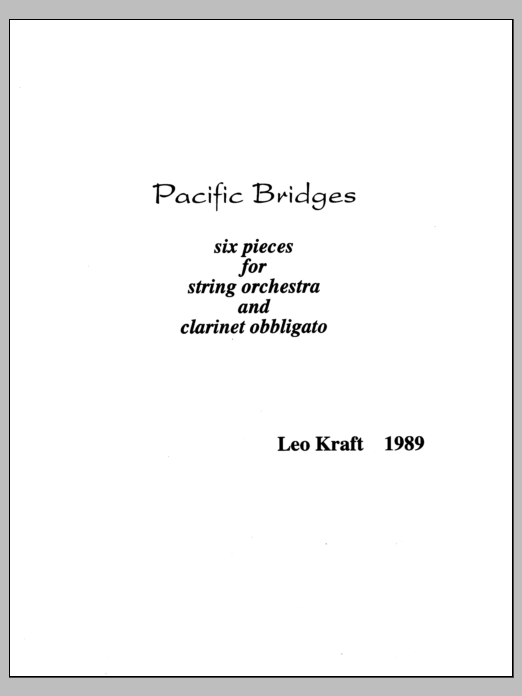

Pacific Bridges: String Orchestra Conductor Score & Parts
Arranged by Leo Kraft
Item: 35-PK00268983
$24.50
Pickup currently not available
Buy Extra Parts (Digital PDF Download)
| Product | Price | Quantity |
|---|---|---|
| Pacific Bridges - Full Score | $9.60 | |
| Pacific Bridges - Clarinet | $2.10 | |
| Pacific Bridges - Violin | $2.25 | |
| Pacific Bridges - Violin | $2.25 | |
| Pacific Bridges - Viola | $2.25 | |
| Pacific Bridges - Violoncello | $2.10 | |
| Pacific Bridges - Contrabass | $1.95 |
Parts Added to Cart!
Description
Six pieces for String Orchestra and Clarinet Obbligato Duration: 16:00


Pacific Bridges: String Orchestra Conductor Score & Parts isn't in MakeMusic Cloud just yet...but it could be. Let us know you'd like to see it, and you'll help shape what comes next. In the meantime, start a free trial and dive into thousands of interactive titles your students can play along with today.
Request This Title
Tell us you want it.
Start Your Free Trial
Explore everything that's ready to play right now.
Sample Audio
No sample audio found.
Sample Video
No sample videos found.
Additional Details
Publisher:
Hal Leonard
SKU:
35-PK00268983
More about this title
About the Arranger: Leo Kraft
Leo Kraft (1922-2016) was a composer and arranger whose catalog spans orchestral, chamber, and vocal music. His arrangements demonstrate a careful ear for texture and balance, qualities evident in his string writing across multiple genres and styles.
Why we love this
The clarinet obbligato threading through six connected pieces gives this set textural distinction uncommon at the string orchestra level. Kraft's arrangement captures lyrical momentum without demanding the technical density that exhausts younger ensembles, making it genuinely playable while remaining musically substantial.
What to expect
Pacific Bridges unfolds with the quiet accumulation of a journey. The clarinet weaves through string textures that suggest light refracted across water, building emotional continuity across movements without demanding dramatic intensity.
Who it's for
String orchestras in secondary and early college settings. The addition of a clarinet obbligato appeals to programs with capable wind players who can integrate into an ensemble setting.
How to get the most out of it
- Balance the clarinet line as a genuine voice within the ensemble, not as a soloist above it. The obbligato works best when strings and clarinet share the acoustic space.
- Shape each of the six pieces as distinct chapters rather than isolated segments. Use the transitions between movements to reset energy and articulation.
- Let vibrato choices communicate character shift from piece to piece. Some passages benefit from a warmer, fuller sound; others call for restraint.
How to use it
This set works as a concert centerpiece when programmed alongside single dramatic works. Its moderate length and continuous arc suit it to a spring concert focused on string writing, or as the narrative core of a program exploring arrangement and orchestration across eras.
Skills your students will build
- Balancing obbligato lines with ensemble textures
- Sustaining momentum across multiple connected movements
- Responding to subtle dynamic and tonal shifts within a single piece
- Ensemble cohesion across diverse instrumental colors