
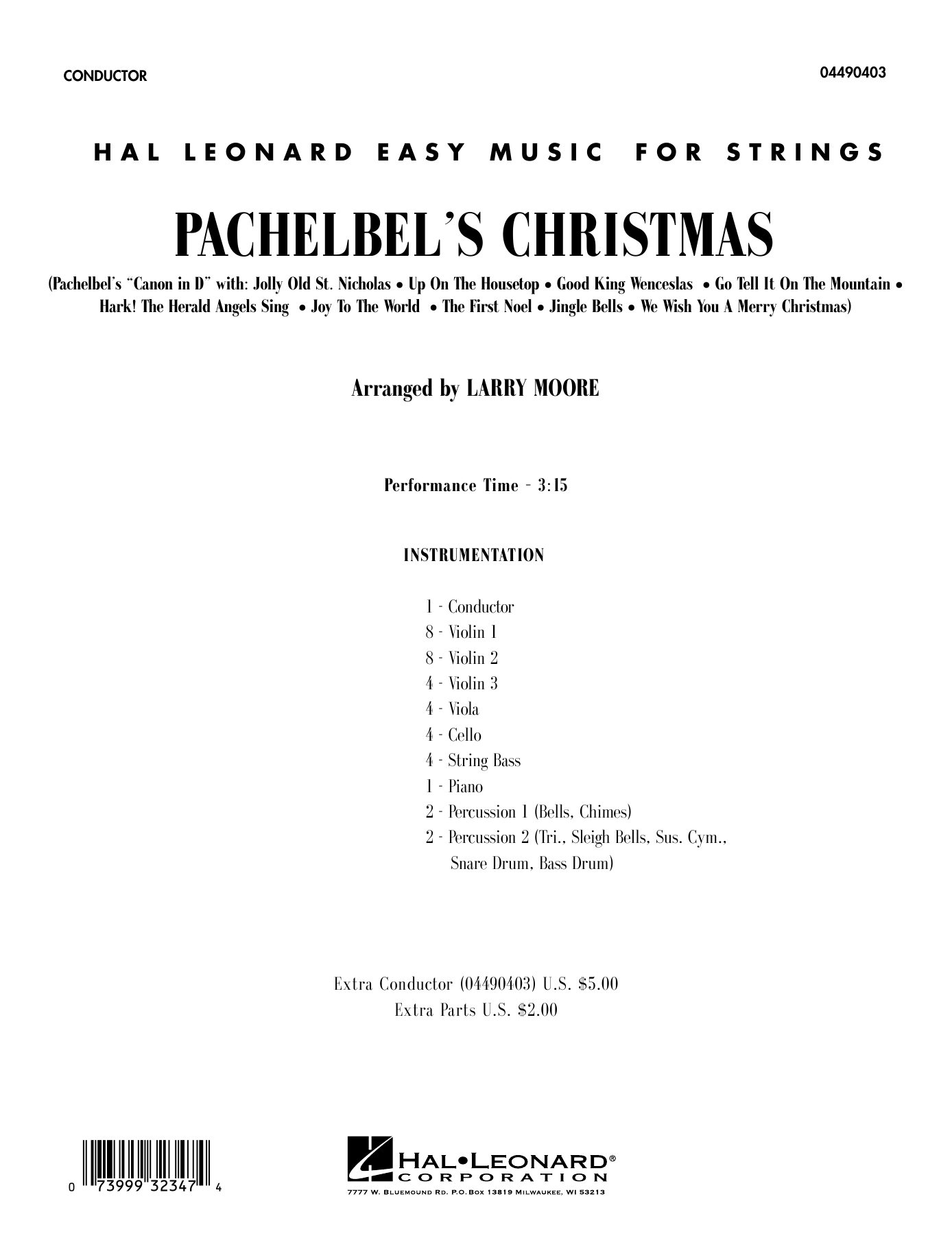

Pachelbel's Christmas: String Orchestra Conductor Score & Parts
By Johann Pachelbel / Arranged by Larry Moore
Grade: 2-3
Item: 35-PK01413183
$45.00
Pickup currently not available
Buy Extra Parts (Digital PDF Download)
| Product | Price | Quantity |
|---|---|---|
| Pachelbel's Christmas - Full Score | $6.00 | |
| Pachelbel's Christmas - Violin 1 | $7.00 | |
| Pachelbel's Christmas - Violin 2 | $7.00 | |
| Pachelbel's Christmas - Violin 3 (Viola Treble Clef) | $7.00 | |
| Pachelbel's Christmas - Viola | $7.00 | |
| Pachelbel's Christmas - Cello | $7.00 | |
| Pachelbel's Christmas - String Bass | $7.00 | |
| Pachelbel's Christmas - Piano | $7.00 | |
| Pachelbel's Christmas - Percussion 1 | $7.00 | |
| Pachelbel's Christmas - Percussion 2 | $7.00 |
Parts Added to Cart!
Description
Larry Moore has created an ingenious combination of favorite carols and Pachelbel's most famous work into a clever holiday treat. Starting with the traditional ground bass and melody, he adds a delightful assortment of holiday tunes, with some that are not so obvious. Let your audience find them all while enjoying this creative arrangement. Includes: "Jolly Old Saint Nicholas, Up On the Housetop, Good King Wenceslas, Go Tell It on the Mountain, Hark! The Herald Angels Sing, Joy to the World, The First Noel, Jingle Bells" and "We Wish You a Merry Christmas".


Pachelbel's Christmas: String Orchestra Conductor Score & Parts isn't in MakeMusic Cloud just yet...but it could be. Let us know you'd like to see it, and you'll help shape what comes next. In the meantime, start a free trial and dive into thousands of interactive titles your students can play along with today.
Request This Title
Tell us you want it.
Start Your Free Trial
Explore everything that's ready to play right now.
Sample Audio
No sample audio found.
Sample Video
No sample videos found.
Additional Details
Publisher:
Hal Leonard
SKU:
35-PK01413183
More about this title
About the Composer: Johann Pachelbel
Johann Pachelbel (1653-1706) was a German Baroque composer whose harmonic innovations and keyboard mastery shaped an entire era. His Canon in D, with its hypnotic ground bass progression, remains one of the most recognizable works in Western music and serves as a foundational study in harmonic analysis and voice leading for music students everywhere.
Beyond the Canon, Pachelbel's output spanned sacred vocal music, fugues, and keyboard works that demonstrate rigorous counterpoint and expressive depth. His influence on Bach and the development of Baroque form makes him essential listening and studying for anyone seeking to understand how harmonic patterns can drive emotional power.
Why we love this
Pachelbel's iconic ground bass gives students an immediate anchor for ensemble cohesion, and Larry Moore's arrangement weaponizes that strength by layering Christmas carols over a familiar harmonic foundation. Your strings stay locked to that driving progression while discovering nine different melodies, creating a genuinely engaging listening experience that doesn't feel like a novelty piece.
What to expect
Baroque grandeur meets warmth and nostalgia. The relentless ground bass propels momentum while each arriving carol lands like a familiar friend, creating a piece that feels both intellectually satisfying and joyfully accessible.
Who it's for
String orchestras at grades 2 through 3 seeking holiday repertoire that entertains without sacrificing musicianship. This arrangement works equally well for young players building fundamental skills and intermediate groups looking for sophisticated fun.
How to get the most out of it
- Keep the ground bass unwavering in the lower voices. The entire arrangement's architecture depends on that rhythmic and harmonic stability. Even slight tempo fluctuations or loose entrances will blur the effect.
- Emphasize the moment each new carol emerges. A slight dynamic rise in the melody line helps the audience identify the familiar tune before the next one arrives.
- Balance the texture so the ground bass supports without overwhelming. Violins carrying melodies should sit comfortably above the lower foundation.
- Take advantage of the recorded accompaniment during rehearsals to lock ensemble precision, then gradually shift your focus to intonation and character once rhythmic security is solid.
How to use it
This works beautifully as a finale for a December concert, offering audiences a combination of reverence and playfulness that feels festive without being purely comedic. You might also program it as a bridge between serious holiday works and lighter selections, giving your ensemble a moment to shine while maintaining artistic credibility.
Skills your students will build
- Maintaining steady ground bass patterns against contrasting melodic movement
- Voice independence and inner part clarity
- Harmonic awareness through repeated bass progression analysis
- Recognizing and balancing multiple simultaneous melodic lines
- Ensemble rhythmic precision and collective timing