
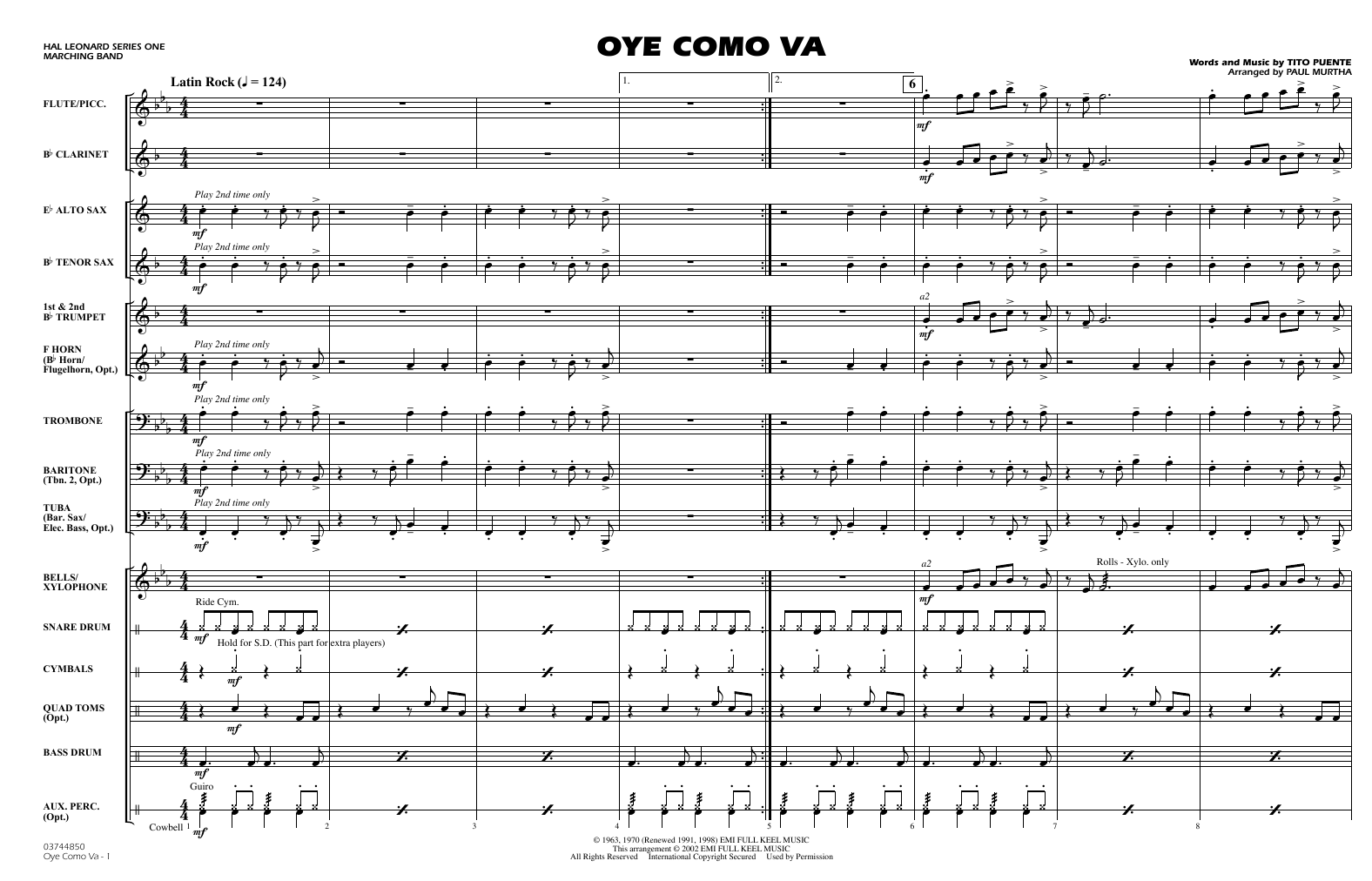

Oye Como Va (arr. Paul Murtha): Marching Band Conductor Score & Parts
As performed by Santana / Arranged by Paul Murtha
Grade: 2
Item: 35-PK01603507
$55.00
Pickup currently not available
Buy Extra Parts (Digital PDF Download)
Parts Added to Cart!
Description
Written by Latin master Tito Puente and made famous by the group Santana in 1971, here is a fun production number that is effective without being difficult to play. There's plenty of solid tutti band patterns and a great Latin percussion foundation.


Oye Como Va (arr. Paul Murtha): Marching Band Conductor Score & Parts isn't in MakeMusic Cloud just yet...but it could be. Let us know you'd like to see it, and you'll help shape what comes next. In the meantime, start a free trial and dive into thousands of interactive titles your students can play along with today.
Request This Title
Tell us you want it.
Start Your Free Trial
Explore everything that's ready to play right now.
Sample Audio
No sample audio found.
Sample Video
No sample videos found.
Additional Details
Publisher:
Hal Leonard
SKU:
35-PK01603507
More about this title
About the Artist: Santana
Santana emerged from San Francisco in the late 1960s with a groundbreaking fusion of Latin rhythms, blues, and rock. The band's self-titled 1971 album became a cultural phenomenon, introducing millions of listeners to the sophisticated interplay of clave patterns, congas, and timbales fused with electric guitar and horn sections. Their work fundamentally expanded what popular music could be, proving that complex polyrhythmic structures and authentic Latin traditions could captivate mainstream audiences without compromise.
For music educators, Santana's catalog represents a bridge between academic respect and student engagement. The band's careful arrangement of Latin percussion parts, their emphasis on tight ensemble playing, and their commitment to authentic groove make their music a pedagogically sound entry point into cross-cultural musicianship. "Oye Como Va" in particular demonstrates how a relatively simple harmonic structure can support layers of rhythmic sophistication when orchestrated by skilled arrangers.
Why we love this
Paul Murtha's arrangement preserves the irresistible clave foundation and bright, propulsive energy of the original while keeping technical demands reasonable for Grade 2 ensembles. The writing distributes Latin percussion patterns accessibly across your battery, allowing even younger players to own a crucial part of the groove rather than simply accompaniment. Audiences recognize this tune instantly, which means your students get immediate feedback that their hard work on rhythmic precision actually matters.
What to expect
Immediate, infectious forward momentum. The clave pattern creates an hypnotic rhythmic anchor while the harmonic movement stays simple enough to support clear sectional playing. There's joy in this arrangement, an almost irresistible impulse to move that comes from authentic Latin groove meeting clean, accessible orchestration.
Who it's for
Grade 2 marching bands seeking engaging repertoire that builds genuine musicianship without excessive technical barriers. Directors programming concerts that mix classical standards with recognizable popular music will find this arrangement a crowd pleaser that respects both the students' abilities and the audience's ears.
How to get the most out of it
- Isolate the clave rhythm in rehearsal before adding harmonic parts. Have your percussion section lock the pattern first, then layer woodwinds and brass one section at a time so the grid stays solid.
- Emphasize the offbeat articulations in the brass parts. These punchy stabs against the clave create the arrangement's signature energy, so make sure they feel deliberate rather than sloppy.
- Record a click track or use the accompaniment at rehearsal tempo early and often. The Latin feel depends on players hearing and internalizing the groove, not just reading the notes.
- Balance your percussion voices so the guiro or shaker remains audible over the full band. This foreground percussion line is what makes the Latin character unmistakable to the audience.
How to use it
Position this as a midsection energy reset in a mixed concert program. It works beautifully between a concert march and a more substantial classical piece, lifting attention without demanding soloistic fireworks from individual players. For a Latin or world music themed concert, it's a natural centerpiece that demonstrates Grade 2 proficiency while staying musically authentic.
Skills your students will build
- Understanding clave rhythm as a foundational organizing principle rather than decoration
- Playing precisely on and around the beat while maintaining steady groove
- Distinguishing Latin percussion voices and their specific functions (timekeeper vs. rhythmic punctuation)
- Ensemble balance with non-traditional instrumentation
- Responding to groove-based phrasing rather than purely melodic direction