

Oy Khodyt Son: SSA a cappella (Opt. Piano) Choral Octavo
Traditional Ukrainian Lullaby / arr. Sarah Martinez
Item: 00-PO-0007001
$2.05
Minimum order quantity: 20 copies
Pickup currently not available
Related Items
Oy Khodyt Son: SATB a cappella (Opt. Piano) Choral Octavo |
$2.05
|
View | |
Oy Khodyt Son: SAB a cappella (Opt. Piano) Choral Octavo |
$2.05
|
View | |
Oy Khodyt Son: 2-Part (opt. a cappella) Choral Octavo |
$2.20
|
View | |
Oy Khodyt Son: PianoTrax Digital Audio Download |
$9.99
|
View | |
Oy Khodyt Son: SATB a cappella (Opt. Piano) Choral Octavo |
$2.05
|
View | |
Oy Khodyt Son: SAB a cappella (Opt. Piano) Choral Octavo |
$2.05
|
View | |
Oy Khodyt Son: SSA a cappella (Opt. Piano) Choral Octavo |
$2.05
|
View | |
Oy Khodyt Son: 2-Part (opt. a cappella) Choral Octavo |
$2.20
|
View |
Description
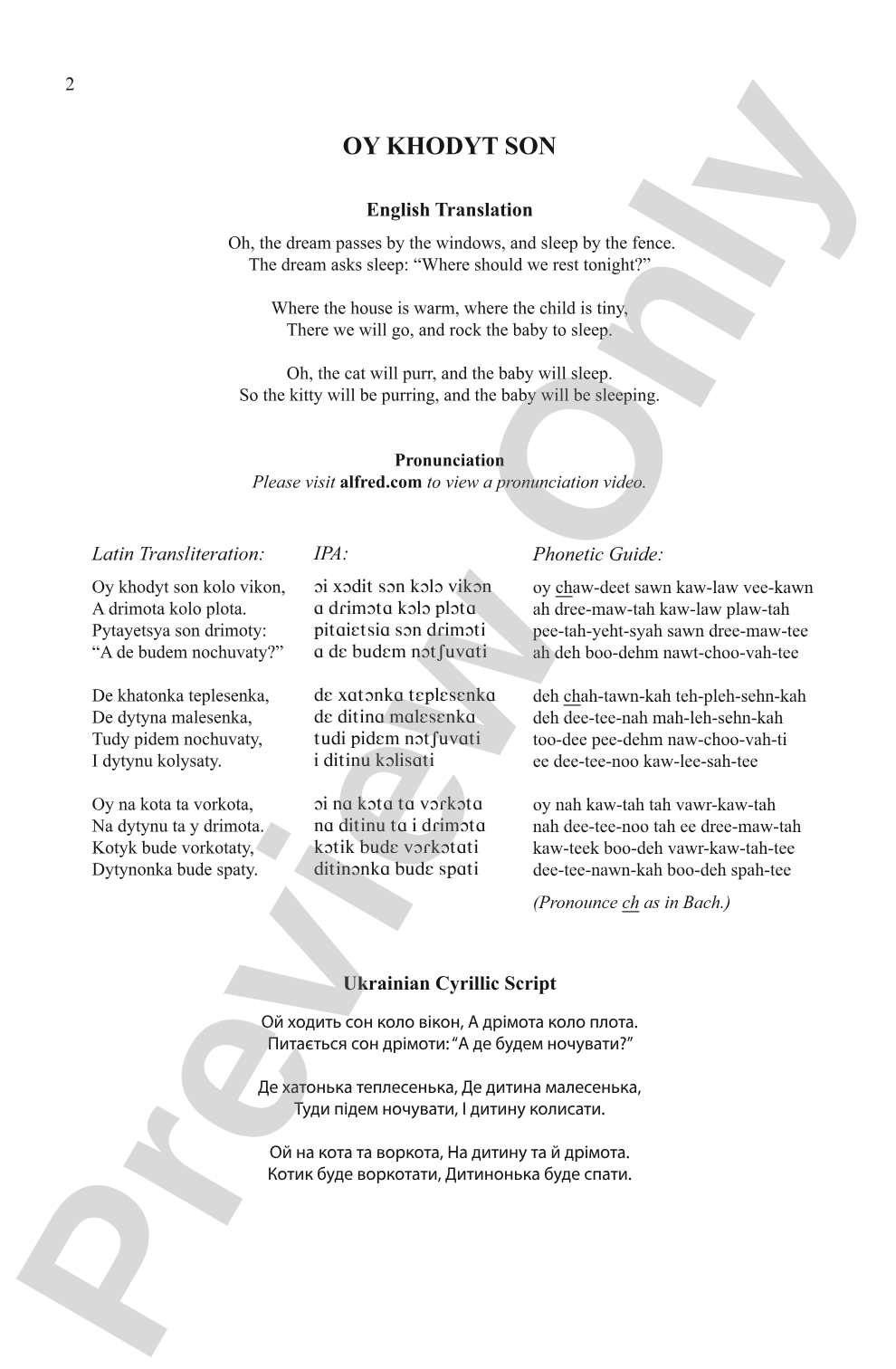
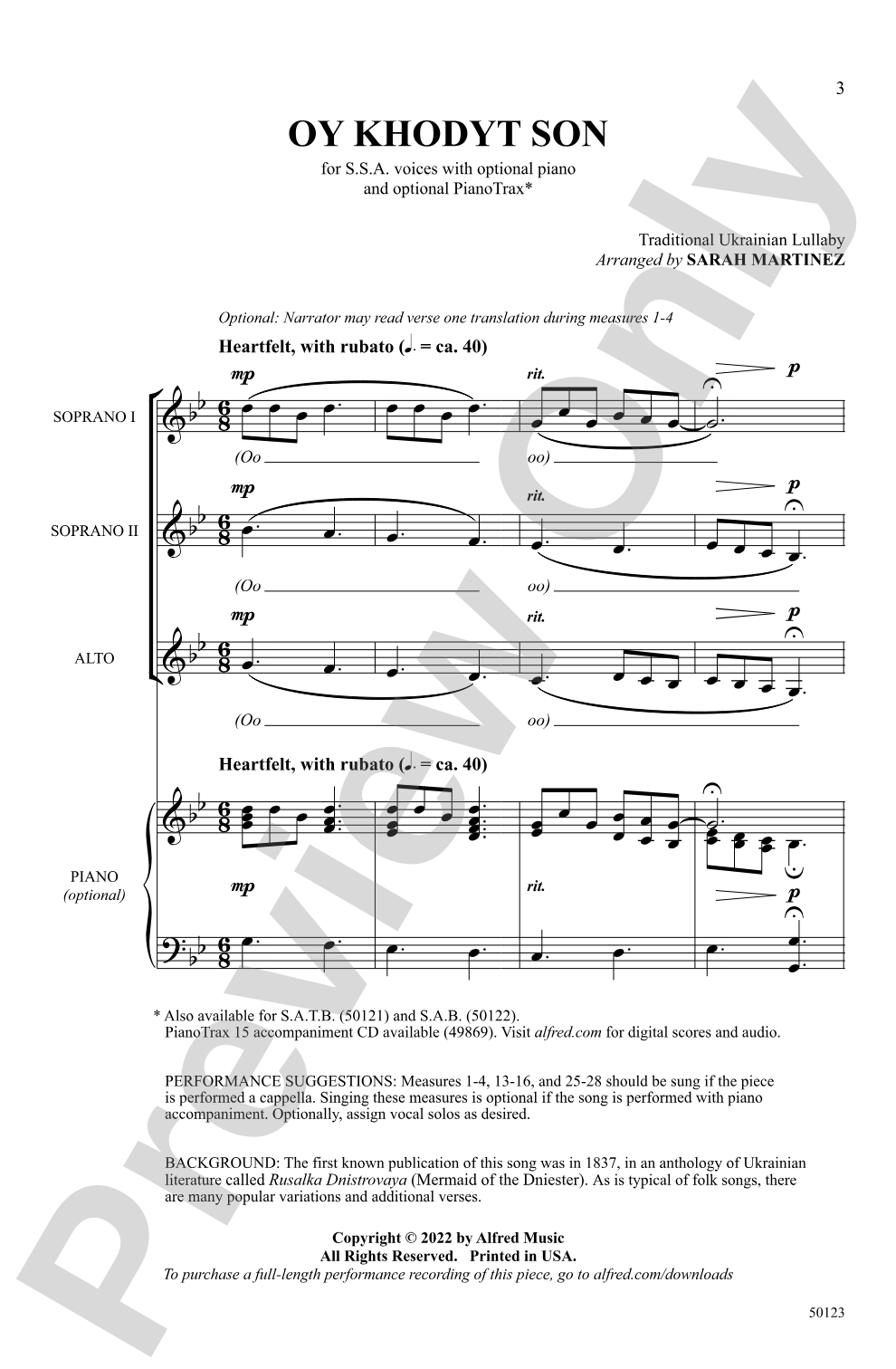
This traditional Ukrainian lullaby is characterized by a somber minor key and heartfelt rubato. A beautifully sparse treatment invites ensembles to personalize their performance by including the optional piano accompaniment or featuring solo voices. An optional narrator may read the English text translation during delicate interludes. Both phonetic and IPA guides appear in the publication or view the pronunciation video to hear a demonstration by a native speaker.


Discover MakeMusic Cloud: thousands of interactive titles your students can play along with today.
Sample Audio
1
Audio File
--:--
0:00
0:00
Sample Video
1 / 3
Additional Details
Series:
Alfred Choral Designs
Publisher:
Alfred Music
Page Count:
8
SKU:
00-PO-0007001
More about this title
About the Arranger: Sarah Martinez
Sarah Martinez brings deep pedagogical expertise to her choral arrangements, combining formal training in both music education and leadership. She holds a Bachelor of Music summa cum laude from Texas State University, a master's degree with Kodály Certification, and a Doctor of Education in Teacher Leadership from Walden University. Her thirteen years as a choir and elementary music teacher in Texas public schools inform her understanding of what works in ensemble settings.
Martinez has held leadership roles throughout the music education community, including service as Kodály Educators of Texas treasurer and TMEA Region 26 middle school vocal coordinator. She currently teaches choir and conducting at the Rio Grande Valley Kodály Certification Program and leads pedagogy courses at Wichita State University's Kodály program. Her work presenting professional development at district, regional, state, and national conferences has shaped how teachers approach repertoire selection and multicultural music in the classroom.
Why we love this
This arrangement honors the delicate emotional core of the Ukrainian lullaby while giving ensembles genuine interpretive choices. The optional piano, solo voice passages, and narrator interludes create flexibility that invites students to collaborate across roles rather than sitting passively; everyone has a stake in bringing the piece to life. The inclusion of phonetic and IPA guides alongside a pronunciation video demonstrates respect for the source culture and removes barriers to authentic performance.
What to expect
The somber minor tonality and sparse texture create an intimate, almost prayer-like quality that lingers with listeners. Each voice line unfolds with the gentleness of a mother's voice, and moments of silence become as important as the sung phrases, inviting the ensemble to sit fully within the song's melancholy beauty.
Who it's for
SSA ensembles looking for repertoire that deepens cultural awareness while remaining vocally and dramatically accessible. This works equally well for middle school or high school choirs seeking a contest or concert piece that invites meaningful interpretation and allows singers to explore the emotional weight of a folk tradition.
How to get the most out of it
- Allow the rubato to breathe naturally rather than metronomically, following the gentle pacing a lullaby demands; the minor key's inherent melancholy will emerge through space and restraint rather than tempo changes.
- If including the optional narrator, rehearse the timing of the English translation interludes separately so speakers can match the ensemble's breath and phrasing without disrupting the flow.
- Use the pronunciation video before rehearsal to establish a shared sonic reference for the Ukrainian text, then let singers listen individually to internalize the vowel colors and consonant placement.
- Layer in the optional piano gradually during rehearsals: first establish strong a cappella foundation, then introduce accompaniment to enhance without overwhelming the voices.
How to use it
Position this as a programming anchor for a set exploring world folk traditions or cultural narratives in song. The optional narrator treatment opens possibilities for collaborative programming with drama or literature classes, or it can stand alone as a concert or festival offering that showcases how small ensembles can create profound emotional impact.
Skills your students will build
- Singing in a minor tonality with tonal security in sparse textures
- Controlling rubato and expressive phrasing without a metronome
- Accurate pronunciation of Ukrainian using phonetic and IPA guides
- Collaboration across multiple ensemble roles (singers, soloists, narrator, optional accompanist)
- Interpreting cultural context and emotional intent in folk music arrangements