
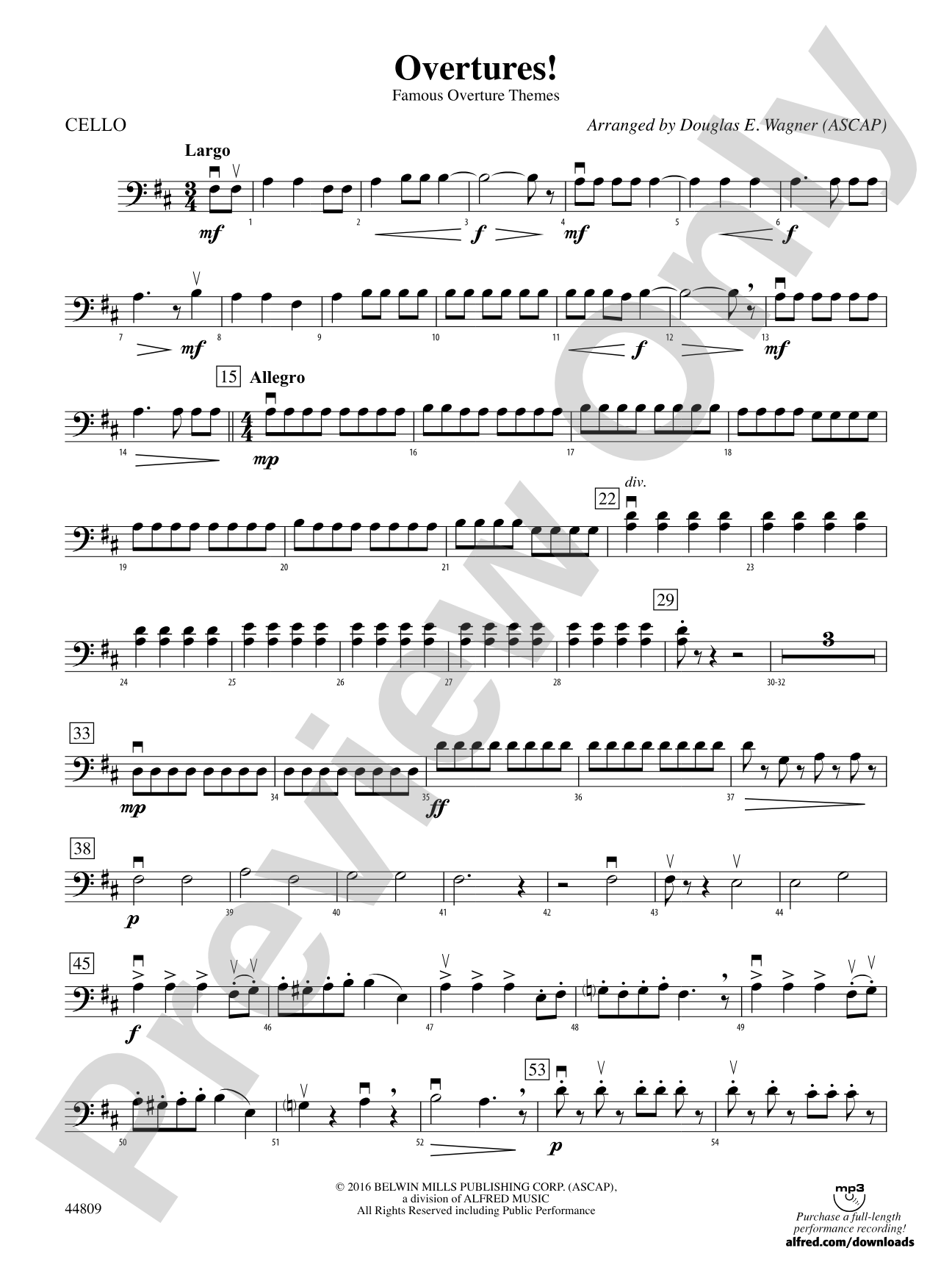

Overtures!: Cello
Famous Overture Themes
Arr. Douglas E. Wagner
Grade: 3
Item: 00-PC-0017326_VC1
$5.99
Pickup currently not available
Description
This seamless medley of the most popular overture themes from the Classical and Romantic periods---a veritable music history listening lesson---will be a sure-fire hit on any concert program. Scored in D-major throughout, the grade 3 arrangement by Douglas E. Wagner presents many teachable moments with style, balance, dynamic control, articulation, and interpretation.
In order of appearance, the themes included are: "1812 Festival Overture" (Largo) by Tchaikovsky; Overture to Zampa by Herold; Overture to The Barber of Seville by Rossini; Overture to The Magic Flute by Mozart; Overture to The Marriage of Figaro by Mozart; Overture to Poet and Peasant by von Suppé; Overture to The Merry Wives of Windsor by Nicolai; Overture to William Tell by Rossini; Overture to Die Meistersinger by Wagner; Overture to Light Cavalry by von Suppé; Overture to Orpheus in the Underworld by Offenbach; "Academic Festival Overture," by Brahms; and "1812 Festival Overture" (Allegro vivace) by Tchaikovsky. (3:30)


In order of appearance, the themes included are: "1812 Festival Overture" (Largo) by Tchaikovsky; Overture to Zampa by Herold; Overture to The Barber of Seville by Rossini; Overture to The Magic Flute by Mozart; Overture to The Marriage of Figaro by Mozart; Overture to Poet and Peasant by von Suppé; Overture to The Merry Wives of Windsor by Nicolai; Overture to William Tell by Rossini; Overture to Die Meistersinger by Wagner; Overture to Light Cavalry by von Suppé; Overture to Orpheus in the Underworld by Offenbach; "Academic Festival Overture," by Brahms; and "1812 Festival Overture" (Allegro vivace) by Tchaikovsky. (3:30)
Don't just read it, hear it, play along with it, and watch your students grow with it. In MakeMusic Cloud, Overtures!: Cello comes alive with professional accompaniment, adjustable tempo, and built-in practice tools that turn solo practice into real progress.
Open in the Player
Jump straight in and assign it today.
Start Your Free Trial
Open this title and explore the full library in minutes.
Sample Audio
1
Audio File
--:--
0:00
0:00
Sample Video
Additional Details
Series:
Belwin Concert String Orchestra
Publisher:
Alfred Music
Page Count:
124
SKU:
00-PC-0017326_VC1
More about this title
About the Arranger: Douglas E. Wagner

Douglas E. Wagner studied composition and music education at Butler University, earning both undergraduate and graduate degrees. After three decades leading high school music programs as an educator and administrator, he shifted his focus entirely to composition and arranging, work that has consumed his attention for over fifty years.
Wagner's catalog exceeds 3,500 published titles spanning choral music for schools and churches, concert band, orchestra, handbells, organ, piano, and vocal works. More than seventeen million copies of his compositions have been purchased worldwide, with performances appearing regularly in concert halls and broadcast on radio and television across the United States and internationally. He lives in Indianapolis with his wife, Sandy.
Why we love this
This medley transforms thirteen iconic overture themes into one cohesive program piece that teaches music history without requiring separate listening assignments. Wagner's choice to keep everything in D major removes unnecessary technical barriers while maintaining the distinct character of each overture, letting your ensemble focus on style and phrasing rather than key changes. The progression from Tchaikovsky through Offenbach, Brahms, and back to Tchaikovsky creates natural momentum for a full concert moment.
What to expect
A journey through the concert hall's greatest hits, each overture arriving with its own distinct personality yet woven seamlessly into a single arc. The familiar melodies and brilliant orchestration create moments of pure satisfaction, from the stormy drama of Tchaikovsky to the sparkling wit of Rossini and the buoyant energy of Offenbach.
Who it's for
String orchestras in the intermediate range will find this arrangement a rewarding survey of the orchestral repertoire that sits comfortably within their technical reach while offering genuine musical substance. Directors seeking a standalone concert piece that teaches style, interpretation, and orchestral tradition will appreciate how Wagner packages these masterworks into one comprehensive program statement.
How to get the most out of it
- Balance the string parts carefully during theme statements, particularly when transitioning between contrasting orchestrations. Some themes feature prominent melody in the first violins while others distribute the line across the section.
- Control the dynamic arc within each overture rather than treating it as a series of isolated sections. Each theme builds and releases tension on its own terms before the next one begins.
- Shape the transitions between themes deliberately. Brief breath-like moments between overtures signal the shift in character and allow the ensemble to reset articulation and vibrato choices.
- Lock the subdivision of each new theme's opening measure. The tempo relationships between overtures stay consistent throughout, but the rhythmic character of each opening requires precise ensemble clarity.
How to use it
This works as a standalone concert opener that sets a sophisticated tone immediately, signaling to the audience that you're tackling substantive repertoire. It also serves as a thematic closer to a program that includes era-specific or composer-focused works, tying together Classical and Romantic threads in one polished statement.
Skills your students will build
- Stylistic interpretation across multiple musical periods and compositional voices
- Dynamic control and balance within multi-section ensemble arrangements
- Articulation variety (sustained, detached, and bouncing bowstrokes across different overtures)
- Sight-reading fluency with rapid thematic transitions and varied textural writing
- Ensemble cohesion when managing tempo and character shifts between distinct musical sections