
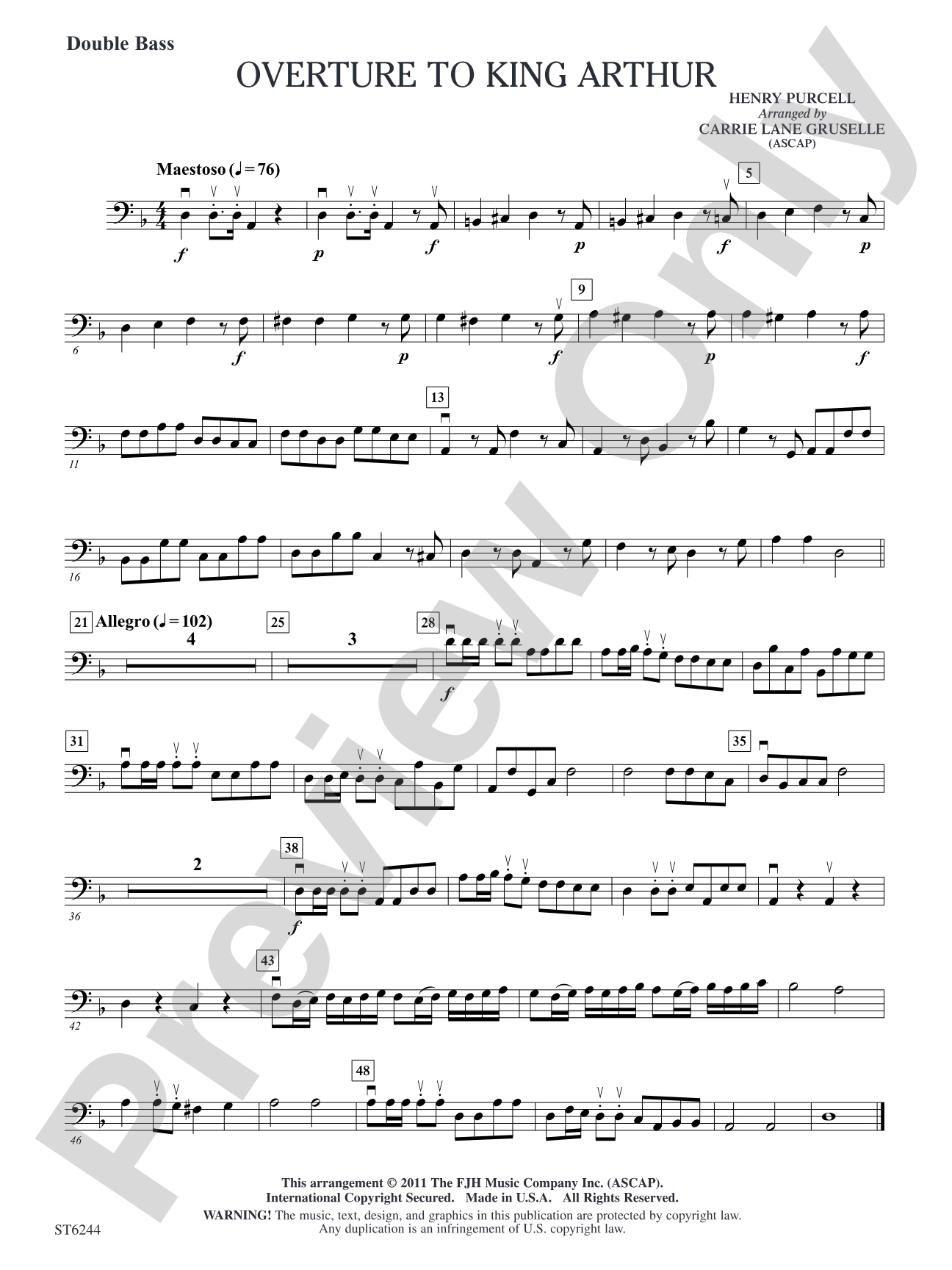

Overture to King Arthur: Double Bass
Arranged by Carrie Lane Gruselle
Grade: 3
Item: 98-PC-DST6244_SB
$7.00
Pickup currently not available
Description
From Henry Purcell's semi-opera King Arthur comes this wonderful arrangement in the style of the French Overture. The piece begins with a strong statement filled with regal and stately dotted rhythms. A lively fugue follows in which all sections play an equal role as they explore independent playing. Written in the key of D minor, shifting is required for first violin and bass while cello uses extensions. An excellent study in Baroque bow style!


Don't just read it, hear it, play along with it, and watch your students grow with it. In MakeMusic Cloud, Overture to King Arthur: Double Bass comes alive with professional accompaniment, adjustable tempo, and built-in practice tools that turn solo practice into real progress.
Open in the Player
Jump straight in and assign it today.
Start Your Free Trial
Open this title and explore the full library in minutes.
Sample Audio
1
Audio File
--:--
0:00
0:00
Sample Video
No sample videos found.
Additional Details
Series:
FJH String Orchestra
Publisher:
The FJH Music Company, Inc.
SKU:
98-PC-DST6244_SB
More about this title
About the Arranger: Carrie Lane Gruselle
Carrie Lane Gruselle earned her Bachelor of Music Education from the University of Wisconsin–Eau Claire and went on to complete a Master of Music Education degree from the University of Wisconsin–Stevens Point, where her studies emphasized Suzuki pedagogy. She brings classroom experience from two settings: she directs elementary and middle school strings for the Appleton Area School District while also teaching cello through the Lawrence University Arts Academy in Appleton, Wisconsin.
Why we love this
This arrangement captures the ceremonial swagger of the French Overture while keeping the technical demands reasonable for Grade 3 orchestras. The fugal section is genuinely musical (not just an exercise in counterpoint), and Gruselle's orchestration honors Purcell's voice-leading while giving every section meaningful independent work. For a festival circuit, it checks boxes for both style study and ensemble development without requiring advanced shifting technique from most of the section.
What to expect
Purcell's ceremonial grandeur opens the door with dotted rhythms that feel formal and purposeful, almost processional in their stateliness. The fugue that follows shifts the mood into something more animated and intricate, where each voice weaves through the texture with clarity and independence, creating a satisfying sense of musical architecture.
Who it's for
String orchestras at the Grade 3 level who are ready to explore Baroque style and textures with more sophistication than simplified arrangements typically allow. Directors preparing for festivals or seeking repertoire that builds secure shifting and independent voice-leading in a context where players stay engaged will find real substance here.
How to get the most out of it
- Shape the opening dotted rhythms with character. They should feel regal and pronounced, not mechanical; listen for the weight and articulation that comes from proper bow weight on the down stems.
- Balance independent voices in the fugal section by attending to dynamics as much as to rhythmic clarity. First violins may have the subject, but inner voices (violas, second violins) carry harmonic responsibility.
- Prepare first violins and bass players for the required position shifts before rehearsal; marking the shifts clearly on their parts prevents uncertainty and builds confidence in the passage work.
- Encourage cellists to practice extension passages separately at a slow tempo, anchoring with the standard fingerboard landmarks before integrating them into the musical line.
How to use it
Program this as a contrasting opening or second selection on a concert, particularly if you are pairing it with a Classical-era work or a contemporary piece; it establishes a stylistic anchor without requiring extensive concert program notes. It also works well in a festival schedule where adjudicators expect to hear evidence of Baroque style understanding and technical facility on the same piece.
Skills your students will build
- Baroque bow style and articulation (dotted rhythms, separate bowing conventions)
- Position shifts for first violin (reading and executing with security)
- Cello extensions and secure intonation beyond half position
- Independent voice-leading in fugal texture (maintaining clarity while balancing with other sections)
- Reading and executing in D minor with confidence across all positions