
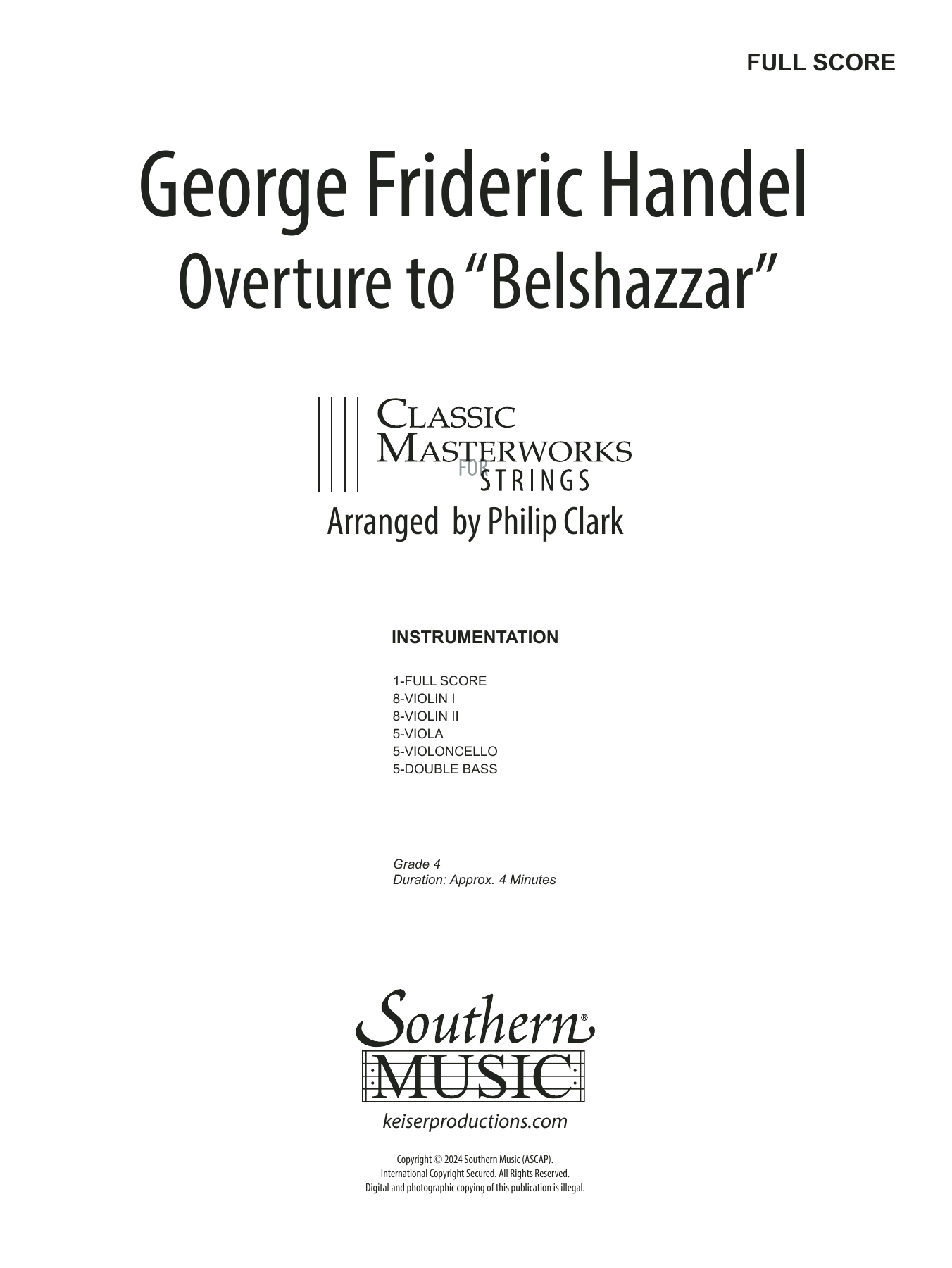

Overture to Belshazzar (arr. Philip Clark): String Orchestra Conductor Score & Parts
By George Frideric Handel / Arranged by Philip Clark
Grade: 4
Item: 35-PK01512524
$60.00
Pickup currently not available
Buy Extra Parts (Digital PDF Download)
Parts Added to Cart!
Description
Though in 1744 Handel presented the oratorio BELSHAZZAR as an oratorio, or religious work, it was later staged many times operatically. The opening should be neither too slow or too fast, and perhaps maybe thought of as an introductory fanfare for strings. (The original included oboes.) For better attack, bowing marked in the score as hooked may rather be played separately and nearer the frog, but this might require greater technical ability.


Overture to Belshazzar (arr. Philip Clark): String Orchestra Conductor Score & Parts isn't in MakeMusic Cloud just yet...but it could be. Let us know you'd like to see it, and you'll help shape what comes next. In the meantime, start a free trial and dive into thousands of interactive titles your students can play along with today.
Request This Title
Tell us you want it.
Start Your Free Trial
Explore everything that's ready to play right now.
Sample Audio
No sample audio found.
Sample Video
No sample videos found.
Additional Details
Publisher:
Hal Leonard
SKU:
35-PK01512524
More about this title
About the Composer: George Frideric Handel
George Frideric Handel (1685–1759) was a German-born composer who spent most of his career in London, where he became the dominant figure in English musical life. His output spanned opera, oratorio, instrumental music, and sacred works, and his facility with melody and dramatic pacing made him one of the most performed composers of his era and beyond.
Handel's oratorios, which he developed partly to sidestep the English public's ambivalence toward Italian opera, became his most enduring legacy in the church and concert hall. Works like Belshazzar showcase his gift for grand architectural structures and vivid musical storytelling, qualities that remain central to string orchestra pedagogy and performance today.
Why we love this
This arrangement captures the ceremonial weight of Handel's original without requiring the woodwind section, making it accessible for pure string orchestras at the high school level. Philip Clark's voicing preserves the fanfare character while creating a natural entry point into Baroque style, and the performance note about bowing choices gives directors real interpretive agency rather than a single prescribed approach.
What to expect
The piece opens with the pageantry and solemnity of a royal court, full of flourishes and ceremonial grandeur. Underneath the ornamental surface runs a propulsive rhythmic energy that keeps the fanfare from ever feeling static, creating music that is both stately and alive.
Who it's for
This overture suits intermediate to advancing string orchestras ready to explore Baroque idioms and conduct technique. It works equally well for high school groups seeking concert repertoire and for serious youth orchestras building a foundation in period style.
How to get the most out of it
- Balance the fanfare character by listening for clarity across all sections; the opening should feel ceremonial but not stiff, so allow the rhythmic vitality to breathe naturally rather than locking everything into metronomic precision.
- The hooked bowings marked in the score can be executed as written for a more articulate attack, or separated and played nearer the frog if your ensemble needs cleaner articulation; experiment in rehearsal to find what suits your group's technical level.
- Approach the tempo with restraint. Handel's instruction to avoid extremes means resisting the urge to rush the fanfare; a stately but not sluggish tempo gives the opening its proper dignity.
- Shape the melodic lines with long-range phrasing rather than playing phrase-by-phrase; string players often underestimate how much this Baroque material rewards sustained musical thinking across what might feel like short segments.
How to use it
Position this as the opening work on a concert devoted to Baroque orchestral music, or use it as an energizing transition between slower works on a mixed program. It pairs especially well with other Handelian arrangements or with later Baroque string repertoire from composers like Vivaldi or Corelli.
Skills your students will build
- Baroque articulation and phrasing conventions
- Reading and executing different bowing styles (hooked, separated, etc.)
- Balancing fanfare passages across multiple string sections
- Interpreting tempo markings that avoid extremes
- Sustained melodic shape across sectional phrases