
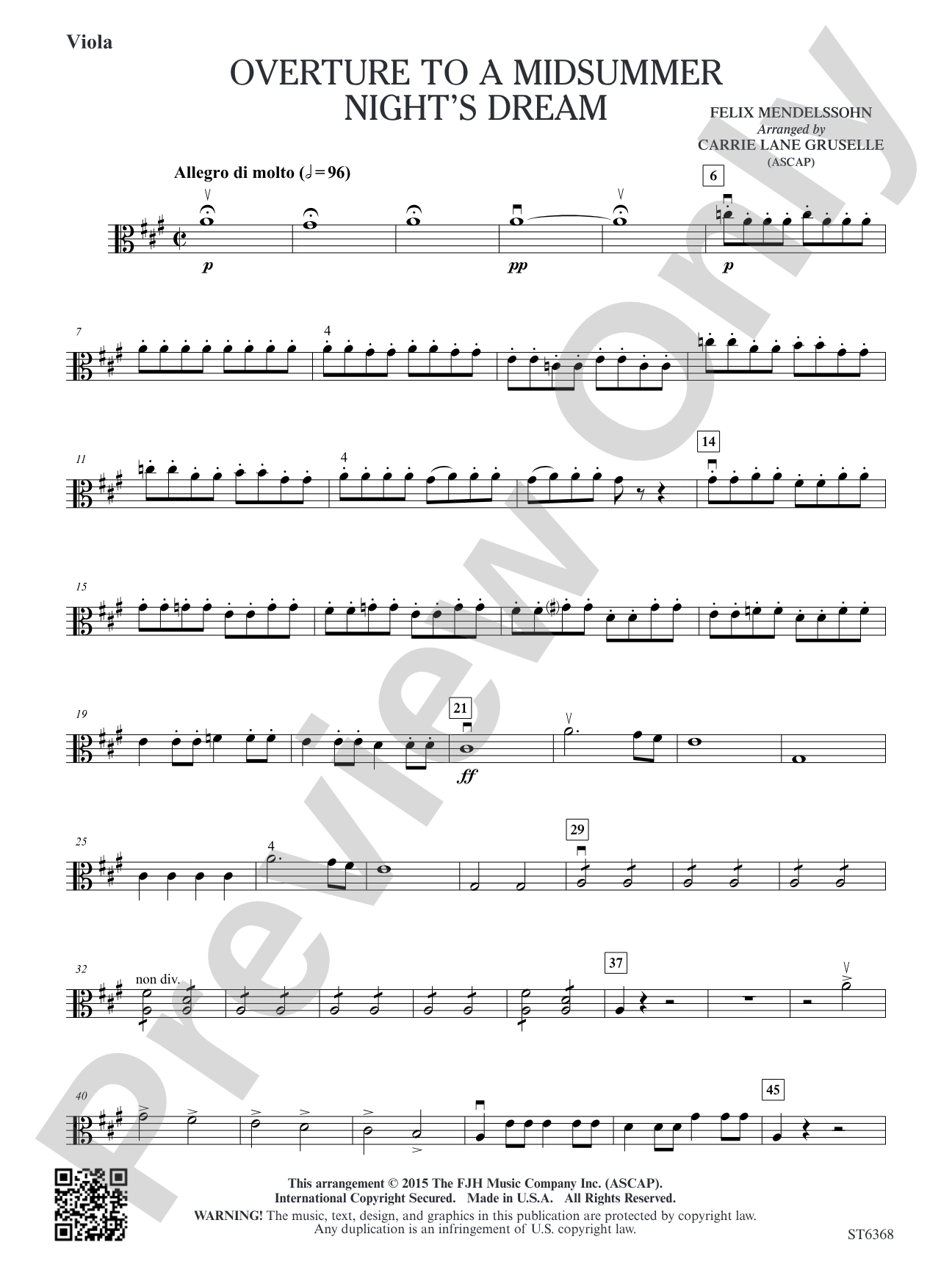

Overture to a Midsummer Night's Dream: Viola
By Felix Mendelssohn / arr. Carrie Lane Gruselle
Grade: 3.5
Item: 98-PC-DST6368_VA1
$7.00
Pickup currently not available
Description
A moonlit evening in a forest filled with flitting fairies and erroneously administered love potions - imagine this and more in this spectacular arrangement of Mendelssohn's overture to the Shakespeare classic. Written in the approachable key of A Major, the music includes off-the string eighth notes and the grandeur of a royal wedding. A wonderful classical addition to your program!


Overture to a Midsummer Night's Dream: Viola isn't in MakeMusic Cloud just yet...but it could be. Let us know you'd like to see it, and you'll help shape what comes next. In the meantime, start a free trial and dive into thousands of interactive titles your students can play along with today.
Request This Title
Tell us you want it.
Start Your Free Trial
Explore everything that's ready to play right now.
Sample Audio
1
Audio File
--:--
0:00
0:00
Sample Video
No sample videos found.
Additional Details
Series:
FJH String Orchestra
Publisher:
The FJH Music Company, Inc.
SKU:
98-PC-DST6368_VA1
More about this title
About the Composer: Felix Mendelssohn
Felix Mendelssohn (1809-1847) was a German Romantic composer whose gifts spanned symphonies, concertos, chamber music, and overtures. His facility with orchestral color and gift for melody established him as one of the nineteenth century's most performed composers, and his work remains central to concert repertoires worldwide. Mendelssohn's overtures stand apart for their dramatic storytelling and structural clarity, making them enduring fixtures in music education.
Mendelssohn wrote the Overture to A Midsummer Night's Dream early in his career (1826) and returned to the play years later to compose a full suite of incidental music. His ability to capture Shakespeare's magic through purely instrumental means, from the delicate fairy music to the triumphant wedding march, demonstrates why his work has inspired musicians and audiences for nearly two centuries.
Why we love this
Mendelssohn crafted this overture as a self-contained narrative that captures Shakespeare without a single word, and this arrangement preserves that storytelling gift while keeping it within reach of developing orchestras. The A Major key feels fresh and open, the writing is grateful for strings, and the mix of delicate passagework with grand ceremonial moments gives your ensemble real musical material to sink their teeth into. It's a legitimate classical masterwork that doesn't ask for professional-level execution.
What to expect
The music opens with a hushed, enchanted quality as if you're tiptoeing through moonlit woods. Delicate, darting passages suggest the flutter of fairy wings, building into moments of romantic urgency and lyrical warmth. By the final section, the sound opens into ceremonial grandeur fit for a royal wedding, leaving listeners with the sense of having witnessed something magical transformed into something joyous.
Who it's for
String orchestras at the Grade 3-4 level looking for a piece that sounds like a genuine concert staple rather than a student arrangement. This works equally well for groups preparing for festival competition or searching for a classical selection that teaches real orchestral craft without oversimplifying the original.
How to get the most out of it
- Shape the opening fairy music with careful attention to dynamic control; those off-the-string eighth notes need lightness and precision to sound magical rather than mechanical.
- Balance the dialogue between first and second violins throughout the piece. Mendelssohn wrote upper string writing that's genuinely conversational, so make sure neither part disappears.
- Let the wedding march material have real pomp and ceremony in the final section. This is your moment to showcase the full sound of the orchestra with confidence and weight.
- Use the conductor score to mark all the key entrances and transitions clearly for your students so they understand the journey from the enchanted forest to the wedding celebration.
How to use it
This arrangement fits naturally into a concert built around classical masterworks or Shakespeare-inspired repertoire, and its approachable key and clear structure make it an excellent choice for a mid-winter or spring concert that needs gravitas without demanding professional-level players. Consider pairing it with lighter contemporary works to create contrast, or program it as the closer to a concert themed around timeless stories.
Skills your students will build
- Executing off-the-string articulations with control and consistency
- Balancing between multiple voice lines in the upper strings
- Shaping long melodic phrases with dynamic nuance
- Reading and executing quick position shifts in contrasting sections
- Responding to clear narrative arc and dramatic form