
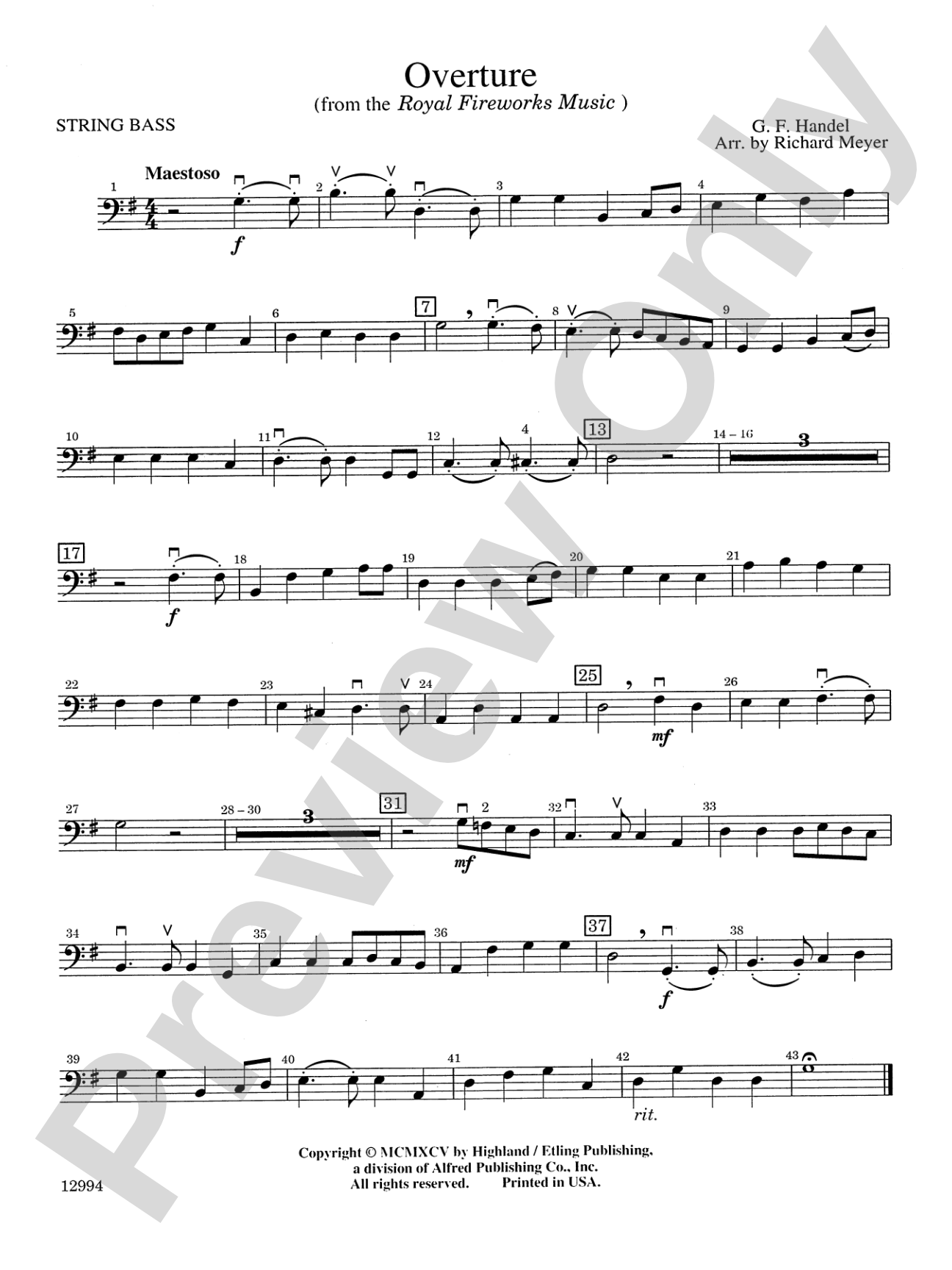

Overture from the "Royal Fireworks Music": String Bass
(from Royal Fireworks Music)
By George Frideric Handel / arr. Richard Meyer
Grade: 1
Item: 00-PC-0000144_SB
$5.99
Pickup currently not available
Description
Richard Meyer has done it again! Following on the fantastic success of his arrangement of "La Rejouissance" from Handel's Royal Fireworks Music, Richard has brought us a wonderful adaptation of the overture from the same great work. Featuring a variety of techniques including hooked bowing, this arrangement is an excellent introduction to the music of the Baroque period. An outstanding contribution to literature for young strings. (Grade 1 - Correlates with Strictly Strings Book 1, page 34) This title is available in MakeMusic Cloud.


Don't just read it, hear it, play along with it, and watch your students grow with it. In MakeMusic Cloud, Overture from the "Royal Fireworks Music": String Bass comes alive with professional accompaniment, adjustable tempo, and built-in practice tools that turn solo practice into real progress.
Open in the Player
Jump straight in and assign it today.
Start Your Free Trial
Open this title and explore the full library in minutes.
Sample Audio
1
Audio File
--:--
0:00
0:00
Sample Video
No sample videos found.
Additional Details
Series:
Highland/Etling Strictly Strings
Publisher:
Alfred Music
Page Count:
72
SKU:
00-PC-0000144_SB
More about this title
About the Composer: George Frideric Handel
George Frideric Handel (1685-1759) dominated the musical landscape of 18th-century London, composing across opera, oratorio, and instrumental music with equal mastery. His ability to blend Italian melodic elegance with German harmonic sophistication made him one of the most performed composers of his era and remains so today.
Handel's instrumental works, including the Royal Fireworks Music, showcase his gift for crafting memorable, singable lines that work across diverse ensembles. For string students, his music offers direct access to Baroque compositional principles: clear phrase structures, logical harmonic progressions, and the rhythmic vitality that defined the period.
Why we love this
Richard Meyer has captured the ceremonial grandeur and infectious rhythmic drive of Handel's overture while keeping the technical demands reasonable for young players. The inclusion of hooked bowing and varied articulation introduces essential Baroque performance techniques without overwhelming students, making this one of the most authentic entry points into period style available at Grade 1.
What to expect
The overture radiates the ceremonial pageantry Handel originally composed for outdoor royal celebrations, full of bright fanfare-like figures and energetic rhythmic drive. Despite the accessibility of the arrangement, the music retains its architectural integrity, offering students a taste of genuine Baroque grandeur rather than a simplified imitation.
Who it's for
This arrangement is designed for developing string orchestras working at Grade 1 level, particularly those using the Strictly Strings curriculum. It works equally well for young orchestra programs seeking repertoire that introduces Baroque style without requiring advanced technical facility.
How to get the most out of it
- Establish clarity on the hooked bowing passages before rehearsing at tempo. This technique requires coordination between bow control and rhythmic precision, so isolate these sections and drill them as rhythmic exercises first.
- Shape the phrasing in two- or four-bar units, allowing the melodic lines to breathe naturally. Baroque music thrives on architectural clarity, so avoid the legit-at-all-costs approach that younger ensembles sometimes adopt.
- Balance the inner voices carefully in sections where the first violins carry the primary melody. The second violins and lower strings provide harmonic foundation and rhythmic propulsion that deserve equal attention in rehearsal.
- Use the score to identify where articulation changes from one section to the next, then mark parts consistently. This visual reinforcement helps students understand that style shifts are intentional compositional choices, not arbitrary instructor preferences.
How to use it
Program this as part of a Baroque-focused concert or as a centerpiece for a program exploring how different arrangers approach the same historical material. The piece also serves as a natural curricular milestone for students ready to move beyond Grade 1 fundamentals into period-specific performance practices.
Skills your students will build
- Hooked bowing and articulation control
- Reading and executing style-specific bowings
- Baroque phrasing and period performance conventions
- Harmonic awareness through inner voice development
- Rhythmic precision in fanfare-like figures and running passages