
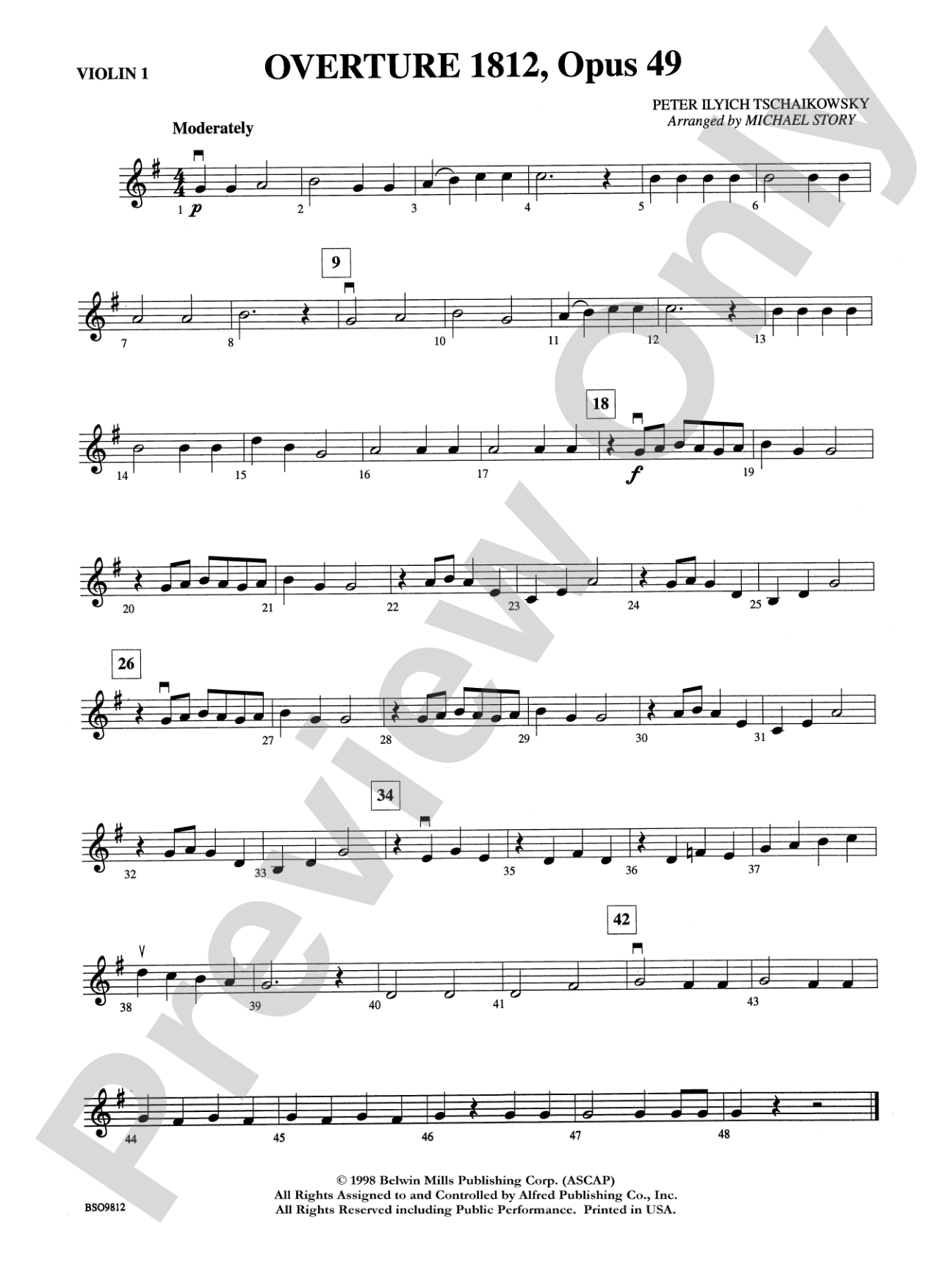

Overture 1812, Opus 49: 1st Violin
By Peter Ilyich Tchaikovsky / arr. Michael Story
Grade: 1
Item: 00-PC-0002259_VN1
$5.99
Pickup currently not available
Description
'But,' you say, 'it's not possible to score this classic at a beginning level!' Surprise! In the hands of a highly experienced educational arranger, Tchaikovsky's best-known composition flows beautifully. Now even your less experienced instrumentalists can enjoy rehearsing and playing this all-time favorite. (1:37)


Don't just read it, hear it, play along with it, and watch your students grow with it. In MakeMusic Cloud, Overture 1812, Opus 49: 1st Violin comes alive with professional accompaniment, adjustable tempo, and built-in practice tools that turn solo practice into real progress.
Open in the Player
Jump straight in and assign it today.
Start Your Free Trial
Open this title and explore the full library in minutes.
Sample Audio
1
Audio File
--:--
0:00
0:00
Sample Video
No sample videos found.
Additional Details
Series:
Belwin Beginning String Orchestra
Publisher:
Alfred Music
Page Count:
72
SKU:
00-PC-0002259_VN1
More about this title
About the Arranger: Michael Story
Michael Story has established himself as one of the most prolific and respected educational arrangers in American music publishing. His gift lies in recognizing which masterworks can open up to younger ensembles without sacrificing musical integrity, and his arrangements consistently appear on festival schedules and in concert programs across North America.
Story's work spans all instrumental and vocal ensembles, and his arrangements for beginning and intermediate groups have become standard repertoire in countless schools. His arranging philosophy prioritizes clear part writing, logical ranges, and musical authenticity, allowing students to connect with canonical repertoire while building confidence and musicianship.
Why we love this
Michael Story has managed what seems impossible: a Grade 1 Overture 1812 that students genuinely enjoy playing and conductors enjoy rehearsing. The arrangement respects Tchaikovsky's melodic and harmonic architecture while distributing the essential material across the ensemble in ways that keep every section engaged. It's the rare arrangement that feels neither condescending nor watered-down.
What to expect
The familiar and rousing character of the 1812 comes through clearly. You'll hear the processional dignity of the original, the rhythmic drive of the famous passages, and that sense of triumph, even in this simplified form. Students feel they're playing a real piece, not an exercise.
Who it's for
This arrangement opens Tchaikovsky to beginning string orchestras that wouldn't normally tackle a major masterwork. It works equally well in school programs serving grades 4-6 and in community or pre-college string ensembles with younger players. Conductors searching for something genuinely rewarding to rehearse at this level will find this invaluable.
How to get the most out of it
- Balance the main theme between first and second violins so the melody sings clearly without drowning out the accompaniment voices. This becomes especially important in the quieter sections.
- Shape the accelerations and tempo transitions deliberately. Mark them in rehearsal so the ensemble moves together rather than lurching forward.
- Isolate the rhythmic figures in the pizzicato sections and drill them separately; rhythmic clarity at this level has enormous impact on the overall sound.
- Give attention to the brass-like unison passages in the strings. They should cut through with confidence, which requires good bow control and tone awareness rather than sheer volume.
How to use it
This works beautifully as a centerpiece for a concert showcasing your developing orchestra, particularly alongside other Belwin Beginning repertoire that gives the program coherence. It's also strong enough to hold its own on a festival or competition schedule. Given its recognizable themes, audiences respond immediately, making it an ideal choice for family concerts or end-of-year performances.
Skills your students will build
- Responding to long-line phrasing and musical shape rather than note-by-note playing
- Executing quick articulation changes and stylistic shifts within a continuous piece
- Maintaining rhythmic precision during accelerations and tempo variations
- Reading and executing parts that move between melody and accompaniment roles
- Tuning extended passages in unison and harmony across multiple voice parts