
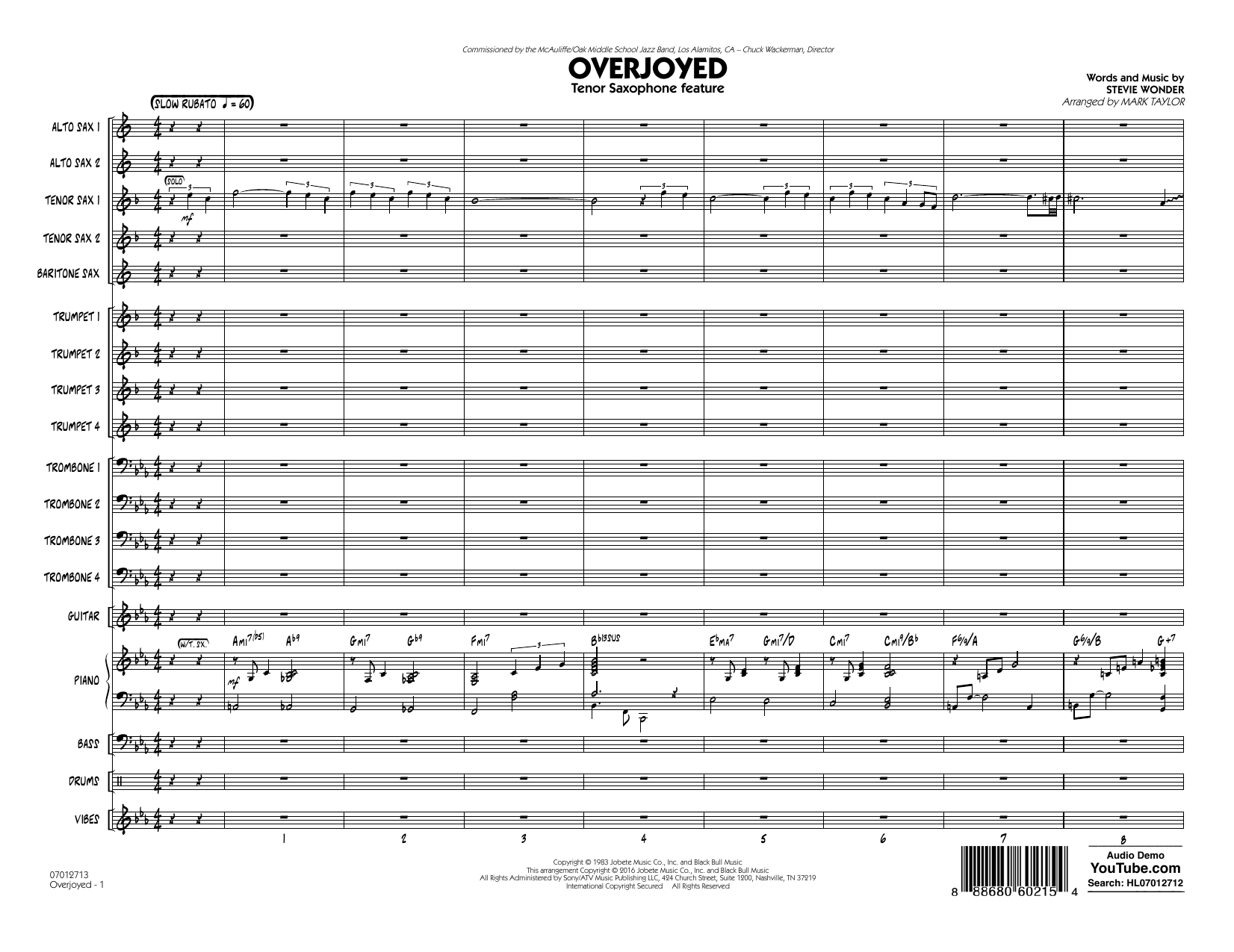

Overjoyed: Jazz Ensemble Conductor Score & Parts
As performed by Stevie Wonder / Arranged by Mark Taylor
Grade: 4
Item: 35-PK00342313
$55.00
Pickup currently not available
Buy Extra Parts (Digital PDF Download)
| Product | Price | Quantity |
|---|---|---|
| Overjoyed - Conductor Score (Full Score) | $7.50 | |
| Overjoyed - Alto Sax 1 | $6.00 | |
| Overjoyed - Alto Sax 2 | $6.00 | |
| Overjoyed - Tenor Sax 1 | $6.00 | |
| Overjoyed - Tenor Sax 2 | $6.00 | |
| Overjoyed - Baritone Sax | $6.00 | |
| Overjoyed - Trumpet 1 | $6.00 | |
| Overjoyed - Trumpet 2 | $6.00 | |
| Overjoyed - Trumpet 3 | $6.00 | |
| Overjoyed - Trumpet 4 | $6.00 | |
| Overjoyed - Trombone 1 | $6.00 | |
| Overjoyed - Trombone 2 | $6.00 | |
| Overjoyed - Trombone 3 | $6.00 | |
| Overjoyed - Trombone 4 | $6.00 | |
| Overjoyed - Guitar | $6.00 | |
| Overjoyed - Piano | $6.00 | |
| Overjoyed - Bass | $6.00 | |
| Overjoyed - Drums | $6.00 | |
| Overjoyed - Vibes | $6.00 | |
| Overjoyed - C Solo Sheet | $6.00 | |
| Overjoyed - Bb Solo Sheet | $6.00 | |
| Overjoyed - Eb Solo Sheet | $6.00 | |
| Overjoyed - Bass Clef Solo Sheet | $6.00 |
Parts Added to Cart!
Description
This wonderful classic ballad recorded by Stevie Wonder is set here as a feature for tenor sax. Beautifully accompanied by piano only in the beginning, a mellow accompaniment follows (with flugels and bones in buckets) as a medium bossa tempo settles in.


Overjoyed: Jazz Ensemble Conductor Score & Parts isn't in MakeMusic Cloud just yet...but it could be. Let us know you'd like to see it, and you'll help shape what comes next. In the meantime, start a free trial and dive into thousands of interactive titles your students can play along with today.
Request This Title
Tell us you want it.
Start Your Free Trial
Explore everything that's ready to play right now.
Sample Audio
No sample audio found.
Sample Video
No sample videos found.
Additional Details
Publisher:
Hal Leonard
SKU:
35-PK00342313
More about this title
About the Artist: Stevie Wonder
Stevie Wonder emerged as a multi-instrumental virtuoso and composer whose work redefined the boundaries of soul, funk, and pop music. His harmonic sophistication, innovative use of synthesizers, and deeply expressive melodic writing have influenced generations of musicians across all genres, making his catalog essential listening for understanding modern songwriting.
Why we love this
Mark Taylor's arrangement captures the introspective beauty of this Stevie Wonder standard while giving your tenor saxophonist a moment to shine. The stripped-down opening (piano only) followed by the gradual addition of flugels and trombone in buckets creates natural dynamic contrast that keeps the ballad compelling without overwhelming it.
What to expect
Warm, introspective, and gently swaying. The arrangement wraps the tenor in an intimate embrace, starting quiet and reflective before deepening into a cushioned, mellow groove. It's the musical equivalent of late evening conversation with good friends.
Who it's for
Jazz ensembles with a strong tenor saxophonist ready for a feature role and the maturity to handle a ballad that demands sensitivity over flash. Directors seeking to program soulful, accessible material that connects with audiences while maintaining artistic substance.
How to get the most out of it
- Shape the initial piano-and-tenor conversation as a dialogue rather than a solo feature; the pianist must listen actively and respond to the tenor's phrasing nuances.
- Balance the addition of flugels and bucket-muted bones so they enhance rather than compete with the tenor; these voices exist to cushion, not crowd.
- Lock the medium bossa pulse early in rehearsal by isolating the rhythm section; the groove anchors everything that floats above it.
- Allow space between phrases. This ballad breathes, and the tender moments matter as much as the sung passages.
How to use it
Pair this with higher-energy jazz selections to anchor a concert in emotional variety. It works beautifully as a second-set opener following a rousing uptempo number, or as a graceful closer to show your ensemble's range beyond bright tempos.
Skills your students will build
- Phrasing and expressive control in a ballad context
- Listening and responding to ensemble texture changes
- Balancing solo work with supportive accompaniment
- Bossa nova rhythmic feel and phrasing
- Dynamic shaping across different instrumental combinations
- Reading lead sheets and interpreting written dynamics and articulation in jazz style